Water Infrastructure
Colorado River Agencies Test Framework for Interstate Water Exchanges
Proposed system could improve economics for desalination and water-recycling projects
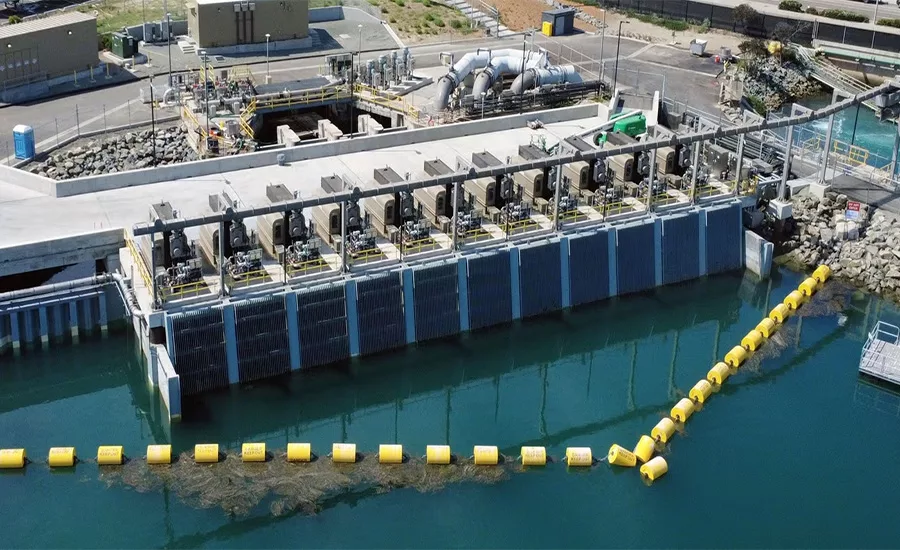
The intake and discharge facility at California's Claude “Bud” Lewis Carlsbad Desalination Plant. Water agencies in California, Arizona and Nevada have signed an agreement to explore interstate exchanges involving desalinated and recycled water supplies using existing Colorado River delivery systems.
Major water agencies across the Southwest along with the U.S. Dept of Interior's Bureau of Reclamation have launched an effort to explore the feasibility of establishing a framework for interstate exchanges of desalinated and recycled water—a move supporters say could spur future investments in new water-supply infrastructure and help supplement strained Colorado River supplies.
The memorandum of understanding (MOU) signed June 3 at the Claude “Bud” Lewis Carlsbad Desalination Plant brings together the federal agency, the San Diego County Water Authority, the Metropolitan Water District of Southern California, Southern Nevada Water Authority, Arizona Dept. of Water Resources, Central Arizona Project and the Salt River Project.
The parties will evaluate how desalinated seawater and recycled wastewater supplies could be integrated into Colorado River Basin operations through exchanges of existing infrastructure rather building new pipelines or other structures.
Read More
Memorandum of Understanding | Text
If implemented, the framework would allow agencies investing in desalination or advanced water recycling to exchange supplies across state lines, potentially improving project economics and avoiding the costly construction of new conveyance.
According to materials released by the San Diego County Water Authority, the type of interstate transfer pilot envisioned under the agreement has never been implemented in the Lower Colorado River Basin.
Independent policy analyst Sarah Porter, director of the Kyl Center for Water Policy at Arizona State University, said the concept could help address two challenges at once: improving the economics of expensive drought-proof supplies while providing additional water-management flexibility for Colorado River users facing future shortages.
In March, Porter told Phoenix public radio station KJZZ that the proposal was “a very tidy solution to a really big problem” because San Diego has already invested heavily in desalination infrastructure while Arizona and Nevada are seeking additional long-term water supplies.
Looking for quick answers on construction and engineering topics?
Try Ask ENR, our new smart AI search tool.
Ask ENR →
RELATED
Reclamation Draft Review Maps Future Operations for Colorado River Dams
How It Works
Under the concept, San Diego could use desalinated water to reduce reliance on Colorado River supplies and leave some of its river share in the system. Other Basin agencies could then pay to access this water via existing Colorado River delivery systems, avoiding interstate pipeline construction.
The MOU envisions these arrangements as voluntary exchanges that could help finance new water-supply projects and allow participating agencies to make better use of available supplies. The agreement is nonbinding and does not commit any party to a specific project.
According to Reclamation, storage in the Colorado River system has fallen to roughly 36% of capacity following more than two decades of drought.
“This agreement brings partners together across state lines to explore desalination, water recycling, and new ways to move water where it’s needed most,” Assistant Secretary for Water and Science Andrea Travnicek said in a statement.
The framework could create a pathway for inland Colorado River users to benefit from coastal desalination investments. San Diego water officials highlighted the role of the Carlsbad Desalination Plant—the nation’s largest seawater desalination facility—which produces up to 54 million gallons per day.
The MOU identifies areas for further study, including interstate exchange legal and policy frameworks, pilot projects, shared agency responsibilities and potential federal funding.
The agencies say they hope to determine within the next two years whether a pilot framework can be developed.
RELATED
Southern California Water Agencies Mount Massive Push for Reuse
Legal and Operational Hurdles
Any pilot program would face legal, regulatory, and operational hurdles. The MOU instructs participants to review the legal and policy framework for interstate exchanges and stresses that future agreements must adhere to water rights, contracts and federal law.
The next phase will assess if a pilot exchange can be structured under Colorado River rules, involving desalinated seawater from Carlsbad and recycled wastewater, and evaluate federal funding needs.
“Next-generation strategies in the face of climate volatility must include interstate partnerships that deliver water where it’s needed most,” San Diego County Water Authority General Manager Dan Denham said in a joint agency statement.
“This is an important step in addressing the goal of augmenting the water supplies of the Colorado River by creating a mechanism to deliver those supplies through an exchange using existing infrastructure,” said Tom Buschatzke, director of the Arizona Dept. of Water Resources. “It represents the kind of innovation that Arizona and its Lower Basin partners believe is needed for all the Colorado River states to help stabilize the system in the long term."
The parties said any future exchanges would not alter existing water rights and would rely on existing delivery systems.

Bryan Gottlieb is the online editor at Engineering News-Record (ENR).
Gottlieb is a five-time Society of Professional Journalists Excellence in Journalism award winner with more than a decade of experience covering business, construction and community issues, including finance, law and real estate. He has reported for Adweek and the San Diego Daily Transcript and led a community newsroom in Santa Monica, Calif. He served as editor-in-chief of the Detroit Metro Times and as managing editor at Roofing Contractor, where he helped shape national industry coverage. At Engineering News-Record, Gottlieb covers breaking news, large-scale infrastructure and megaprojects, regulatory developments and business trends across the U.S. and global construction sectors.
email: gottliebb@enr.com | office: (248) 786-1591