Transportation
FRA Proposal Would Replace 115 Columns to Unlock Penn Station Capacity
Track, platform and circulation improvements would reshape train operations beneath Madison Square Garden

Amtrak and Penn Transformation Partners are advancing final design for Penn Station as a new federal study recommends engineering changes intended to improve train operations beneath the station.
A Federal Railroad Administration study released July 15 identifies replacement of about 115 columns, extensions of three platforms and rebuilt track connections as potential upgrades to increase peak cross-Hudson rail capacity at New York City’s Penn Station.
The Phase I report adds engineering specificity to plans for the estimated $7- to $8-billion Penn Station Transformation project. It identifies improvements to be included in or delivered alongside the reconstruction being developed by Amtrak and master developer Penn Transformation Partners, while also directing that the design not preclude future capacity upgrades.
The recommendations focus on improving passenger circulation and reducing conflicting train movements rather than expanding the station's footprint.
Proposed work includes demolishing about 60% of the existing Mail Platform, a former rail mail handling facility, adding up to 23 new stairs and escalators, and reworking track connections serving the new Hudson River Tunnel. Equipment, signage and utility cabinets also would be relocated to improve passenger flow and shorten train dwell times.
Cost and Construction Details Deferred
The study does not estimate project costs, establish an implementation schedule or explain how the proposed structural and track work would be executed. FRA also acknowledged that construction sequencing remains unresolved since removing even one track or platform from service could constrain station capacity and disrupt riders.
Phase II of the federal study, scheduled for completion in 2028, will advance preliminary engineering, implementation planning and updated cost estimates.
Coordination with the Metropolitan Transportation Authority also remains an important consideration as project planning advances.
Looking for quick answers on construction and engineering topics?
Try Ask ENR, our new smart AI search tool.
Ask ENR →
Speaking at a June 24 MTA board meeting, MTA Chair and CEO Janno Lieber said the agency is "happy and thrilled to engage with the federal government on the redesign and re-imagining of Penn Station." He said MTA intends to review "the drawings and the engineering" to ensure the work does not disrupt Long Island Rail Road operations during construction or after the station is completed.
The engineering challenge is compounded by Penn Station's existing configuration. Its 21 tracks and 11 mostly narrow platforms sit beneath Madison Square Garden and surrounding structures, supported by more than 1,000 columns, a structural grid FRA says complicates substantial track and platform modifications.
And, while the study identifies removal and replacement of about 115 columns as part of its preferred concept, it does not specify the structural approach or construction sequence for that work.
Track Reconfiguration Drives Capacity Gains
Penn Station would be reorganized into three operating zones under FRA's preferred concept. The new Hudson River Tunnel would feed terminating and originating NJ Transit trains onto the station's southern tracks, while the existing North River Tunnels would connect through the station's middle tracks toward the East River tunnels. The northern tracks would primarily serve LIRR trains to and from West Side Yard.
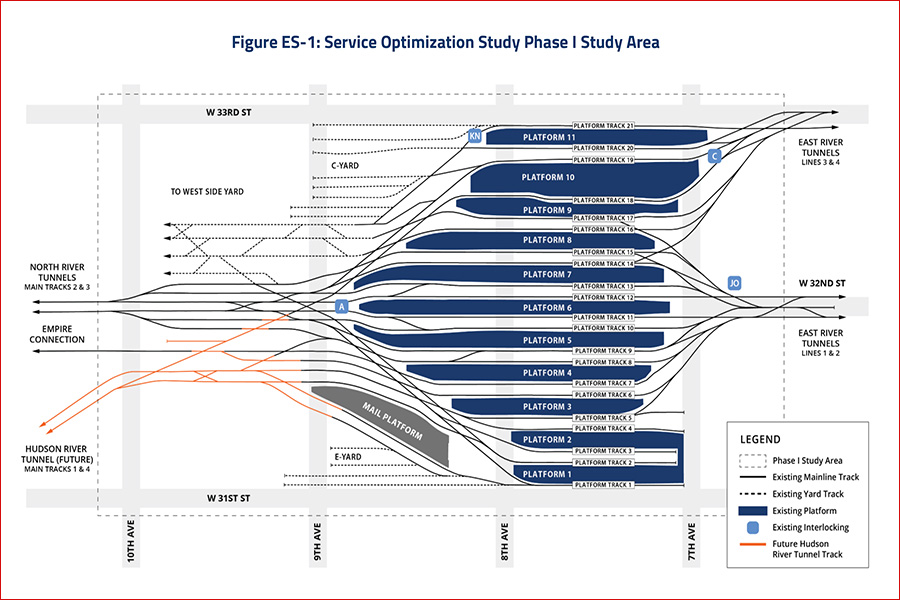
This FRA study diagram shows the proposed operating concept for Penn Station, including reconfigured track connections, platform assignments and the future Hudson River Tunnel approach intended to reduce conflicting train movements and increase peak rail capacity. Click to expand.
Federal Railroad Administration

The plan calls for disconnecting Platform Tracks 1 through 5 from the existing "U" and "M" ladders, constructing a new double-ladder connection at the Hudson River Tunnel approach and extending Platforms 1, 2 and 3 approximately 200 ft to 350 ft west to accommodate 10-car NJ Transit trains.
FRA modeling found the reconfigured track layout could reduce conflicting train movements at A Interlocking during the morning peak from 113 to 51—a 55% reduction. Fewer crossing movements would reduce signal delays, improve reliability and limit the spread of disruptions among rail operators.
Additional stairs and escalators, platform decluttering and revised boarding practices could reduce average passenger service time by about 2.4 minutes, or 28%.
Combined rail and pedestrian-flow simulations suggest improvements could increase cross-Hudson capacity from 24 to as many as 32 trains per hour during the morning peak and 30 trains per hour in the evening.
The operating concept would maintain current LIRR service levels while allowing increased Amtrak and NJ Transit service. It also would enable up to four commuter trains per hour in each direction to continue through Penn Station rather than terminate there.
The 32-train scenario proved feasible under the study's Phase I assumptions, although it produced slightly higher modeled delays than the baseline. A 30-train version slightly improved delay performance.
The report cautions that results depend on shortened dwell times, operational changes and assumptions about the variability of trains entering the station. Accommodating more than 32 trains per hour in each direction would require broader regional improvements in reliability and schedule adherence.
Design Moves Forward, Future Options Remain
Amtrak and Penn Transformation Partners signed a predevelopment agreement June 22 to advance final design, financing and stakeholder coordination while establishing a firm construction price. The FRA findings are expected to inform continuing track-level design as environmental review, permitting and engineering proceed ahead of a targeted late-2027 groundbreaking.
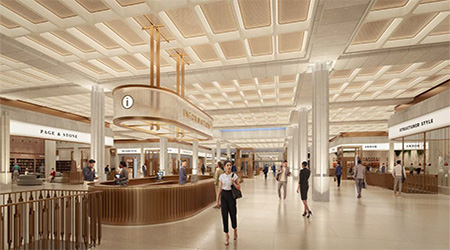
The FRA study concludes that improving passenger circulation, alongside track and platform modifications, is critical to increasing Penn Station's peak operating capacity.
Amtrak/Penn Transformation Partners
FRA Administrator David Fink said in a news release accompanying the report that Penn Transformation "will improve the track-level operations and infrastructure to deliver more capacity" while station redevelopment moves forward.
The study also evaluated a longer-term concept that would combine Platforms 5 and 6 into an approximately 64-ft-wide platform by removing Tracks 10 and 11 and filling the space between the existing platforms.
The concept could support as many as eight through-running commuter trains per hour in each direction, in addition to planned Amtrak service, but did not perform reliably in dynamic simulations under current train-delay assumptions and congestion at LIRR's West Side Yard.
Rather than recommend immediate construction, FRA said Penn Transformation should preserve the option by leaving space for future stairs and escalators and avoiding new structural columns within the potential platform expansion area.
RELATED
Penn Station Renderings Reveal Design for $8B Reconstruction Beneath Madison Square Garden
Phase II, scheduled for completion in 2028, will expand the analysis beyond Penn Station to evaluate regional service plans, railroad interoperability, signaling and electrical systems, fleet requirements, governance and funding strategies. It will also assess additional Gateway Program investments needed to support higher service levels through the station.
Neither the Federal Railroad Administration, the U.S. Dept. of Transportation nor Penn Transformation Partners immediately responded to ENR's requests for comment.
Bryan Gottlieb is the online editor at Engineering News-Record (ENR).
Gottlieb is a five-time Society of Professional Journalists Excellence in Journalism award winner with more than a decade of experience covering business, construction and community issues, including finance, law and real estate. He has reported for Adweek and the San Diego Daily Transcript and led a community newsroom in Santa Monica, Calif. He served as editor-in-chief of the Detroit Metro Times and as managing editor at Roofing Contractor, where he helped shape national industry coverage. At Engineering News-Record, Gottlieb covers breaking news, large-scale infrastructure and megaprojects, regulatory developments and business trends across the U.S. and global construction sectors.
email: gottliebb@enr.com | office: (248) 786-1591