Regulatory
Reclamation Draft Review Maps Future Operations for Colorado River Dams
Review assesses reservoir management options related to hydropower reliability and infrastructure risk
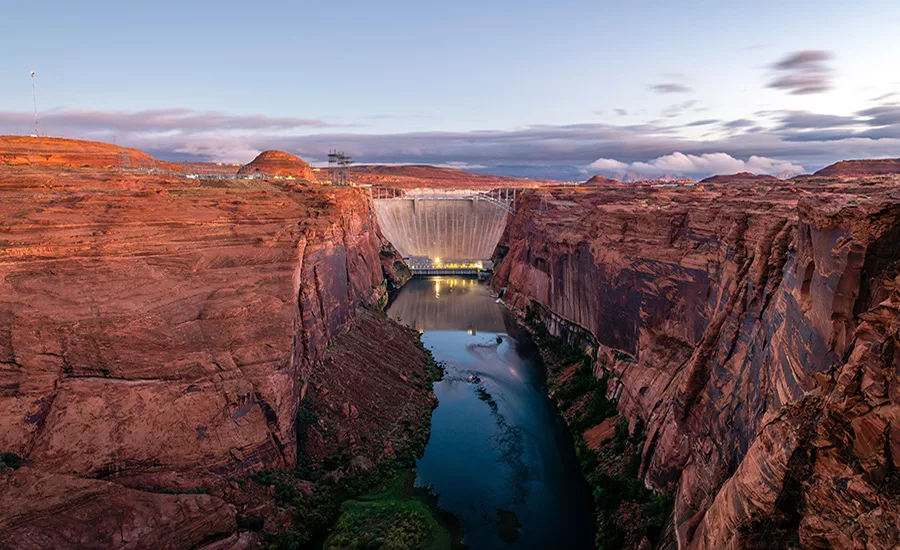
Glen Canyon Dam on the Colorado River, where prolonged drought has intensified scrutiny of post-2026 reservoir operations under a newly released federal draft environmental impact statement.
The U.S. Bureau of Reclamation on Jan. 9 released a draft review on managing Colorado River’s two largest reservoirs after 2026, impacting dam operations, hydropower reliability and infrastructure risk management across the West.
The Draft Environmental Impact Statement (EIS) evaluates post-2026 operational alternatives for Lake Powell and Lake Mead beginning in 2027, when the 2007 Interim Guidelines governing coordinated operations at Glen Canyon Dam and Hoover Dam are set to lapse. Reclamation did not designate a preferred alternative, preserving flexibility as negotiations among the seven Colorado River Basin states continue.
RELATED
At Lake Powell, Engineering Is Outpacing Colorado River Policy
Those negotiations involve the seven states that make up the Colorado River Compact—Arizona, California, Colorado, Nevada, New Mexico, Utah, and Wyoming—which are divided between the Upper Basin and Lower Basin under the original 1922 agreement that governs the river's use.
“The Department of the Interior is moving forward with this process to ensure environmental compliance is in place so operations can continue without interruption when the current guidelines expire,” said Andrea Travnicek, assistant secretary for water and science at the U.S. Department of the Interior. “The river and the 40 million people who depend on it cannot wait. In the face of an ongoing severe drought, inaction is not an option,” she added.
RELATED
Biden Administration Claims Near-term Victory in Colorado River System Stability
A New Reality
The Draft EIS reflects the operational strain created by roughly 25 years of prolonged drought in the Colorado River Basin and forecasts that continue to point toward drier conditions.

A Bureau of Reclamation diagram shows Glen Canyon Dam intake structures, highlighting the minimum power pool at 3,490 ft and the dead pool at 3,370 ft, thresholds central to post-2026 operations planning.
Image courtesy of the Bureau of Reclamation
These pressures have lowered reservoir levels to points that limit hydropower output and complicate dam operations, requiring federal managers to focus on safeguarding the infrastructure itself in addition to water delivery.
Reclamation analyzed five operational alternatives. The alternatives differ in how releases are coordinated between Lake Powell and Lake Mead, how shortages are triggered and distributed and how conserved water is stored and released under changing hydrologic conditions.
Any eventual agreement among Compact states is expected to incorporate elements or variations of these approaches rather than adopting a single option wholesale.
“Given the importance of a consensus-based approach to operations for the stability of the system, Reclamation has not yet identified a preferred alternative,” said Scott Cameron, acting commissioner of the Bureau of Reclamation, in a statement.
“Reclamation anticipates that, when an agreement is reached, it will incorporate elements or variations of these five alternatives,” Cameron added, noting the breadth of alternatives in the EIS for “sustainable and effective management of the Colorado River.”
The Draft EIS directly addresses how close federal facilities are operating to critical thresholds. At Lake Powell, the analysis models conditions approaching minimum power pool, where turbine generation becomes constrained, and evaluates operations below that level through alternative outlet works.
Federally Operated Colorado River Hydropower Facilities
The Colorado River system includes nine federally operated hydropower facilities managed by the Bureau of Reclamation, located on the mainstem river and key tributaries.
Lower Basin and Mainstem
- Hoover Dam
- Davis Dam
- Parker Dam
Upper Basin and Colorado River Storage Project
- Glen Canyon Dam
- Flaming Gorge Dam
- Navajo Dam
- Blue Mesa Dam
- Morrow Point Dam
- Crystal Dam
Historically, these facilities have generated about 12 billion kWh annually, though output has declined during prolonged drought as reservoir elevations have fallen.
Reclamation also assessed buffer elevations intended to reduce the likelihood that either Powell or Mead would fall into ranges that jeopardize hydropower generation and system operations.
To compare alternatives, the Draft EIS uses decision-making under “significant uncertainty,” assessing how often reservoir levels remain above specified performance thresholds across hundreds of possible future hydrologic scenarios, rather than relying on a single forecast.
The comprehensive approach highlights which operating strategies are most resistant to extended drought and pinpoints scenarios that could push the system into undesirable operating conditions.
The Colorado River supplies water to more than 40 million people across seven states and supports hydropower generation at nine federally operated facilities across the system, while also serving 30 Tribal Nations, two Mexican states and about 5.5 million acres of irrigated farmland.
Reclamation said the Draft EIS addresses only domestic river operations. A separate, binational process addressing deliveries to Mexico under the 1944 Water Treaty is also underway through the International Boundary and Water Commission.
Reclamation said the Draft EIS will be published in the Federal Register on Jan. 16, initiating a 45-day public comment period that runs through March 2. A decision on post-2026 operations is expected before Oct. 1, the start of the 2027 water year.

Bryan Gottlieb is the online editor at Engineering News-Record (ENR).
Gottlieb is a five-time Society of Professional Journalists Excellence in Journalism award winner with more than a decade of experience covering business, construction and community issues, including finance, law and real estate. He has reported for Adweek and the San Diego Daily Transcript and led a community newsroom in Santa Monica, Calif. He served as editor-in-chief of the Detroit Metro Times and as managing editor at Roofing Contractor, where he helped shape national industry coverage. At Engineering News-Record, Gottlieb covers breaking news, large-scale infrastructure and megaprojects, regulatory developments and business trends across the U.S. and global construction sectors.
email: gottliebb@enr.com | office: (248) 786-1591