Government
Colorado River States Clear Emergency Water Transfer as System Nears Hydropower Floor
With Interior’s final approval imminent, engineers and contractors face a basin operating at its physical limits—and a capital cycle that emergency releases cannot defer

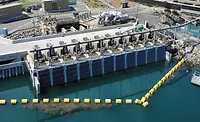
Glen Canyon Dam on the Colorado River in northern Arizona impounds Lake Powell, where declining water levels are approaching the 3,490-ft minimum power pool that constrains hydropower generation.
The Upper Basin states formally approved an emergency water transfer to Lake Powell on April 23, clearing the way for Interior Secretary Doug Burgum to authorize releases as soon as Friday—roughly double the 500,000 acre-feet released in a comparable 2022 emergency.
The plan, announced April 17 by the U.S. Bureau of Reclamation under the 2019 Drought Response Operating Agreements, calls for releasing 660,000 acre-feet to 1 million acre-feet from Flaming Gorge Reservoir between April 2026 and April 2027.
The action is paired with a reduction in annual releases from Lake Powell to Lake Mead of 1.48 million acre-feet—from 7.48 million acre-feet to 6.0 million acre-feet through September 2026—authorized under the 2024 Supplemental Environmental Impact Statement for near-term Colorado River operations.
Together, the measures are projected to raise Lake Powell about 54 ft to an elevation of at least 3,500 ft by April 2027.
The urgency reflects rapidly deteriorating hydrologic conditions. The April 2026 24-Month Study projects water year 2026 inflow to Lake Powell at 3.87 million acre-feet—about 40% of average—with end-of-year elevation projected at 3,483 ft.
The projected number is 7 ft below the 3,490-ft minimum power pool—a level below which turbine generation ceases—at Glen Canyon Dam.
The Upper Colorado River Commission warned April 17 that Lake Powell could approach critical elevations as early as June 2026, while Reclamation modeling places that risk later in the summer without intervention.
“Given the severity of the risks facing the Colorado River system, it is imperative that we take action quickly to protect a resource that supplies water to 40 million people,” said Andrea Travnicek, assistant secretary for water and science at the U.S. Dept. of the Interior.
Interior Secretary Doug Burgum expressed his appreciation for the cooperation among the four Upper Basin states, adding that Interior and Reclamation would “continue to coordinate with the basin states, tribes, Mexico and basin stakeholders as we make the decisions necessary to operate and protect the system.”
The governors of Colorado, New Mexico, Utah and Wyoming characterized the situation in a joint statement issued April 9 as “an unprecedented year on the Colorado River and likely will be one of the worst on record.”
The governors noted that Upper Basin states were already enforcing mandatory, uncompensated water rights cuts affecting communities, tribes and local economies, and conditioned their support for the releases on assurances that all water transferred from upstream reservoirs would be fully recovered.
Wyoming Commissioner Brandon Gebhart said the approval reflected necessity, not preference. “We wouldn’t be recommending this release, except for the historically dry conditions,” he told the Colorado Sun. Chuck Cullom, executive director of the Upper Colorado River Commission, was direct: “It’s clear that additional actions at Lake Powell are necessary.”
RELATED
Reclamation Draft Review Maps Future Operations for Colorado River Dams
Lake Levels, Dam Output and System Storage Hit Critical Thresholds
As of the end of March, Lake Powell stood at an elevation of 3,527.99 ft with 5.72 million acre-feet in storage, or about 25% of live capacity, according to Reclamation. Flaming Gorge was about 79% full and about 17 ft below capacity as of April 23; releases are expected to draw it down roughly 35 ft, to about 59% of capacity, over the next year.

Exposed “bathtub ring” along Lake Powell’s shoreline marks declining reservoir levels, reflecting prolonged drought conditions that are pushing the Colorado River system toward critical operating thresholds.
Image: Adobe
Systemwide storage across the Colorado River Basin has fallen to about 36% of capacity. Reclamation said no releases are planned from two other upstream Colorado River Storage Project reservoirs—Blue Mesa in Colorado and Navajo in New Mexico—due to their low water levels and poor inflow forecasts.
Reclamation acknowledged that reduced releases from Lake Powell will accelerate declines at Lake Mead and could reduce Hoover Dam hydropower generation by up to 40% as early as this fall.
The financial consequences are already registering at utilities: Emily Brandt, energy resource manager at Utah-based Heber Light & Power, told the Associated Press that the utility has raised rates 13% over the past five years as it replaces declining federal hydropower with market purchases.
The emergency response does not resolve the larger governance question facing the basin. The 2007 Interim Guidelines governing coordinated operations at Glen Canyon Dam and Hoover Dam expire at the end of 2026, and the seven basin states have not reached consensus on a replacement operating framework.
Interior has said it will determine post-2026 operations this summer if no agreement is reached. Arizona water director Tom Buschatzke signaled the emergency will not accelerate those negotiations. “The fact that this is occurring isn’t going to help us, in any way, shape or form, get to a seven-state agreement,” he said, according to KJZZ.
RELATED
Two Dams Now Set the Colorado River’s Post-2026 Reality
As ENR has reported since January, federal modeling in the Draft Environmental Impact Statement for post-2026 Colorado River operations shows Glen Canyon Dam and Hoover Dam operating near their physical limits across median and dry hydrology scenarios well into the next decade.
Jenny Dumas, water attorney for the Jicarilla Apache Nation, noted that the most recent action is a short-term solution. "It's going to take time to recover these reservoirs before we can do this again. So while we can exhaust our reserves to avoid system collapse this year, it means reserves won't be there next year," she said, as reported in High Country News.
Emergency releases can defer the point at which infrastructure modifications become unavoidable. But as Reclamation’s modeling shows, repeated operations near minimum power pool narrow that window rather than eliminate it.

Bryan Gottlieb is the online editor at Engineering News-Record (ENR).
Gottlieb is a five-time Society of Professional Journalists Excellence in Journalism award winner with more than a decade of experience covering business, construction and community issues, including finance, law and real estate. He has reported for Adweek and the San Diego Daily Transcript and led a community newsroom in Santa Monica, Calif. He served as editor-in-chief of the Detroit Metro Times and as managing editor at Roofing Contractor, where he helped shape national industry coverage. At Engineering News-Record, Gottlieb covers breaking news, large-scale infrastructure and megaprojects, regulatory developments and business trends across the U.S. and global construction sectors.
email: gottliebb@enr.com | office: (248) 786-1591