LAX People Mover Builders Claim Airport Seeks to Shift Delay and Cost Blame
New lawsuit allegations erupt as system failed to open in time for World Cup matches
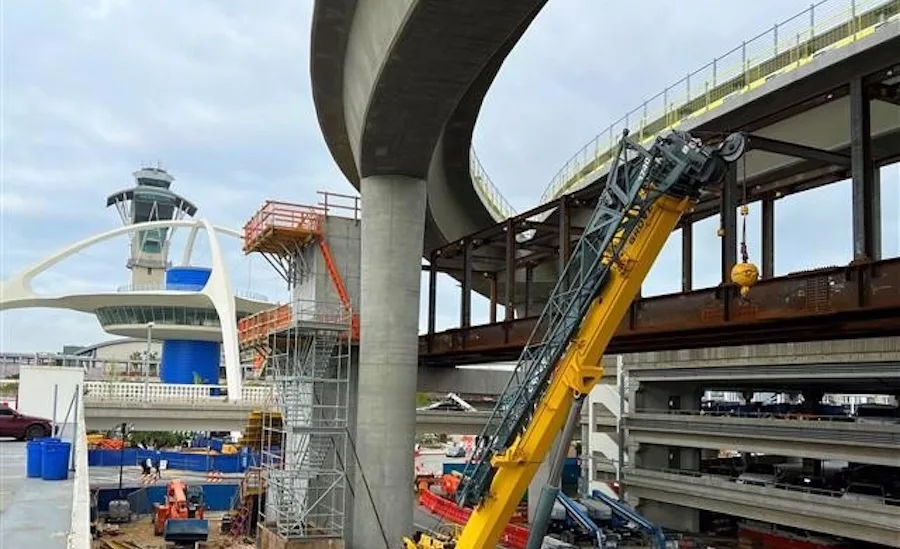
The last of the structural steel work for the Los Angeles People Mover, now called SkyLink, was a milestone when it was done in 2022.
The consortium building the Los Angeles International Airport's delayed and over-budget new people mover has expanded its dispute with the airport in a new lawsuit filing. It claims Los Angeles World Airports, which operates the airport, caused critical delays related to electrical power, ignored decisions in the builders' favor by a neutral project technical expert and even intentionally allowed other contractors to "destroy" work performed by the consortium.
As described in a July 9 state court filing in Los Angeles, the consortium, called LINXS, accuses the agency and city of Los Angeles of delaying the SkyLink people mover in tandem with the Los Angeles Dept. of Water and Power.
The sharply worded accusations are the latest in a long, contentious project whose system testing was to have finished June 30. Airport officials declined in a statement to comment on the pending litigation, claiming they are still reviewing the new accusations, but said the airport and city remain committed to getting the system into operation.
The 2.25-mile elevated guideway, part of a huge renovation of the entire airport, has three stations within the airport and three outside. It is intended to relieve traffic congestion and ease access.
There was an original completion date of 2023 and budget of $1.03 billion for construction cost, with another $918 million financed by a private concessionaire.
By 2024, however, the airport had agreed to pay LINXS an additional $880 million. The recent World Cup soccer matches put a new spotlight on the contentious public-private partnership and the design-build-finance-operate LINXS concession. Its lead construction partners include Fluor Corp. and Balfour Beatty.
The airport and city first undersized electrical feeder cables, LINXS claims. But the feeder cable upgrade triggered new woes with utility metering cabinets that caused power to the project to be lost for 141 days. Although the independent technical expert—referred to as the "project neutral" and meant to rule on disputes during the project—awarded the delay claim to the consortium, the airport refused to comply, the builders' lawsuit claims.
Another conflict ensued over a solar panel system that was supposed to supply electricity to the system. The consortium claims airport officials also refused to comply with the neutral's ruling in the consortium's favor.
Looking for quick answers on construction and engineering topics?
Try Ask ENR, our new smart AI search tool.
Ask ENR →
In addition, in what could be its most incendiary claim, the new filing accuses officials of allowing other contractors to destroy finished work by the consortium, further delaying project completion.
The consortium charges that Los Angeles World Airports' "intentional blocking of developer's ability to achieve construction completion, and falsely blaming the developer for the delays has a self-evident motive—to deflect blame from itself in the public's eyes for the long period of time [that the people mover] project has been and is still being delayed."
Officials of the airport operator declined to reply to the specific allegations.
“As we review the filing, our focus remains unchanged" on "the successful and timely delivery of SkyLink" that "will transform the experience for LA visitors in the years to come," the operator said in its statement. "Los Angeles World Airports remains fully committed to a collaborative, constructive path forward with LINXS" to start passenger service "as soon as possible."