Criminal Trial
Italian Court Convicts 32 in Morandi Bridge Collapse Case
Former Autostrade per l'Italia CEO Giovanni Castellucci receives 12 years as judges assign responsibility across inspection, design and public oversight
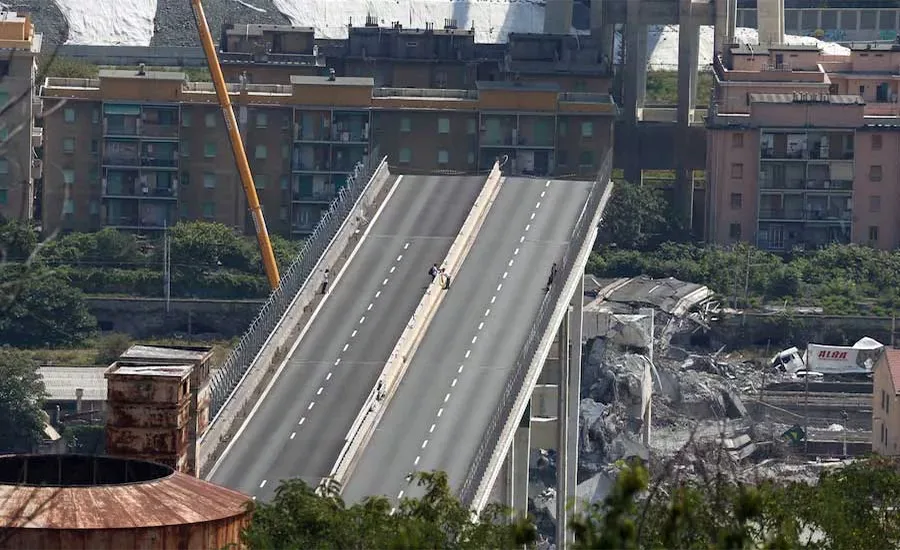
The remaining approaches of Genoa's Morandi Bridge stand after the Aug. 14, 2018, collapse of a 200-m section that killed 43 people. On July 16, an Italian court convicted 32 former executives, engineers and public officials in the first criminal verdicts stemming from the disaster.
Former Autostrade per l'Italia CEO Giovanni Castellucci was sentenced to 12 years in prison July 16 after an Italian court handed down the first criminal verdicts stemming from the 2018 Morandi Bridge collapse that killed 43 people.
The Tribunal of Genoa convicted 32 former highway executives, engineers and public officials after concluding an eight-year criminal case examining the collapse of the Polcevera viaduct.
Former Autostrade maintenance chief Michele Donferri Mitelli received an 11-year sentence, while other defendants received lesser prison terms. The ruling also included acquittals and dismissals of some charges because statutes of limitation had expired. According to the sentencing order published by Genoa broadcaster Telenord, the court's written opinion is due within 90 days, subject to a possible statutory extension.
The prosecution arose from the Aug. 14, 2018, collapse of about 200 m of the viaduct during a rainstorm, sending vehicles plunging onto rail lines, warehouses and city streets below. The disaster severed one of northern Italy's principal highway links and prompted a sweeping engineering investigation.
Before the collapse, Autostrade had sought bids for a roughly $23-million project to reinforce the stays at Piers 9 and 10, but construction had not begun. The damaged bridge was later demolished and replaced by the Renzo Piano-designed Genoa San Giorgio Bridge, which opened in 2020.
Court Assigns Responsibility Across Infrastructure Chain
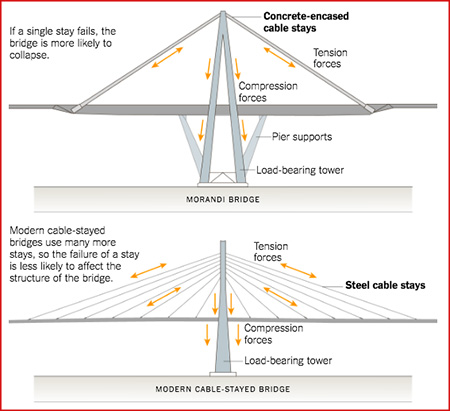
The Morandi Bridge used a small number of concrete-encased stay cables, unlike modern cable-stayed bridges that distribute loads across many exposed steel stays. Prosecutors argued deterioration within one stay at Pier 9 contributed to the 2018 collapse that killed 43 people.
Graphic courtesy of Kaiser Science
In a statement accompanying the verdict, the Tribunal of Genoa said the case centered on what it described as a “system of defects” in the upper portion of the Genoa-seaward stay of Pier 9 that formed the collapse mechanism. The court said the trial examined whether the failure was foreseeable and preventable.
The tribunal said responsibility extended across the bridge’s inspection, oversight and project-delivery chain. Those convicted included personnel within Autostrade per l’Italia and its engineering, inspection and maintenance subsidiary SPEA; officials responsible for supervising the concessionaire on behalf of Italy’s infrastructure ministry; participants in the design of planned strengthening work for Piers 9 and 10; and members of the Technical-Administrative Committee that reviewed the project.
Looking for quick answers on construction and engineering topics?
Try Ask ENR, our new smart AI search tool.
Ask ENR →
The criminal case also examined an uncompleted reinforcement program for Piers 9 and 10.
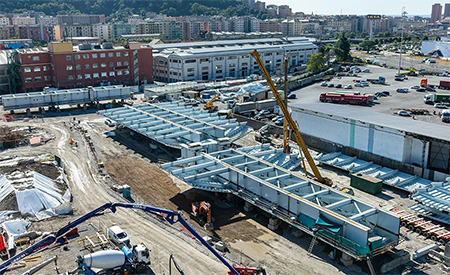
Following the Aug. 14, 2018, collapse of Genoa's Morandi Bridge, the damaged viaduct was demolished and replaced by the Renzo Piano-designed Genoa San Giorgio Bridge, which opened to traffic in 2020. This 2019 image shows deck modules being assembled during construction.
Photo by PerGenova
Design work on the reinforcement program began in 2015 and progressed through preliminary, final and executive phases, but the project never reached construction. The tribunal said it evaluated the roles of the contracting authority, designers and project reviewers involved when assigning criminal responsibility.
The tribunal said defendants' responsibilities arose under bridge-surveillance requirements, public procurement rules and engineering standards, including a 1967 Ministry of Public Works circular governing highway structures and Italy's 2008 Technical Standards for Construction.
The court also distinguished between the objective foreseeability of the collapse and the defendants' state of mind.
It concluded the failure was foreseeable and preventable but did not find that the defendants had actually anticipated the collapse and consciously relied on it not occurring. Instead, the convictions rested on findings of negligence without actual foresight of the event.
Experts Fault Inspection Methods
The Italian infrastructure ministry's post-collapse commission found that reflectometric monitoring used to assess the condition of the bridge's prestressing strands was qualitative and sampled only a portion of the cables, limiting its ability to determine their actual condition.
According to Italian public broadcaster RAI, court-appointed experts later concluded in a supplemental report prepared during the criminal trial that inspections performed by Autostrade and SPEA were insufficient and unreliable for determining deterioration of the steel cables within Pier 9's stays.
The experts found that no direct examination had ever been performed at the top of the Genoa-seaward stay—despite defects previously identified at Piers 10 and 11—concluding that coring and endoscopic inspections should have been conducted, as nondestructive testing alone could not establish the cables' condition.
The experts also rejected a defense theory that corrosion resulted solely from oxygen trapped in a hidden construction void. According to RAI's account of the supplemental report, prosecution experts concluded the amount of corroded steel required more oxygen than such a cavity could have contained, and instead pointed to long-term intrusion of water and oxygen through cracks in the concrete.
Defense Plans Appeal
Castellucci's attorneys said they would appeal, arguing the verdict improperly detached criminal liability from specific personal conduct.
"The gravity of the event requires that justice continue to be based on establishing individual responsibility and not on the search for a scapegoat," the defense said in a statement released after the ruling.
The attorneys maintained the collapse resulted from an undiscovered construction defect that went undetected for more than 50 years despite reviews by designers, builders, public authorities, private operators and engineering experts.
They also argued the trial established no policy of sacrificing maintenance spending for cost savings and said Castellucci supported reinforcement work approved by Autostrade's board.
Victims' committee president Egle Possetti said the verdict established responsibility not only among company officials but within the public oversight system.
"Specific responsibilities have been established for specific individuals," Possetti said after the ruling, according to ANSA. She added that the decision also found fault with public oversight because "no controller stopped the operator."
Autostrade per l'Italia responded before the verdict by issuing its first formal apology for the disaster.
In an open letter published July 15, CEO Arrigo Giana said the company's failure to apologize immediately after the collapse had compounded the suffering of victims' families.
"The actions and choices of some left indelible wounds," Giana wrote.
Calling the long-delayed apology "our moral imperative," he said the company now operates under different ownership and management with renewed emphasis on infrastructure monitoring, maintenance planning and risk prevention, according to ANSA.
The first-instance trial ranked among Italy's largest infrastructure prosecutions. According to the Tribunal of Genoa, the proceedings spanned 284 hearings, included testimony from 282 witnesses and technical consultants, generated more than 24,000 pages of hearing transcripts and involved approximately 12 terabytes of documentary evidence.
The tribunal's written opinion, due within 90 days unless the filing deadline is extended, is expected to explain how judges weighed the competing engineering theories presented during the trial and apportioned criminal responsibility among executives, engineers, designers and public officials.
All convictions remain subject to appeal.

Bryan Gottlieb is the online editor at Engineering News-Record (ENR).
Gottlieb is a five-time Society of Professional Journalists Excellence in Journalism award winner with more than a decade of experience covering business, construction and community issues, including finance, law and real estate. He has reported for Adweek and the San Diego Daily Transcript and led a community newsroom in Santa Monica, Calif. He served as editor-in-chief of the Detroit Metro Times and as managing editor at Roofing Contractor, where he helped shape national industry coverage. At Engineering News-Record, Gottlieb covers breaking news, large-scale infrastructure and megaprojects, regulatory developments and business trends across the U.S. and global construction sectors.
email: gottliebb@enr.com | office: (248) 786-1591