Top 100 Project Delivery Firms Face Stress Test
June 3, 2026
Top 100 Project Delivery Firms Face Stress Test
June 3, 2026An ironworker working for Gray Construction completes high-elevation bolted connections, aligning and securing structural steel beams from an aerial lift during frame erection of a solar cell manufacturing plant project in Indiana.


Related Links:
ENR Top 100 Design-Build Firms 2026
ENR Top 100 Construction Management-at-Risk Firms 2026
ENR 2026 Top 100 PDF
Subscription Required
Pressure mounts for Top 100 Project Delivery firms as AI-related infrastructure projects propel demand for design-build and construction management-at-risk delivery methods—increasing revenue gains for this year’s listed firms. Yet behind the numbers, and inside delivery teams, firms say there is a disconnect between project scale and speed, and owners must right-size operations to ensure success.
In comments to ENR, Top 100 Project Delivery firms shared that navigating market challenges such as limited skilled labor pools, long material lead times and compressed project schedules have become part and parcel of pushing projects to completion. However, an increased need for collaboration has shifted how teams integrate solutions among design-build and construction management-at-risk (CMAR) delivery methods.
“The main issues today are what have always been the main issues—how can we get all of the groups on the same page, talking and working together,” says Gray Construction President and CEO Rebekah Gray. “While some of the peripheral processes have changed or been altered over the years, we’re all still working toward that one main goal.”
As project information changes hands from team to team, “communication can break down and there can be gaps or delays,” she says, adding that she believes design-build shines in such moments.
“With design and construction united under a single banner from the beginning of the project, design-build incentivizes collaboration through shared resources and continuous communication,” says Gray.
Under CMAR, industry-wide project cost uncertainty has also opened doors for more collaboration and a shift in howcontingency fee structures are negotiated, says Daniel Getting, Swinerton director of construction in Raleigh, N.C..
“Owners are more open to collaborative conversations about contingency, rather than treating it as a fixed or adversarial item,” he says, adding that teams are also working together earlier to “identify specific risks, align contingency to real exposures and review them as market conditions change.”
Such an approach gives owners more transparency and predictability, says Getting, “while allowing contingency to be sized more accurately, leading to fewer surprises, better team alignment and a healthier project financial structure.”
Breaking Down Bottlenecks
Silicon Valley’s leading cloud service providers Amazon, Alphabet, Meta and Microsoft are expected to pump well over $600 billion into rapidly scaling data centers this year to support artificial intelligence (AI) infrastructure. At a global scale, research consulting firm McKinsey estimates that AI-related spending will reach $6.7 trillion by 2030.
Looking for quick answers on construction and engineering topics?
Try Ask ENR, our new smart AI search tool.
Ask ENR →

To meet the needs of such a surge in demand, Top 100 firms say owners must shift operations and expectations to serve the delivery model that works best for the project to prevent bottlenecks.
Project bottlenecks are often tied to “decision-making speed and coordination across stakeholders,” says Todd Imming, Korte Co. chief marketing officer. “Projects move best when decisions are made early and communication stays consistent.”
For that reason, Burns & McDonnell prefers a collaborative delivery approach, says Chair and CEO Leslie M. Duke. “When an owner has limited resources to deliver its capital portfolio of work, project timelines can be negatively impacted,” she says. With engineering, procurement and construction, “owner expectations can align with the project team early in the process, minimizing the strain on an owner’s resources.”
Dan Spinetto, senior vice president of procurement and project delivery at Brasfield & Gorrie, says he has seen many project bottlenecks begin upstream, before construction begins.
“Alignment during preconstruction, decision-making speed and coordination between stakeholders have a significant impact on the overall outcome,” he says. “As projects become more complex, delays in those early phases can create compounding effects during construction.”
Behind the Numbers

“The main issues are
what have always been the main issues—how can we get all of the groups on the same page.”
Rebekah Gray, President & CEO, Gray Construction
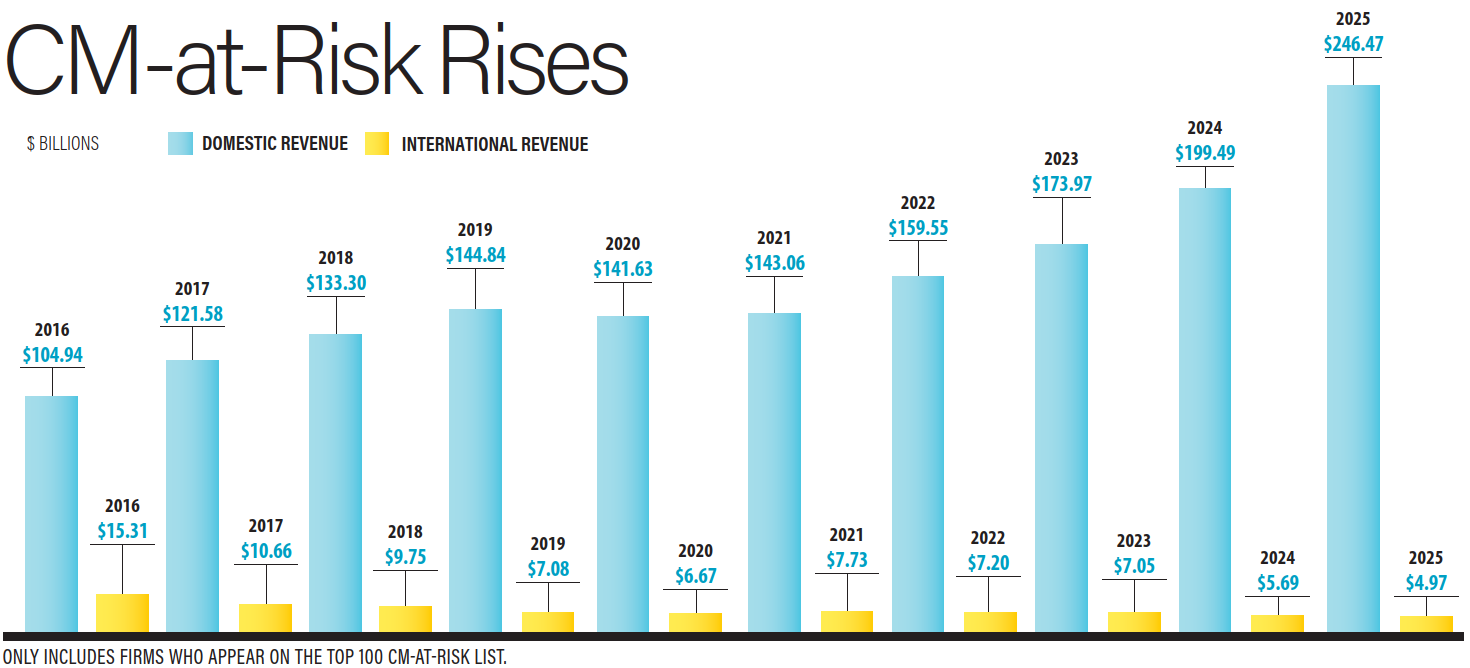
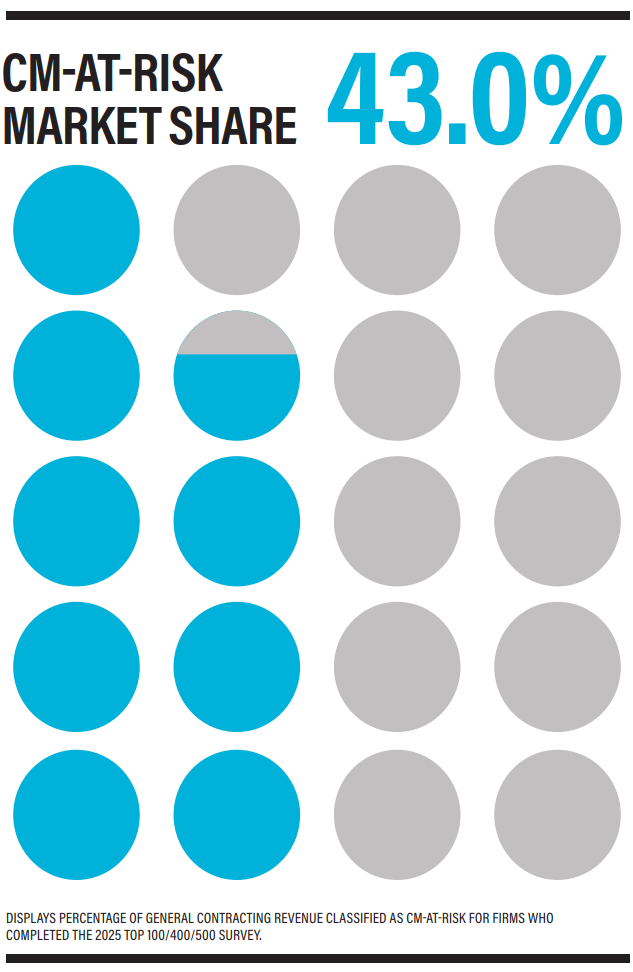
Top 100 Project Delivery firms delivered a substantial increase in revenue earned from CMAR projects in 2025. Revenue for Top 100 CMAR firms rose 22.5% from 2024, reported at $251.44 billion. Domestic CMAR revenue jumped 23.6%, while international revenue fell 12.7%. International revenue has fallen for four straight years.
Median CMAR revenue came in at $1.32 billion, up 21.1% from $1.09 billion last year. Of 99 ranked firms that reported CMAR revenue both this year and last, 83% said it had increased.
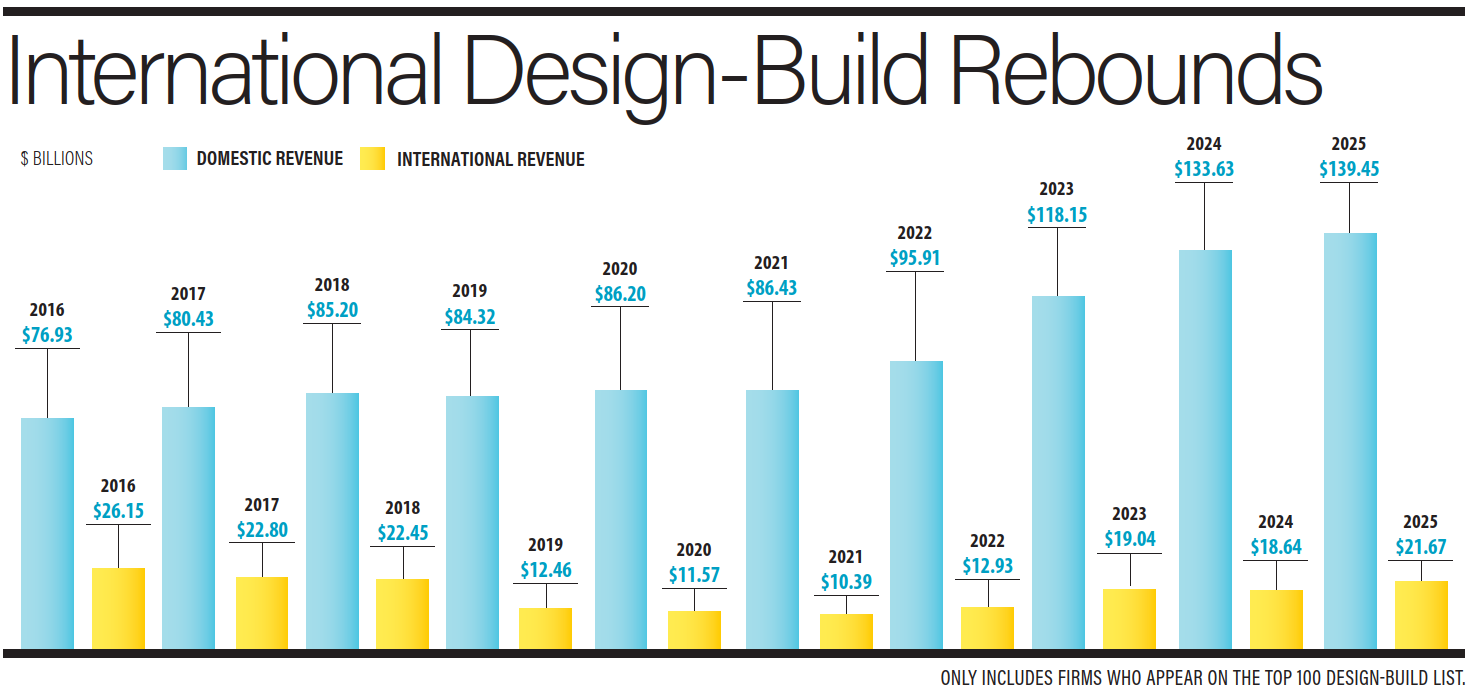
In comparison, design-build revenue saw more modest increases among Top 100 Professional Delivery firms. It rose 5.8% between 2024 and 2025. International revenue from design-build projects increased 16.3% to $21.7 billion, increasing by double digits three of the past four years.
However, median design-build revenue fell 7.2%, to $729.7 million in 2025. Of 98 firms that reported design-build revenue both this year and last, 64% saw an increase.
Focus on Water Supply | By Jonathan Keller
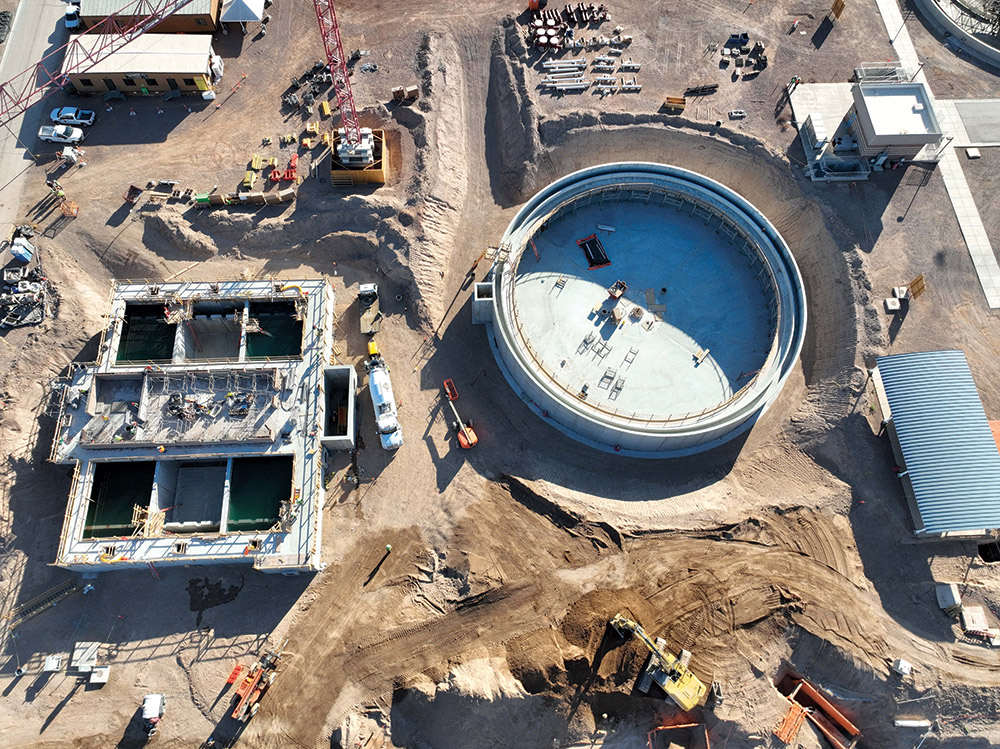
Photo courtesy of McCarthy Building Cos., Inc.
McCarthy (No. 19) is CM-at-risk on the recently completed Kurt R. Segler Water Reclamation Facility Phase 4 Improvements project in Henderson, Nev. The project includes a new 12-million-gallon-per-day biological nutrient removal basin and a 125-ft secondary clarifier.
Shifting Value Proposition

“The best owner advisers have evolved from traditional oversight roles into genuine delivery facilitators.”
Adam R. Jelen, President and CEO, Gilbane Building Co.
As projects increase in complexity, Top 100 firms say the value proposition for delivery models must also change.
“At STO Building Group, we employ a target value delivery model which is now about shaping the project early—aligning scope, systems, schedule and investment decisions before risk is locked in,” says STO Building Group Chief Strategy Officer Amy Wincko. “Owners are most excited by early contractor involvement, open‑book pre-construction and flexible GMP [guaranteed maximum price] structures that provide transparency, optionality and predictability in volatile markets," she adds. "CM-at‑risk succeeds today by helping owners set the right target and deliver certainty, not just chase savings.”
Walbridge President John Rakolta III says CMAR delivery has evolved “from late stage cost cutting to early, strategic decision making.” Owners get most excited about early CM involvement that “delivers cost certainty sooner in the design process while allowing them to retain design control,” he notes. “Through constructibility input, real time estimating and market insight, CMs help owners make informed decisions around scope, systems and phasing before costs are locked in. That front end collaboration has become the primary value driver of CM-at-risk, particularly on complex projects where predictability, schedule and risk management are critical.”
Evolving Roles
While early collaboration is baked into design-build delivery, Top 100 firms say they are also seeing a shift in how owner advisers serve delivery success, particularly during procurement, team selection and GMP development, according to Adam R. Jelen, president and CEO of Gilbane Building Co.
“Owner advisers are increasingly responsible for integrating governance, decision velocity and risk alignment,” he says. “As delivery models accelerate timelines and complexity increases, that role is essential in helping clients make timely decisions and keep stakeholders aligned.”
Barton Malow Chief Operating Officer Chuck Binkowski says “the best owner advisers have evolved from traditional oversight roles into genuine delivery facilitators.” He adds they are "helping owners understand what ‘good’ looks like before the project starts, setting evaluation criteria that actually distinguish between delivery approaches, and staying engaged through execution to ensure the model is working as intended. That’s a meaningful shift from the more transactional, compliance-focused role of even five years ago.”
Brasfield & Gorrie’s Spinetto believes the role of an owner adviser will continue to evolve, “especially as AI and other technological advancements influence the earlier planning of each project and as our turnkey services continue to grow.”
Building More Methods

“Because so many new owners are entering in design-build, we’re seeing [more] demand for helping owners assess their readiness.”
Lisa Washington, Executive Director, Design-Build institute of America
The National Defense Authorization Act for Fiscal 2026, signed by President Donald Trump in December, expressly authorized the use of accelerated design-build and progressive design-build delivery methods for military construction projects. Design-Build Institute of America Executive Director Lisa Washington says the move created a surge of interest in design-build education for federal defense projects.
“Because so many new owners are entering the arena in design-build, we’re seeing [more] demand for helping owners assess their readiness for design-build,” says Washington. In response, she says the group is set to launch an owner readiness assessment tool with the Charles Pankow Foundation to ensure owners choose the right delivery model. The tool comes as the association is set to release Design-Build Teaming Agreements, a deep dive into best practices for owners and design-builders to develop teaming agreements that support transparency, risk management and collaboration.
Washington says it all serves to help the industry master design-build delivery. “Our concern is that because there is such interest in design-build, they’re rushing into something that they don’t completely understand,” she says.
Amid market unpredictability, alternative project delivery methods can offer owners more flexibility to navigate challenges, says John R. Lupa Jr., CRB vice president of national construction. “We see a strong desire for clients to pursue design-build and [CMAR] delivery models compared to traditional execution approaches. Companies that offer full EPCM services can better ensure a construction-driven approach to any given project, which ultimately reduces the risks.”