Battery Storage Charges Ahead as Ultimate U.S. Renewable Energy Growth Enabler
July 23, 2026
Battery Storage Charges Ahead as Ultimate U.S. Renewable Energy Growth Enabler
July 23, 2026The 125-MW/500-MWh Tumbleweed energy storage facility in California became in June the first major U.S. battery site that can discharge power for eight hours, doubling capacity at most other domestic locations


Driven by unprecedented AI power demands, a historic 90% drop in manufacturing costs, increased electrification and public sector policies and incentives, grid-scale battery storage in the U.S. is at record growth—with renewable energy capacity installations reaching new levels as utilities race to prevent transmission blackouts.
Energy storage is not new—simple systems date back thousands of years and utility-scale pumped storage hydropower emerged in Europe in the late 19th century to manage early electric grid loads. But the convergence of booming energy needs, insufficient grid capacity, multi-level government policies, new funding and, most importantly, user demand for cleaner, fast-deploying power has made storage critical for renewable sources, especially solar.
Emerging is a storage ecosystem at a grander scale—as design and construction firms develop safer, more densely packed arrays; improve existing technologies and test new ones; and collaborate with officials, utilities, owners and other stakeholders to speed building and power grid interconnection.
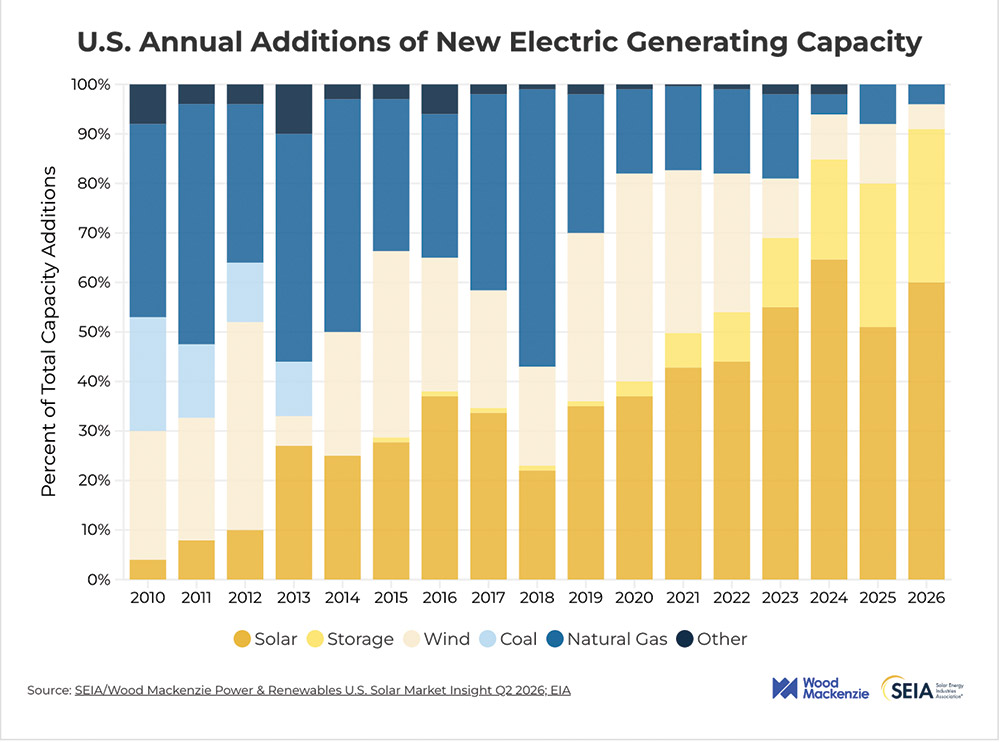
Solar power continues to be the fastest-growing source of new U.S. generation at utility scale, set to rise to 424 billion kilowatt hours by 2027 from 290 billion kWh in 2025, says the U.S. Energy Information Administration. Almost 70 GW of new solar projects are set to come online in 2026 and 2027, 49% above U.S. operating capacity in 2025. If these happen as planned, 2026 will mark the third consecutive year of record solar installations.
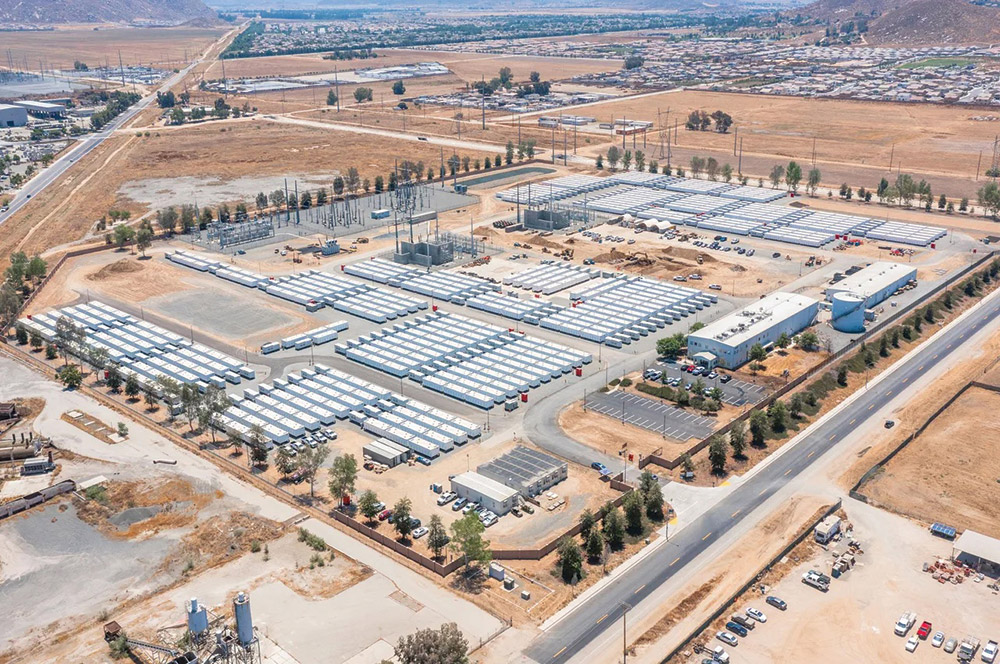
Nova Power Bank standalone battery energy storage system, a 680-MW and 2.7-GW-hour facility, is one of the largest operating storage sites in the U.S., located at a decommissioned gas power plant in California.
Photo courtesy Mortenson
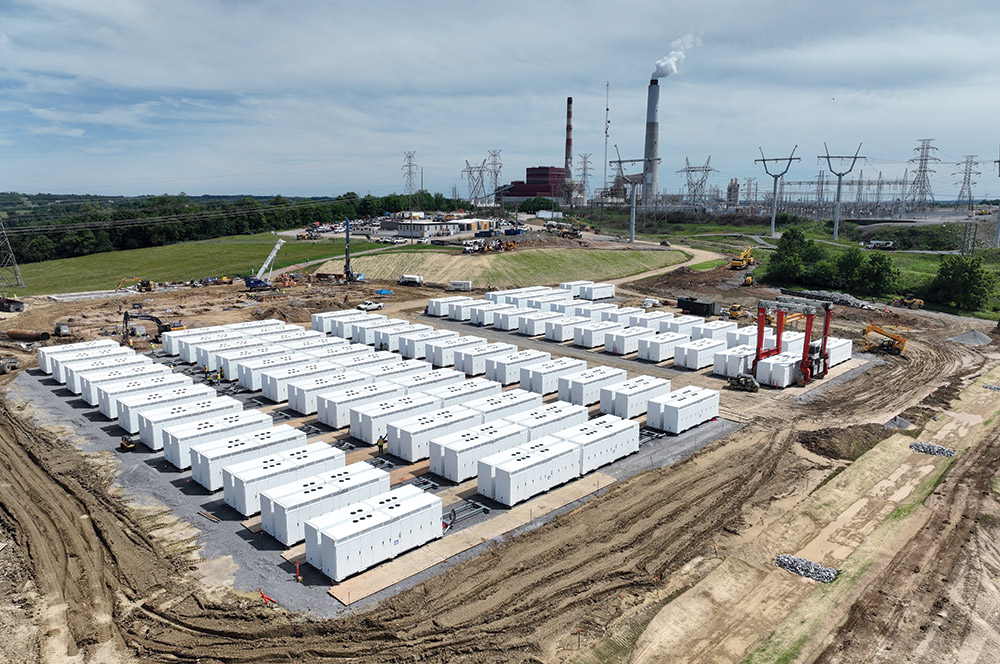
Louisville Gas & Electric and Kentucky Utilities are installing a 125-MW/500-MWh lithium-ion storage system at the existing E.W. Brown gas power plant site in Harrodsburg, Ky., which will store solar energy from a small existing array to provide dispatchable power when needed, leveraging existing grid infrastructure.
Photo courtesy Burns & McDonnell
The U.S. also installed 9.7 GW hours of battery energy storage in this year’s first quarter, up 32% year-over-year, and the country’s highest-ever Q1 energy storage deployment, the Solar Energy Industries Association said May 21. About 24.3 GW of new battery storage also is set to come online by year end, which would surpass the 15-GW record set in 2025.
Energy demand from U.S. data centers is expected to rise by nearly 360% to 110 GW through 2030, according to energy research firm Wood Mackenzie, while gas-fired power additions face more delay from a shortage of turbines and other equipment.
Wind and solar output have eclipsed coal generation on an annual basis since 2024, but 2026 marks the first time those renewables have also outperformed nuclear power installations in the first half of a year, according to federal data.
To bypass the current transmission interconnection gridlock, with wait times of up to 48 months, tech giants are executing so called “private wire" arrangements—co-located solar-and-storage approaches behind the meter to ensure 24/7 power. “Renewables and storage continue to be the fastest way to get new electrons on the grid until additional gas-fired generation can be built,” NextEra Energy CEO John Ketchum said in an April investor presentation.
Looking for quick answers on construction and engineering topics?
Try Ask ENR, our new smart AI search tool.
Ask ENR →

Records are also being broken worldwide, with annual additions of energy storage, excluding pumped hydro, reaching 112 GW in 2025—exceeding the 100-GW mark for the first time, said research group Bloomberg NEF. China makes up more than half of the global market, accounting for 54% of additions last year. Europe and Australia, among others globally, are also taking bigger steps. The European Union enacted on June 26 its first agreement on energy storage that includes 22 member states, industry and financial institutions committed to adding 30 to 35 GW of new storage capacity by 2028 to store and deploy intermittent renewable sources, such as wind and solar.
Enactment of the federal Inflation Reduction Act in 2022 brought new supportive policies in the Biden-era and billions in funding and tax credits that boosted the solar-storage market. But Trump administration policies have eliminated or constrained many renewables incentives and added market barriers, leaving sector participants concerned about its ability to attract users and investors. Many clean energy tax credits ended July 4 for projects not at “beginning of construction” safe harbor, although those with battery storage, as well as standalone projects, retain incentives until a 2036 expiration date.
With provisions in the 2022 federal law, new solar storage configurations have “fundamentally changed project execution,” says Joshua Tucker, energy storage director of engineering at Burns & McDonnell. “The most significant change has been the shift from treating solar and storage as two separate projects to developing them as a single energy facility executed under one EPC contract,” he adds. “Engineering, procurement, construction sequencing, commissioning and long-term operation must now be planned as an integrated solution rather than two parallel efforts.”
Improved battery cell capacity also “enables developers to install more generation and storage capacity in the same or even smaller footprints, improving overall project economics,” Tucker notes. “This simplifies the short-circuit, grounding and load-flow analyses while ensuring that interactions between the solar and [battery energy storage] systems are fully accounted for.”
“Designing systems together allows us to develop a single electrical model for the site,” adds Kyle Burns, Burns & McDonnell solar electrical engineering section manager. “This simplifies the short-circuit, grounding and load flow analyses while ensuring that interactions between the solar and [battery energy] systems are fully accounted for.” Tucker says storage system yards require deep foundations or heavy slab-on-grade concrete work, “which includes precision heavy-rigging operations to set 50-ton battery enclosures … in a limited yard space.”
Storage can address rising energy demand and strengthen U.S. energy independence, “but only if Washington lets the solar and storage industry build,” says the Solar Energy Industries Association.
But market growth is driven by more than federal support, argued Arun Muthukrishnan, a senior manager at California renewables developer Arevon Energy, in a July 1 Utility Dive opinion. “The idea that the [Inflation Reduction Act] is the sole engine behind the energy storage rise is a convenient but flawed narrative,” he noted. Storage “has been a solution in search of a market for the last decade,” but today's market makes it “essential, not optional.”
The latest annual report from investment bank Lazard said renewables again remain the lowest levelized cost of new power generation after a decade, even without subsidies and other economic impacts that caused an 11% hike for onshore wind and 18% for solar. Kevin Smith, CEO of developer Cypress Creek Energy, who formerly ran Arevon Energy, told an American Council of Renewable Energy conference in June that “I am having pipeline discussions all the time with lenders.”
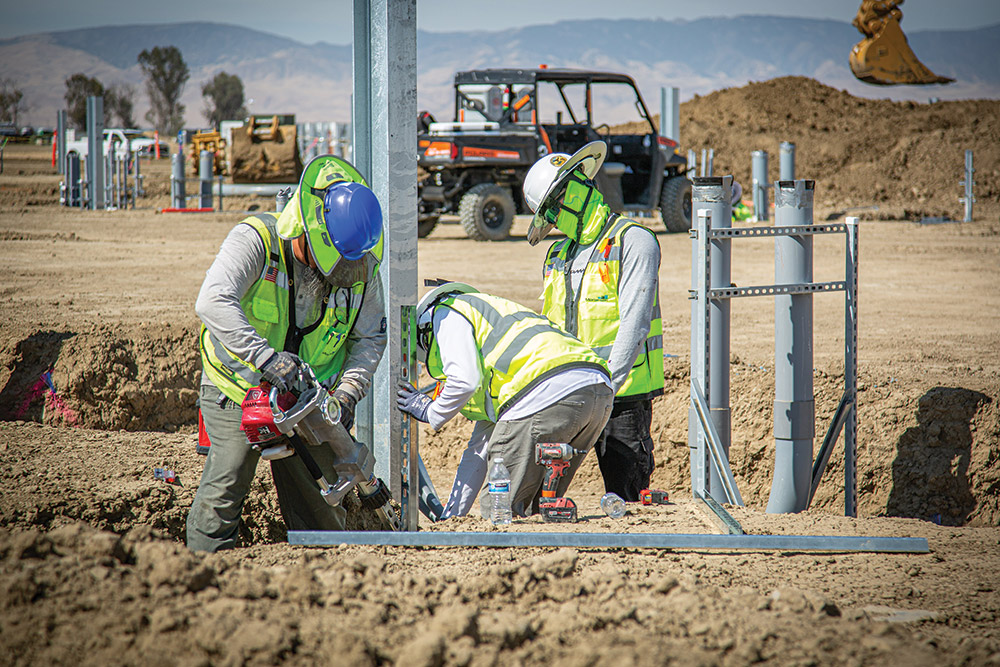
In Fresno County, Calif., construction proceeds on the Darden Clean Energy Center, which is set to be a combined 1.15-GW solar energy plant and up to 4.6-GW battery storage facility, one of the largest in the state and expected to finish by early 2029
Photo courtesy IPX
Load Growth
Rapid scaling over the last five years has produced more than 40 GW of installed storage capacity, with about 48% co-located with solar arrays.
Major energy storage ventures set for 2026 commercial operation include two in Texas—Lunis Creek, a 621-MW standalone battery project, and Clear Fork Creek, with 600 MW each of solar and battery storage. The state leads among 23 that added solar capacity in the first quarter, with 830 MW, according to S&P Global data. In addition to its strong solar resources, Texas “has low regulatory friction and is experiencing very high load growth,” says John Murray, an S&P Global principal focused on renewable markets.
The Texas grid, run mostly by state power entity ERCOT, has scaled storage to more than 14 GW. Batteries supplied a record 20% of evening electricity demand on March 13, while solar generation reached a record 34.427 GW on May 13 and nearly surpassed that on July 9 with 35.425 GW of solar power, says the solar energy trade group.
“The fact that a project of this scale is being built in Arkansas speaks volumes about America's growing demand for electricity. Utility-scale solar and battery storage have reached an inflection point.”
—Kevin Smith, CEO, Cypress Creek Energy
California also is an active region, with expensive peak-hour power, frequent energy emergencies, large land areas, and a target of 100% zero-carbon energy generation by 2045. The California Energy Commission projects 52,000 MW of battery storage will be needed by that year. As of 2026, California grid operator CAISO has installed more than 15.7 GW of utility-scale battery storage.
Among its landmark solar-storage projects are Edwards & Sanborn, an 875-MW facility in Kern County that came on line in 2024, with a 3.29-MWh battery storage system that uses large banks of Tesla Megapacks and LG Chem batteries. Built by veteran sector contractor Mortenson Construction, it was the world’s largest combined-capacity facility of its kind at the time and involved more than 2,200 site employees. The contractor now is embarking on a larger state effort, the 1.15-GW Darden solar mega-facility in Fresno County, with a 4.6-GWh battery system.
Google acquired project developer Intersect and its development unit, IPX, for $4.75 billion in December 2025 to build off-grid energy parks that combine wind, solar, batteries and modular gas generation that will be co-located with data centers.
“[Energy parks] are the right tool for the job and feature an all-of-the-above energy strategy,” Intersect founder and CEO Sheldon Kimber said at a recent Reuters conference. “These plants are also designed to grow and change with the generation technology over time as batteries become cheaper, potentially reducing the hours that the gas must run.” The deal involves buying only Intersect’s development capabilities, rather than existing operating assets, which are set to be spun off as a separate company. The strategy appears to signal a shift toward more vertical integration between customer and builder, Caroline Golin, Google former global head of energy, said on a podcast early this year.
According to IPX, Darden will also include a project substation, a 500-kV transmission line to tie into the existing PG&E Los Banos-Midway #2 transmission line, and a new 500-kV utility switchyard, all to be built on about 9,500 acres viewed as water-constrained, retired farmland. IPX said its pipeline of large solar and battery storage projects also includes Athos and Oberon, operating in California, and Lumina and Radian in Texas. "IPX customers include some of the nation’s largest energy users and clean energy investors, including utilities, community choice aggregators, large corporate buyers, and energy service providers," the developer said.
'Opt-In' Fast-Track Approval
With the state’s clean energy mandates in mind, the California Energy Commission enabled Darden to be the first project to bypass standard local approvals through its Opt-In Certification program, which has a strict 270-day timeline for environmental review and community input, except in specific circumstances.
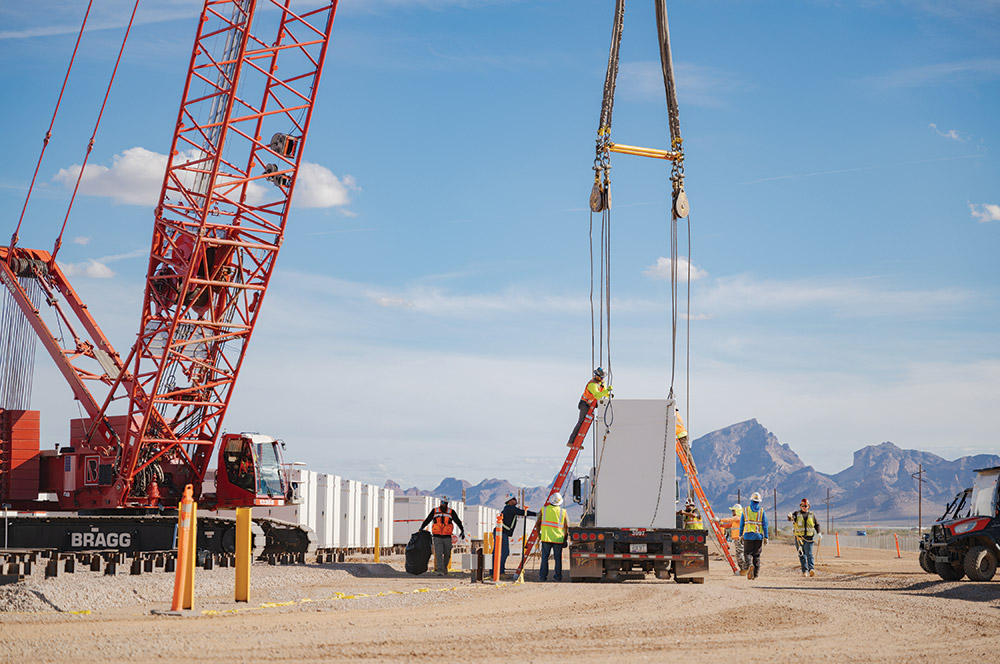
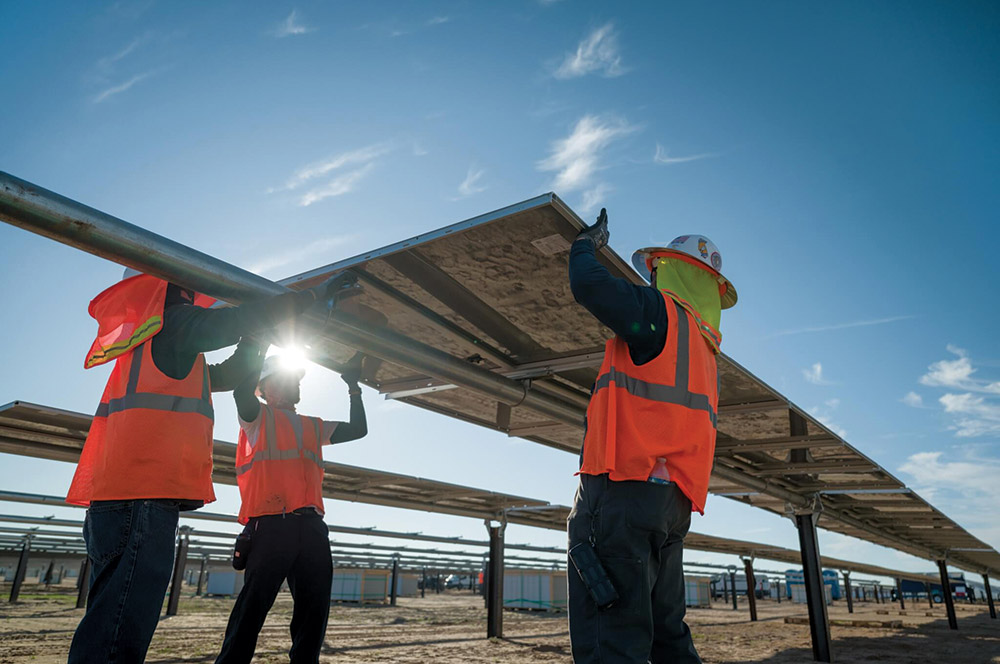
SOLV Energy solar power site (left) and Arevon Energy solar development are among projects in a sector described as the fastest-growing source of new U.S. generation by the U.S. Energy Information Administration.
Photos courtesy of SOLV Energy and Arevon Energy
Darden gained state energy commission approval in June 2025—with two other projects, a battery storage and a solar-plus-storage facility, approved in 2026. Two other projects are being reviewed, and four more are in the filing stage. They represent more than 2.6 GW of generating capacity and about 5 GW of storage “approved or under consideration,” says Stacey Shepard, a commission senior information officer. “We've demonstrated that projects can move through a comprehensive environmental review process while still receiving timely decisions,” as well as considering needs of both developers and communities.
While the streamlined process can speed the path to construction, “success requires significant upfront engineering, detailed environmental and technical analyses, and close coordination with regulatory agencies,” said a social media post by Lexi Beebe, civil engineering manager for Coffman Engineers, which supported permitting and engineering for the 400-MW/3.2-GWh Potentia-Viridi battery storage project in Alameda County, approved in May and set to start construction next year. She also noted a “greater level of design development and documentation required at the application stage.”
Mortenson declined to specifically comment on Darden construction, but the firm "is committed to investing upwards of $67 million toward local procurement, creating major opportunities for small businesses across the region," it says on its website, and along with IPX and the Fresno Area Hispanic Foundation, launched a small business grant and technical assistance program.
Related to solar-plus-storage projects, they "introduce added considerations around charging strategies, discharge schedules, interconnection capacity, market participation, curtailment management, equipment sizing, controls architecture and long-term operating goals, says Kevin Boyce, the contractor's energy storage vice president. “When storage is in the mix, design decisions made early in development have a larger impact on lifetime project performance, making integrated, value-driven design one of the highest-leverage things an EPC can bring to the table,” he contends.
Battery storage “concentrates enormous power density into a fraction of a solar-only footprint, compressing laydown, access and site logistics from day one,” he adds. “That density drives a tightly choreographed underground sequence where medium-voltage, direct current, controls, communications, grounding and fire alarm systems must be layered in the right order, since rework beneath finished battery pads isn't an option.”
According to Boyce, the Edwards & Sanborn site “reinforced the importance of designing for commissioning and long-term operations, not simply construction completion.” To boost its capabilities, Mortenson in April acquired California-based Nor-Cal Controls, which specializes in energy management control systems for solar, battery energy storage and microgrid applications.
More storage is planned in other large U.S. transmission regions such as PJM Interconnection, Midcontinent Independent System Operator and Southwest Power Pool, with one 200-MW battery project near Columbus, Ohio, set to be PJM’s largest when in service next spring. The grid, which covers 13 states, needs to build at least 16 GW of storage by 2032 to meet demand, mostly from data centers, and reliability, said sector economic analyst The Brattle Group in a 2025 review,
But notes Solar Energy Industries Association in its tracking of first-quarter storage growth, 13 states now have explicit energy storage targets, and 71% of utility scale installation is in states won by President Donald Trump.
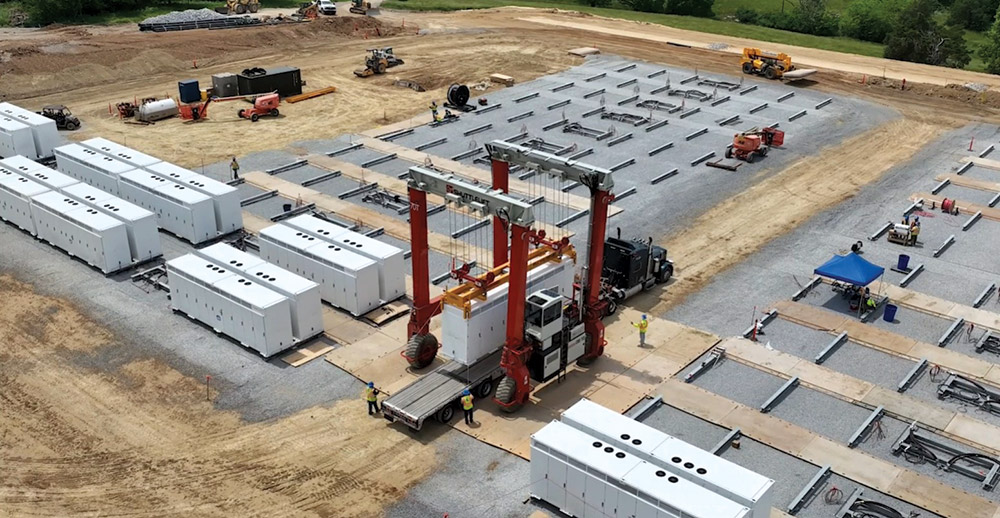
Use of gantry crane at energy storage site provides Burns & McDonnell team with more flexibility when navigating constrained sites and installing heavier battery enclosures.
Photo courtesy Burns & McDonnell
Regional Giant
In Arkansas, construction has begun on the estimated $4.5-billion Steel River Energy Center, advancing what is set to be one of the nation's largest solar-plus-storage projects. The three-phase development by Cypress Creek Energy, which broke ground July 14, will deliver 2.5 GW of direct current solar generation paired with 2.9 GWh of battery storage by 2029 on about 15,000 to 17,000 acres in Mississippi County.
The first two phases underway will provide 1.6 GW of solar generation and 1.9 GWh of battery storage, with Florida-based Moss as EPC contractor and an estimated 700 construction jobs set. Development accelerated after Cypress Creek acquired the project in March and closed last month on $3.5 billion to support the phases' construction and long-term operation. Phase three financing is expected in early 2027 with final completion in 2029, according to CEO Smith.
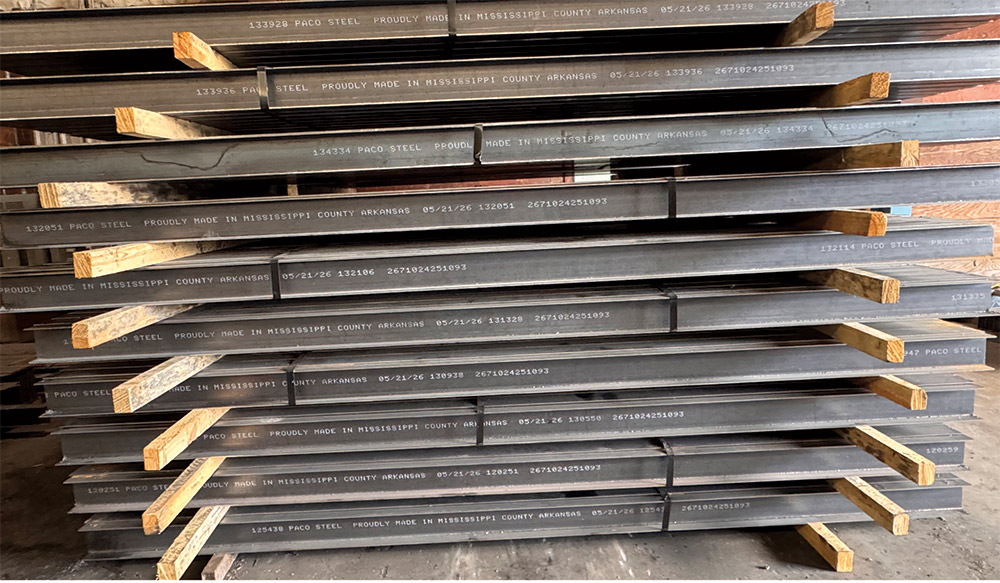
With federal domestic-supply mandates in place, the project is being built using more than 400,000 structural steel foundation piles manufactured by PACO Steel in Blytheville, Ark., from more than 142,000 tons of steel coils produced at a U.S. Steel mill nearby. The piles will support NextPower solar trackers fitted with photovoltaic modules made by U.S.-based First Solar, while LG Energy Solution Vertech is supplying battery energy storage systems assembled domestically using mostly U.S.-produced cells.
Google has signed a virtual power purchase agreement for the first two phases, making Steel River the largest solar-and-storage project in its global portfolio. In addition to serving company operations, “the investment supplies the grid at large and passes along the benefits from the local power plant to all customers in Arkansas,” Will Conkling, Google head of data center energy, told the Financial Times.
“Solar array delivers low-cost energy, while the battery enables participation in capacity markets, enhances resource adequacy and provides operating flexibility needed to respond to changing system conditions over the life of the project,” Smith told ENR. Steel River would boost the regional grid to support large power users such as steelmakers and data centers. “The fact that a project of this scale is being built in Arkansas speaks volumes about America's growing demand for electricity,” he said. Smith added that being able to control power discharge timing “can better align generation with periods of higher demand and higher energy prices,” which “increases the overall value of the solar asset while also improving grid reliability and operational flexibility … to respond to changing conditions and evolving market opportunities.”
The $4.5-billion Steel River Energy Center, which broke ground in Arkansas on July 14, is set to be one of the largest U.S. solar-plus-storage projects. It will have more than 400,000 steel piles using material made in a nearby U.S. Steel plant.
Photo courtesy Cypress Creek Energy
Changing Parameters
As energy density increases, battery enclosures continue to become much heavier, with some containers now exceeding 50 tons. Burns & McDonnell has implemented use of gantry cranes, which provide added flexibility when navigating constrained sites. It also is developing in-house solar grading tools, powered by proprietary Python algorithms, which help optimize terrain following tracker layouts across complex sites. “These tools allow our engineers to minimize grading and site disturbance while improving constructability and reducing overall project costs,” says Tucker. But planning also is complicated by longer lead times for critical equipment, such as two years for large main power transformers and three years for high voltage breakers.
Other builders are adapting to take better advantage of the growing market, such as San Diego-based SOLV Energy, which raised about $589 million from an initial public offering in February and achieved a nearly $6-billion company valuation. Among its major projects is a 1.2-GW multiphase facility in Arizona featuring solar generation, battery storage and supervisory control and data acquisition (SCADA) infrastructure that is the largest in its history, and a 1.15-GW effort in Texas with solar generation, substations and grid infrastructure and systems. The firm declined to identify projects by name or client.
As its solar project sizes grow, SOLV Energy CEO George Hershman points to the firm's ability to manage throughout their lifecycle, including O&M, high-voltage testing, engineering and performance optimization. The company now supports nearly 22 GW of operating solar and energy storage assets across 155 U.S. sites.
“The pace of change has been extraordinary, and the most significant changes have been due to the increase in scale,” says Jesse Jackson, SOLV Energy vice president of energy storage. “We routinely design and construct projects that exceed 500 megawatts of solar paired with 2,000 megawatt-hours or more of storage, and the industry is increasingly seeing gigawatt-hour battery plants under development. The sheer physical scale changes almost every discipline: civil and electrical design along with construction and commissioning sequencing.”
Longer Duration
While most U.S. batteries having just four-hour power storage, the first longer-duration facility at scale has emerged at a project for California Community Power, a consortium of local nonprofit power providers and developer Rev Renewables. On June 1, the Tumbleweed project in Kern County became the first major facility that can discharge power for up to eight hours.
“As the first eight-hour long duration energy storage project developed under the California Public Utilities Commission’s Integrated Resource Plan procurement requirements, Tumbleweed demonstrates how forward-looking policy can most affordably accelerate deployment of the next generation of grid infrastructure,” said Leuwam Tesfai, its executive director, in a statement.
Mortenson was hired to double a four-hour, 125 MW/500 MWh storage site adjacent to solar projects completed in mid-2024, turning the facility into an eight-hour, 1-GWh battery and meeting a state deadline just as it was extended to 2031. The contractor doubled the number of battery containers on site without increasing megawatt capacity. “The transition toward higher-density battery systems, longer-duration storage configurations and more sophisticated energy management platforms has been particularly impactful,” says Mortenson's Boyce.
While lithium-ion batteries remain dominant, issues with them as a storage site fire risk escalated with the 2025 blaze at the 750-MW Moss Landing facility in San Jose that destroyed a 300-MW array with an older, less stable technology. While the incident cause is still not determined, the Darden site will use a design set to limit fire spread, a spokesperson previously told ENR, while a detailed fire safety analysis was a key part of its Opt-In approval, an energy commission spokesperson says.
Thermal management design is a “consequential decision for long-term battery performance,” says SOLV Energy's Jackson. “Fire safety and emergency response must be treated as first-order design requirements, not code compliance exercises.” He says lithium-ion batteries work best in a relatively narrow temperature range, "and cells that operate at elevated temperatures, even temporarily, degrade faster and are at greater risk of thermal runaway." An alternative process that depends on sodium ions to carry an electrical charge "is advancing rapidly and deserves serious attention from anyone making technology selection decisions today," he says, although Jackson cautions that manufacturing advances “do not automatically translate into better project performance.”
Capturing innovation benefits requires “integrating those advances into a coherent system design and project execution, and that … is where outcomes are won or lost.” He emphasizes that control system engineering “is sophisticated, proprietary, and rarely discussed publicly.” SOLV Energy has made the strategic decision to develop “its own proprietary [energy management system] solution rather than rely solely on third-party platforms,” Jackson says. In some cases, its installation of a technology at utility scale “involves a system architecture that had no prior field reference,” he notes. “We were writing the playbook in real time.”
Drone-based thermal imaging “can cover thousands of acres in a single day and produce point cloud data used to verify pre and post construction conditions” before commercial operation, Jackson contends. “At the scale of a 500 MW+ project spanning thousands of acres, variability is the enemy of schedule, quality and safety."
Looking ahead, “AI and advanced analytics will help teams improve scheduling, logistics planning, risk identification and operational optimization,” says Boyce. “The goal is not replacing expertise. It's allowing experienced teams to make better decisions faster.” Jackson emphasizes the training complexities on a timeline “measured in years, not months, and the scale of investment needed to build it across trade apprenticeship programs, technical training curriculum and the instructor base to deliver [it] at scale.”
He adds that “policymakers need to understand that deployment timelines are determined not just by permitting and financing that tend to receive the most attention, but also by physical supply chains and workforce pipelines that have their own multi-year lead times and cannot be accelerated by political will alone.”
Cypress Energy CEO Smith is hopeful that the Steel River Energy Center project demonstrates “that utility-scale solar and battery storage have reached an inflection point” and that policy makers and institutional investors “no longer view them as renewable energy technologies, but as infrastructure capable of delivering affordable electricity, rapid deployment and reliable capacity needed to power America's next era of economic growth.”


Bryan Gottlieb is the online editor at Engineering News-Record (ENR).
Gottlieb is a five-time Society of Professional Journalists Excellence in Journalism award winner with more than a decade of experience covering business, construction and community issues, including finance, law and real estate. He has reported for Adweek and the San Diego Daily Transcript and led a community newsroom in Santa Monica, Calif. He served as editor-in-chief of the Detroit Metro Times and as managing editor at Roofing Contractor, where he helped shape national industry coverage. At Engineering News-Record, Gottlieb covers breaking news, large-scale infrastructure and megaprojects, regulatory developments and business trends across the U.S. and global construction sectors.
email: gottliebb@enr.com | office: (248) 786-1591