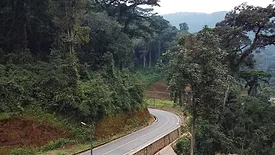
Traveling between Pindura, a town deep in the Republic of Rwanda’s Nyungwe Primary Forest, and Bweyeye, another village in the western part of the country, usually involved a multi-hour trip along steep hillsides on a winding dirt road.
With completion of the Kanawha River Bridge in August 2024, the team constructed dual three-span plate girder bridges, each with a 562-ft main span, creating the longest steel plate girder span bridge river crossing in the U.S.
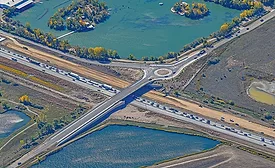
Scope for this progressive design-build effort included reconstruction of 14.5 miles of I-25 and a buffer-separated tolled express lane with 12-ft inside and outside shoulders in each direction.
Two long-span steel structures—the Lake Fork Bridge and the Blue Mesa Middle Bridge—each carry two lanes of US 50 traffic over the Blue Mesa Reservoir, but each structure had three fracture critical spans consisting of two continuous welded steel plate girders.
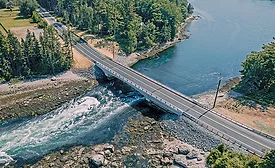
Community engagement played a key role in shaping the $9.6-million strategy to replace the picturesque, yet deteriorating concrete tied-arch bridge spanning the reversing falls across Salt Pond that lead to the Atlantic Ocean.
The $82-million project replaced a severely deteriorated 1920s-era through-truss bridge with a 2,087-ft-long, six-span structure designed to serve this key border crossing for at least 100 years.
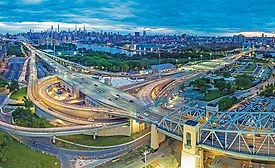
The $108-million project enhances multimodal access to Randall’s Island recreational amenities by replacing aging infrastructure with two new vehicular ramps that eliminate substandard left-hand merges and reduce congestion.
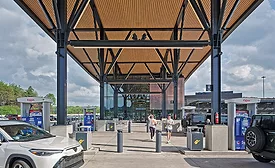
The project redefined the standard for toll corridor service facilities by transforming three traditional roadside travel plazas along the 88-mile West Virginia Turnpike into integrated, hospitality-driven destinations.
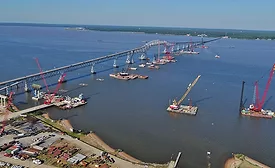
The $463-million project replaced an aging 1.9-mile Potomac River crossing with a new structure featuring long-span prestressed concrete girders on the approaches and steel plate girders over the navigation channel.
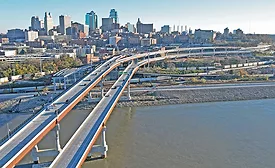
Composed of twin span girder bridges, the $219-million Buck O’Neil Bridge replaced a functionally obsolete structure that was first built in 1956, providing a vital pathway in and out of downtown Kansas City.