ENR 2025 Global Best Projects
Best Project, Road/Highway: Pindura-Bweyeye Road
Cutting travel time in western Rwanda
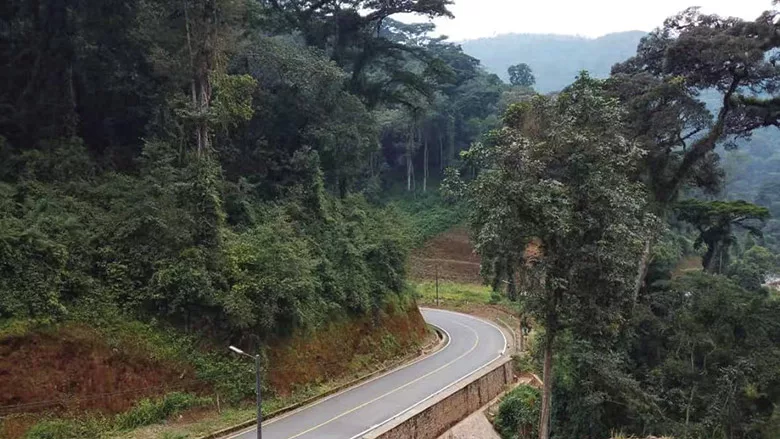
The contractor adjusted the proportion of large aggregates in the road asphalt mix for ideal long-distance travel.
Pindura-Bweyeye Road
Rusizi, Rwanda
Best Project, Road/Highway
Submitted by China Road and Bridge Corp.
Owner: Rwanda Transport Development Agency
Lead Design Firm, Contractor and Structural Engineer: China Road and Bridge Corp.
Traveling between Pindura, a town deep in the Republic of Rwanda’s Nyungwe Primary Forest, and Bweyeye, another village in the western part of the country, usually involved a multi-hour trip along steep hillsides on a winding dirt road. To improve access for farmers and tourists, the Rwandan government hired China Road and Bridge Corp. to transform the 32-km road connecting the two towns into a safer and more swiftly traveled two-lane highway.
Ultimately, the $35-million project transformed a difficult rural road into a modern, paved connector with bridges, culverts and drainage. Upgrading this vital link for Bweyeye has benefited many people. Resident John Claude Muhizi informed the Rwanda Transportation Development Agency that he can now reach the Pindura main road in one hour to “get to the markets quickly and bring back goods without worry.” Alice Muhorakeye, a potato grower in the town, told the agency the road “has changed everything for us in terms of our livelihood, as farmers [and] produce are now reaching the market faster and safely ... at a much lower cost.”

Photo courtesy China Road and Bridge Corp.
China Road and Bridge enhanced capacity and performance of the surface pavement by adjusting the asphalt mix ratio, increasing the proportion of large aggregates [from the traditional 30% to 35%] and fine-tuning the compaction, equipment and temperature for long-distance transportation. To reduce any environmental impact, temporary camps used solar power and recycled rainwater through a collection system.
The collaboration between engineers from China and Rwanda provided challenges and opportunities, but multilingual collaboration platforms helped smooth communication.
To make work safer amid heavy rainfalls and dramatic temperature changes, all workers were equipped with personal protective equipment and covered by project-wide health insurance. Two health clinics were set up at the jobsite, and workers received regular checkups.
Looking for quick answers on construction and engineering topics?
Try Ask ENR, our new smart AI search tool.
Ask ENR →