WSP Gets Ready to Tackle the Southeast's Biggest Infrastructure Challenges
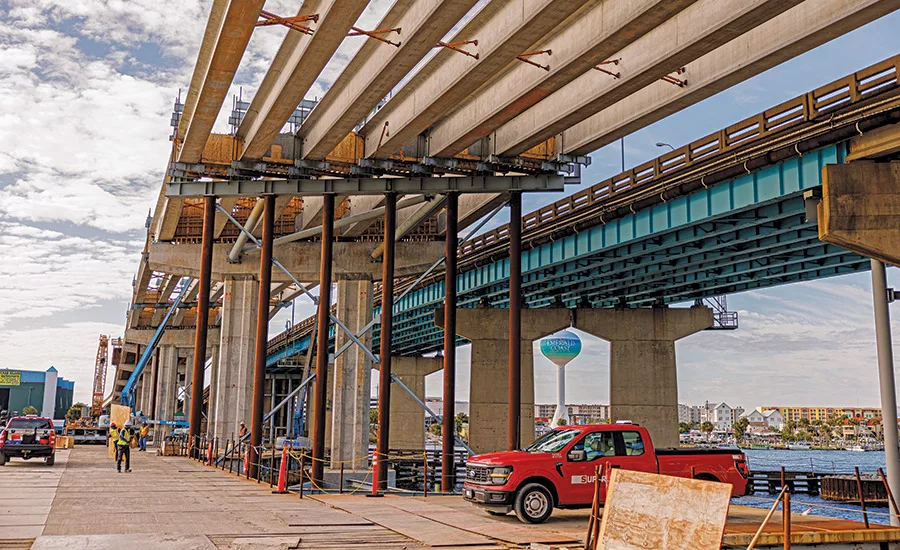
WSP and Superior Construction are delivering the John T. Brooks Bridge replacement in Fort Walton Beach, Fla/. for the state Dept. of Transportation.
Over the last five years, Montreal-based engineering firm WSP has grown through notable strategic acquisitions that have expanded business lines and its geographic footprint. Its purchase of the environment and infrastructure business of John Wood Group plc in 2022 and its acquisition of power and energy sector heavyweight TRC Cos. earlier this year indicate more growth lies ahead.
Numbers bear out the merits of those additions. ENR’s 2026 Top 500 Design Firms List shows WSP total annual revenue more than doubling—from $2.3 billion in 2022 to nearly $5.1 billion reported for 2025, with the firm ranking at No. 4 overall.
Revenue across ENR’s Texas & Southeast region also has climbed, from $542 million reported in 2021 to its 2025 total of $1.185 billion, securing WSP the No. 2 ranking on this year’s regional Top Design Firms list.
The acquisition of Wood Group and its approximately 6,000 employees was especially impactful for the Southeast, significantly bolstering WSP’s footprint in Florida, Georgia and the Carolinas.
At the time of the purchase, WSP President and CEO Alexandre L’Heureux said the move would “contribute to the achievement of our strategic ambitions while expanding our geographical range and adding expertise in key sectors. This will create even greater momentum as we future-proof our cities and our environment.”
WSP’s broad expertise is showing up across a diverse range of projects—and keeping the firm more than busy. Its work includes raw water supply wellfield and injection well systems in an effort to deliver alternative water sources in Polk County, Fla.; delivering meteorological guidance to the Georgia Dept. of Transportation; helping to create living shorelines in Apalachicola Bay; designing and delivering a shore power system at PortMiami; and serving as lead designer to the Superior-Lane JV team constructing Florida DOT’s approximately $1-billion Westshore Interchange project, among others.

To expand Hartsfield-Jackson’s Concourse D, the project team is employing 19 large-scale modules for the new structures.
Photo courtesy WSP
Staying Hot in the Southeast
The Atlanta construction market is increasingly keeping WSP active. Since 2019, the firm has served as general engineering consultant on Georgia’s $1.25-billion I-285 at I-20 West Interchange project, which started construction in 2025. The project will reconstruct and widen several interstate system-to-system ramps at the I-285/I-20 interchange and add auxiliary lanes along I-20 west and I-285 north of the interchange, among other improvements.
Top among its current Atlanta-area contracts is in leading the Atlanta Aviation Associates program management joint venture effort to deliver the $11.6-billion ATLNext program that will modernize Hartsfield-Jackson Atlanta International Airport. WSP provides program/project management support, quality management, safety oversight, constructibility reviews and supplier diversity outreach, among other tasks.
Contained within that program is the $1.4-billion expansion of the airport's Concourse D, for which WSP reports that the CM at-risk joint venture of Holder Construction Group, C.D. Moody Construction Co., Bryson Constructors and Sovereign Construction and Development is building a total of 19 modular construction units and moving them more than 1 mile across two runways to grow the concourse from 60 to 99 ft wide and extend its length by 288 ft.
“Given the scale and visibility of the Concourse D project, WSP’s role goes far beyond traditional program management,” says Edmund Ramos, WSP vice president for aviation delivery and the project’s deputy program director. “Our main contribution is helping the airport balance heavy construction with daily operational demands.”
Regarding the sprawling work at Hartsfield and other major projects, Claudia M. Bilotto, WSP Atlanta-based Southeast region executive, says, “Part of leading a big job is you have to be able to administer a big job—and have the infrastructure to do that. We have a lot of very experienced project managers who have done big jobs before but we also have the infrastructure to support them.”
The firm’s ability to provide clients a wide variety of services is key, Bilotto adds.
“We have clients like Amazon for which we’re able to provide [data center] services from site location, due diligence and civil work all the way to engineering of the facility,” she says. “Being able to provide a full suite of services to clients is a critical part of our growth strategy, and it’s been really effective.”
“Being able to provide a full suite of services to clients is a critical part of our growth strategy.”
—Claudia Bilotto, Southeast Region Executive, WSP
Another notable Atlanta project for WSP is the Stitch, described as a “transformational civic infrastructure investment” that will create approximately 17 acres of community park space atop a ¾-mile-long platform spanning the Downtown Connector between Ted Turner Drive and Piedmont Avenue, among other features.
While also noting WSP’s considerable environmental and resilience work, Bilotto adds, “What I’m really excited about is the sheer breadth that we cover across the Southeast. In this area of the country, we have some of the most exciting projects just because of the growth—and we’re also a firm that’s able to be engaged in those projects in many different ways.”
Work in Florida that is especially of note includes the estimated $1-billion Westshore Interchange project, considered Tampa’s largest-ever highway construction contract. Joint-venture partners Superior Construction and The Lane Construction Corp. engaged WSP as lead designer for the phased design-build projec. It will add capacity in general-use and tolled express lanes, upgrade the east end of I-275 at the Howard Frankland Bridge, replace an existing loop ramp and construct new direct connectors to and from Tampa International Airport.
In the phased design-build approach, the joint venture team will work collaboratively with Florida Dept. of Transportation to refine the design, with work packages incorporated into the project in phases as design progresses. Through this type of procurement—the first of its kind for a major transportation initiative in Florida—WSP will enable better stakeholder collaboration to produce innovation and optimized design.
Notably, WSP has a history of working with Superior Construction, including as lead design firm on the $171-million, 2,111-ft-long John T. Brooks Bridge over Santa Rosa Sound, currently under construction in Fort Walton Beach, Fla.
Evan Lawrence, Superior construction project manager, notes that in addition to WSP’s excellent communication with the project team, its work on the Brooks Bridge indicates "problem-solving ability that is second to none because [the firm] is such a big resource.”
He adds: “A lot of engineers understand what it looks like on paper, but they don’t know what it looks like in the field. WSP just truly understands how we have to build. It’s a more agreeable approach where [both parties know] we’re going to have cost overruns, we’re going to have issues on the job, but let’s work through them. There’s never any pointing fingers.”

The Apalachicola Bay Living Shoreline/Franklin 98 project aims to bolster the resilience of 6 miles of Florida Highway 98.
Photo courtesy WSP
Attracting, Keeping Talent
Another notable acquisition of sorts took place this past April, when WSP announced that Katus Watson joined the firm as its U.S. chief operating officer. A Jacobs executive for the past eight years, he most recently served as its executive vice president and general manager for the Canada and U.S. East region. In his new role, Watson—based in Tampa—oversees operational performance.
Watson sees plenty of opportunity for growth while addressing significant challenges. While noting the “high caliber of [WSP] leadership and the strength of its talent” in an interview with ENR, he said, “the opportunity to embrace a future-ready mindset—building for the future—was one of the things that brought me to WSP.”

“The opportunity to embrace a future-ready mindset ... was one of the things that brought me to WSP.”
—Katus Watson, Chief Operating Officer, WSP
While recognizing significant ongoing demand for major improvements across all types of infrastructure systems as a “big problem for us to solve,” Watson sees his new firm ready to address the challenges.
“WSP is pretty well poised to address all of these issues, whether it’s transportation, energy transition ... data centers, environmental remediation, sustainability and defense,” he says. “We have the depth, the talent and the skill sets to help address all of these challenges.”
To that end, WSP describes its developing professionals network that enables employees to be “surrounded by experienced mentors, participate in cutting-edge projects and build a strong foundation for a successful career.”
Richard Sinz Lopez, a civil engineering consultant in WSP’s Atlanta office, notes the network benefits. It "allows you to really see and find those opportunities if you’re looking for them,” he says, adding that WSP’s size and scale can provide a seamless transition to a new venture.
In looking for his first position after graduating from college six years ago, Sinz Lopez says “What really sold me was the structure and career opportunities pitched to me back then that were so evident.”
Since then, after seeing what similar programs are being offered by other companies, “I really came to realize that no other one has developed a young professionals network as robust, well-organized, well-structured as this one," says Sinz Lopez.
With WSP’s broad focus on solving big infrastructure challenges of today, keeping its employees engaged like this certainly can’t hurt.
