2025 East Best Projects
Best Highway/Bridge: Madawaska-Edmunston International Bridge Replacement
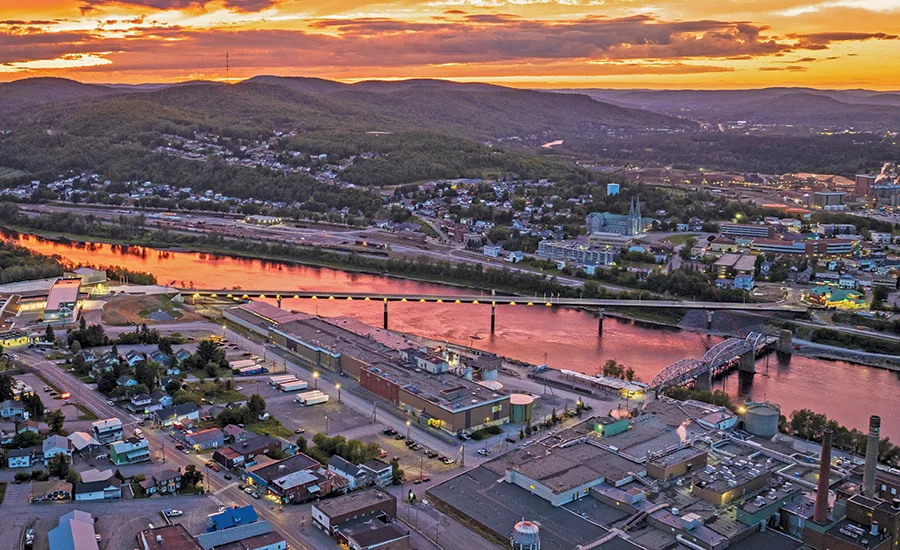
Madawaska-Edmunston International Bridge Replacement
Madawaska, Maine
BEST PROJECT
Submitted by HNTB Corp.
Owner: Maine Dept. of Transportation/New Brunswick Dept. of Transportation and Infrastructure
Lead Design Firm: HNTB Corp.
General Contractor: Reed and Reed
Geotechnical Engineer: GZA GeoEnvironmental
The $82-million project replaced a severely deteriorated 1920s-era through-truss bridge with a 2,087-ft-long, six-span structure designed to serve this key border crossing for at least 100 years. Constructed on a new alignment upstream from the original bridge, the new structure features 12-ft vehicle travel lanes, shoulders and a raised 6-ft-wide sidewalk that accommodates pedestrians, cyclists, ATVs and snowmobiles. Weathering steel, stainless-steel rebar and LED lighting further extend the bridge’s expected lifespan while reducing maintenance costs. Skewed abutments and flared bridge ends align with adjacent border facility geometries, improving vehicle flow and security sightlines. The design also incorporates community feedback on aesthetic features, including decorative railings and lighting that reflects local identity.
Delivering the new bridge on time and at budget required overcoming a convergence of challenges rarely encountered in bridge construction—from satisfying two nations’ wage, labor, tax and environmental laws to concurrent construction of new port-of-entry facilities on both sides of the river. A variety of advanced modeling tools validated the design’s complex geometry and construction phasing, while a parametric study ensured compliance with both U.S. and Canadian bridge design codes, eliminating redundant calculations and reducing permitting complexities.
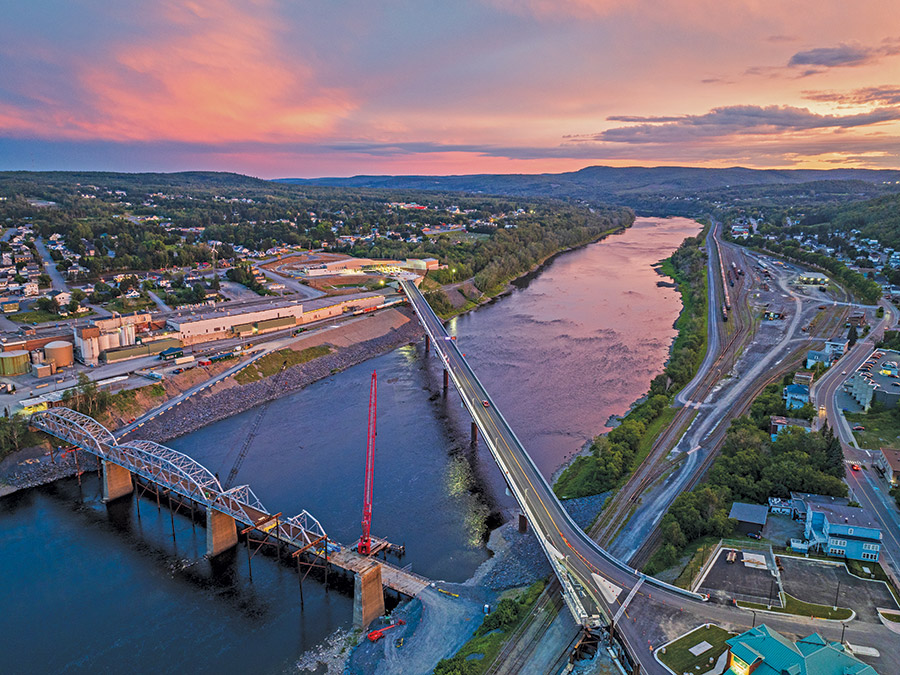
Photo by Deschaine Digital, courtesy of HNTB Corp.
The steep river valley’s complex topography required five foundation types, each tailored to geotechnical and access constraints. Permanent steel casings eliminated the need for temporary formwork during construction, and they provide long-term protection against ice flows. Heavily fluctuating water levels during construction complicated equipment access and construction sequencing. Wintertime work required crews to dismantle and reassemble trestles to prevent ice jams and flooding.
To project the project from pandemic-related supply chain volatility during the design phase, the Maine Dept. of Transportation proactively included its first-ever steel price escalation clause in the construction contract.


