History
From the Archives: June 26, 1969


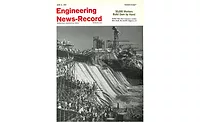
This 1969 image depicts a 12-story concrete core for an office building in Vancouver, Canada, that was one of the earliest examples of top-down construction.
The steel frames of each 108-sq-ft floor were assembled at ground level, and hoisted into position using steel cables slung over concrete arches on the building’s crown.
The six sets of cables carried the perimeter weight of the floors, which extend 36 ft out from the core. The combined weight of the floors has a prestressing effect on the core, adding to the building’s resistance to earthquakes, an important requirement since Vancouver is in a seismically active zone.
The structural concept, developed by engineers Bogue Batik & Associates and architects Rhone & Iredale, both of Vancouver, reportedly saved 15% in structural costs over a conventional steel frame building.
The core rises from a 56-sq-ft concrete slab that is 6 ft thick.
The contractor, Marwell Construction Co., used the slipform method, completing the 270-ft-tall core in 21 days, less than one quarter of the time needed for conventional forming.
It served as the headquarters of the Westcoast Transmission Co. until 2000. In 2005 the building was converted to residential use and is now called the Qube.
Looking for quick answers on construction and engineering topics?
Try Ask ENR, our new smart AI search tool.
Ask ENR →