History
From the Archives: June 20, 1940
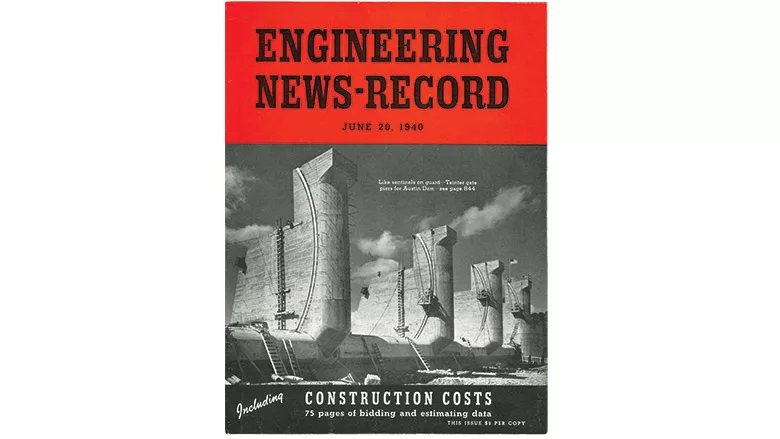
Image from ENR Archives

The monoliths in this 1940 cover image are the Tainter gates of the Austin Dam in Texas, a troubled structure which was undergoing a comprehensive rebuild at the time.
When completed in 1893 it was the largest concrete dam in the world. It failed in 1900, killing several dozen people and leaving the city of Austin without electricity for months. Rebuilt in 1915, it partially failed again that same year.
Methods for stabilizing faulty subsoils and the science of geoengineering had advanced by the time reconstruction commenced in 1938.
A concrete cut-off wall was constructed and extensive grouting was done, rendering the dam foundation relatively impervious to the flow of water. The broken buttresses of the hollow dam were connected and spliced into a new downstream portion and were further supported to prevent sliding.
A new downstream deck was added, all of the buttresses were thoroughly underpinned and piers were built to support nine Tainter gates.
A thick concrete apron was built to prevent future erosion of the rock downstream from the dam. Now named the Tom Miller Dam, it is 100 ft high and 1,590 ft long.
Looking for quick answers on construction and engineering topics?
Try Ask ENR, our new smart AI search tool.
Ask ENR →