Opinion
How to Adjust Your DEI Plan
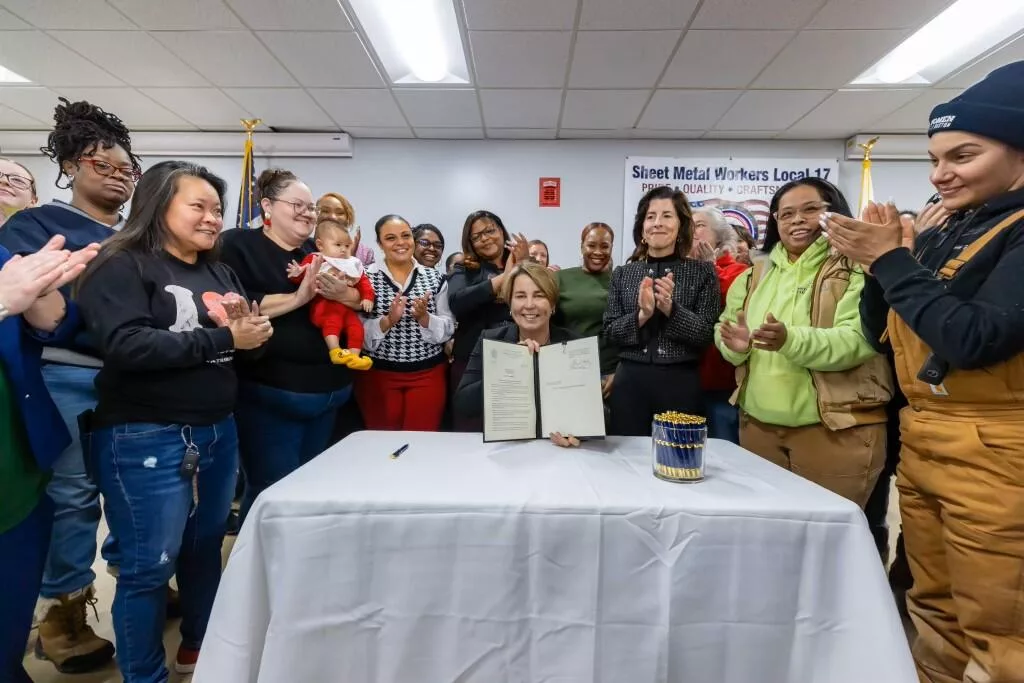
Gov. Maura Healy of Massachusetts signs an executive order promoting diversity in construction.
Credit: Office of the Massachusetts Governor

Kenneth Rubinstein
The changing national debate around diversity, equity and inclusion (DEI) has contractors feeling confused.
President Trump’s Executive Order 14173, mandating federal agencies stop supporting DEI, and subsequent guidance from the U.S. Dept. of Justice and Equal Opportunity Employment Commission, make one thing plain: there will be heightened scrutiny of any contracting program that appears to favor one group over another based on race, gender or other protected characteristics.
At the same time, public owners in states like Massachusetts as well as many private ones, continue to include good-faith participation requirements with measurable criteria in their procurement processes—expecting contractors to demonstrate efforts to include minority-, women-, and veteran-owned businesses on their project teams. Many contractors want to pursue those efforts in their own right. The tension is real, and contractors fear getting caught in the crossfire between these mandatory and seemingly contradictory directives.
There is a path forward, however. Contractors should pivot from emphasizing outcomes to prioritizing engagement. While procurements based solely on protected characteristics—such as race, nationality or gender—may trigger federal scrutiny, it remains entirely permissible to make sincere efforts to broaden participation.
By actively seeking out new and diverse subcontractors and encouraging them to compete, contractors can build more inclusive project teams without running afoul of federal requirements. In fact, replacing rigid set-asides with open, proactive inclusive outreach—grounded in transparent criteria like price, qualifications and experience—allows contractors to align these otherwise conflicting expectations.
Broadening the pool of competing subcontractors not only helps meet state good-faith requirements, it also delivers clear business advantages. A wider field of bidders fosters greater competition, often resulting in more favorable pricing, innovative approaches and improved performance. It also creates meaningful opportunities for underrepresented businesses to demonstrate their capabilities—with the result being a more dynamic and resilient supply chain.
Merit and Competition
Inclusion goals—such as those requiring good-faith efforts to engage businesses owned by minorities, women and veterans—can be pursued without compromising standards for quality, safety or cost, while still allowing businesses outside of protected classes to retain the same fair opportunities for success. When done thoughtfully, efforts to meet hiring and contracting goals should remain grounded in merit while broadening the employment and bidding pool and encouraging healthy competition.
Looking for quick answers on construction and engineering topics?
Try Ask ENR, our new smart AI search tool.
Ask ENR →
Here’s the hard part. Contractors must also place greater emphasis on documentation and transparency. They will need to be able to show that their programs are rooted in neutral outreach, that every subcontractor was evaluated based on merit against the same benchmarks. Bid solicitations, prequalification procedures and training materials should be reviewed to include clear expectations and remove language that could imply preference.
States such as Massachusetts have not backed away from their expectations, and contractors who fail to meet good-faith participation requirements may see impacts in bid evaluations or even face questions of noncompliance. At the same time, federal pressure is real, and noncompliance on that front carries its own risks. This is why contractors need a more thoughtful approach—one that meets the spirit and letter of state-level inclusion goals without violating the evolving federal limits.
This is not an abstract issue—it affects every bid, every public contract and every team assembled to deliver the work. Contractors who get this right will position themselves to avoid legal risk—avoiding enforcement while continuing to meet expectations of public owners and local communities, and the contractor’s own mission of an inclusive workforce and project team. This depends for success on clarity, consistency and attention to detail—but it can be done.
Despite the shifting legal landscape, contractors that navigate this reconciliation thoughtfully will be well-positioned to lead in the next generation of public procurement and to achieve their goals in creating optimal project teams.
Working from Boston, Mass. and Concord, N.H., Kenneth Rubinstein is chair of Preti Flaherty’s Construction Law Practice Group. He can be reached at krubinstein@preti.com.