Government
New York Orders Moratorium on Large Data Center Permits
State is first to implement a full halt on new approvals
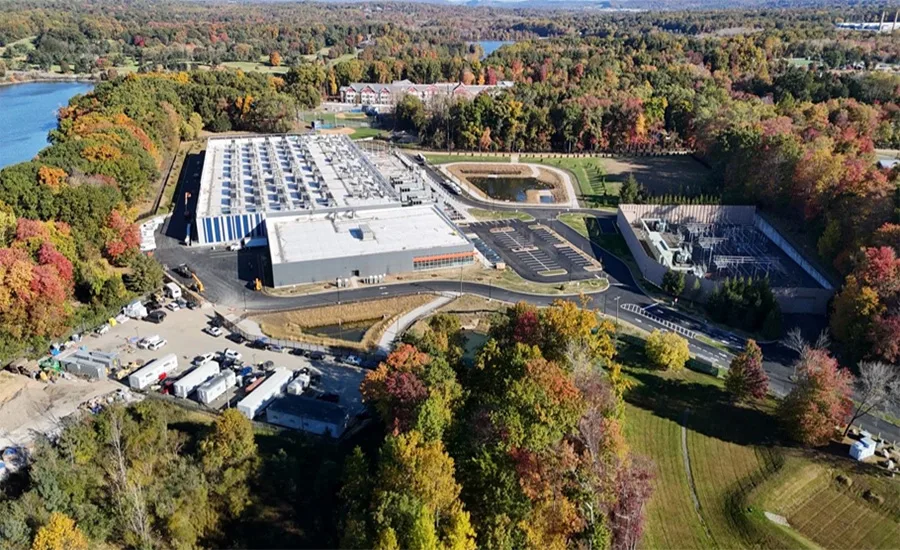
Aerial view of DataBank's LGA3 data center campus in Orangeburg, N.Y., a 20-MW facility that opened in 2025 as demand for AI-driven computing infrastructure accelerated. New York's new executive order pauses certain state environmental permit reviews for qualifying large data centers while regulators develop a statewide framework governing their energy, water and community impacts.
New York Gov. Kathy Hochul on July 14 ordered state regulators to halt action on qualifying environmental permit applications for large data centers while New York develops new statewide standards governing their energy use, water consumption and community impacts.
While several states have flirted with a data center pause, New York is now the first to impose a broad permitting moratorium on the rapidly expanding sector.
The governor's executive order directs the state Dept. of Environmental Conservation to hold in abeyance pending applications for discretionary permits, approvals and licenses that had not been deemed complete before July 14 until the Dept. of Public Service completes a Generic Environmental Impact Statement evaluating the environmental effects of data center construction and operation. The order does not affect permits issued by local governments.
"As data center development threatens to hike up utility bills, deplete our natural resources, and create uncertainty for New Yorkers, it's my responsibility to take action and lead," Hochul said in announcing the order.
The action comes as New York confronts a sharp increase in proposed data center projects driven by artificial intelligence and cloud computing. The executive order says nearly 12 GW of data center load requests were awaiting interconnection in the New York Independent System Operator queue as of May, with more than 8 GW entering the queue during 2025 alone.
Statewide Review Begins
The environmental review process will examine the effects of data center construction and operation on electricity demand, water use and quality, air quality, disadvantaged communities and noise. The state Dept. of Public Service will seek public comment and conduct hearings during this period.
The order directs Empire State Development to publish a community investment framework within 60 days to help communities negotiate with developers over investments in public infrastructure, child care, schools and other local benefits while prioritizing prevailing wage standards, project labor agreements, apprenticeships, workforce development and local hiring.
Looking for quick answers on construction and engineering topics?
Try Ask ENR, our new smart AI search tool.
Ask ENR →
Hochul also directed regulators to develop proposals ensuring large data centers bear the costs of electric grid upgrades needed to serve their operations rather than shifting those costs to utility ratepayers. Among the options under consideration are upfront developer contributions, demand-response participation, support for new clean energy resources and protections against stranded infrastructure investments.
For purposes of the executive order, a covered data center is defined as a facility—or group of facilities on the same or contiguous sites—used for data storage, cloud computing or related digital operations that consume or can consume 50 MW of electricity or more. Facilities primarily used for manufacturing, research, education and medical care are excluded.
The executive order follows passage last month of the Legislature's Responsible Data Center Development Act, which likewise would impose a moratorium on certain permits for new large data centers while establishing utility cost-allocation rules, community benefit requirements and labor standards.
The legislation applies to facilities with a peak electrical demand of 20 MW or more, capturing projects below the executive order's 50-MW threshold.
Industry Warns of Lost Investment
“Grid modernization costs don't disappear when data centers do. They shift onto everyday New Yorkers, who will shoulder a larger share of infrastructure modernization,” said Carlo A. Scissura, president and CEO of the New York Building Congress, arguing that targeted regulation and fair cost allocation would better address the state's concerns than a blanket permitting pause.
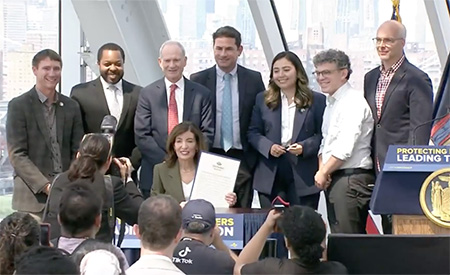
New York Gov. Kathy Hochul signs Executive Order No. 62 on July 14, establishing a moratorium on certain state environmental permit applications for large data centers while agencies develop a statewide regulatory framework addressing energy, water and community impacts.
Screenshot: Office of New York Gov. Kathy Hochul/Livestream
“Halting permits for as much as a year in this fast-moving sector will not simply delay projects—it will send them permanently to Virginia, Texas, Georgia and other states actively competing for these investments,” Mike Elmendorf, president and CEO of Associated General Contractors of New York State, told ENR in an email.
He said New York already has one of the nation's most rigorous environmental review processes and argued regulators should complete the statewide study while continuing to process permit applications rather than suspending them.
The Associated Builders and Contractors likewise opposed the executive order, arguing the pause could undermine U.S. leadership in artificial intelligence and advanced manufacturing.
"Halting their construction would not slow global AI development; it would simply shift investment, talent and innovation elsewhere," said Kristen Swearingen, ABC vice president of government affairs.
Environmental groups generally welcomed the executive order but argued additional regulation may be needed to capture smaller projects below the order's 50-MW threshold.
"The governor's executive order addresses many of the concerns that New Yorkers have regarding data centers, but several facilities are being proposed that use less than 50 MW of maximum grid power," said Eric Wood, senior environmental program coordinator for the New York Public Interest Research Group.
"The state must lead the way to regulate this rapidly expanding industry and consider strengthening regulations to ensure that facilities between 5 and 50 MW don't leave the public footing the bill, the environmental harm, and the nuisances that these centers present," Wood added.

Bryan Gottlieb is the online editor at Engineering News-Record (ENR).
Gottlieb is a five-time Society of Professional Journalists Excellence in Journalism award winner with more than a decade of experience covering business, construction and community issues, including finance, law and real estate. He has reported for Adweek and the San Diego Daily Transcript and led a community newsroom in Santa Monica, Calif. He served as editor-in-chief of the Detroit Metro Times and as managing editor at Roofing Contractor, where he helped shape national industry coverage. At Engineering News-Record, Gottlieb covers breaking news, large-scale infrastructure and megaprojects, regulatory developments and business trends across the U.S. and global construction sectors.
email: gottliebb@enr.com | office: (248) 786-1591