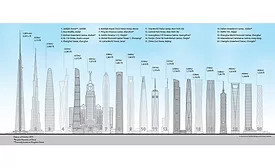
Thanks to problems with elevator-cable girth, weight and sway, supertall-building specialists often get hung up on the ropes when designing towers taller than 500 or 600 meters.
In 2010, when Ronald W. Wackrow was about four months shy of completing the rescue of the troubled 6.5-million-sq-ft Cosmopolitan in Las Vegas, his boss, Related Cos. Chairman Stephen M. Ross, suggested his next assignment: Relocate to the East Coast to steer design and construction of the developer’s 17.5- million-sq-ft Hudson Yards—a 26-acre mini-city primarily sited over the Long Island Railroad yard on the far West Side of Midtown Manhattan.
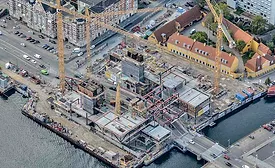
To create Blox’s stacked box profile “hovering over the road,” many trusses are needed to transfer loads around spaces varying from apartments to a 200-seat auditorium.
Various “thought leaders” in the industry have been trying—some would say hitting their heads against the wall—for at least the 37 years that I have been covering buildings (and likely before that), to use technology to streamline, automate and quicken building design and construction.
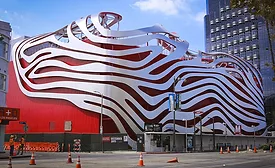
A Los Angeles car museum gets a renovation to match its collection with a cherry-red exterior and 310 distinct metal panels flowing around it like a fluid-dynamics wind-tunnel test.
Located in the heart of the University of Miami’s Coral Gables campus, the Frost Music Studios project is part of a $61.5-million master plan that will nearly double the school’s space while preserving its historically significant architectural elements.
Having recently reached a height of 113 meters, the contender for the title of the world’s tallest building is slowly growing up in Jeddah, Saudi Arabia.
 RSS
RSS