Transportation
New Panama Canal Chief Takes on Next Wave of Megaprojects
June 24, 2026
Transportation
New Panama Canal Chief Takes on Next Wave of Megaprojects
June 24, 2026
Related Links:
June 23, 2026: Water Conservation Meets Geopolitics at the Panama Canal
June 23, 2026: Q&A: Panama Canal’s First Woman Administrator Looks Ahead
July 9, 2024: Panama Canal Officials Detail $1.6B Reservoir Project Needed to Bolster Water Supply
July 31, 2023: Severe Drought Prompts Panama Canal Passage Limits
June 15, 2016: Panama Canal Expansion Wraps Up
Ilya Espino de Marotta has spent the last four decades of her life working on the Panama Canal, but it was her time leading the waterway’s $5.4-billion third lane expansion, completed in 2016, that prepared her for the next challenge. In October, Espino de Marotta will become the head of the Panama Canal Authority (Autoridad del Canal de Panamá, or ACP).
As ACP administrator, Espino de Marotta will inherit a canal about to undertake an $8.5-billion-plus capital improvement plan aimed at creating a Trans-Isthmus logistics corridor to complement the historic and heavily used waterway.
"You see a lot of countries want to do land corridors to compete with the Panama Canal," Espino de Marotta says. Mexico’s Tehuantepec interoceanic corridor, which began cargo rail operations in late 2023, and a Guatemalan interoceanic proposal are the most prominent recent examples. "We already have one. We'll just improve it, make it even better."
ACP isn’t going to wait for those projects to catch up. The authority is currently anticipating the qualifying submissions for two projects: a new liquefied petroleum gas pipeline running along the canal route and two new container terminals located at either entrance.
Slightly further out is the $1.6-billion Río Indio reservoir, needed to secure the canal's freshwater supply through the next half-century. That project is under environmental review with hopes to put out for tender in the next year.
Beyond that are plans for an expanded interoceanic land corridor on the west side of the waterway and a green-fuel bunkering hub for ships transiting the canal.
Lessons ACP and Espino de Marotta learned surmounting the challenges of the third-lane expansion are proving invaluable. The structure of the contracts, as well as upfront restrictions on consortium eligibility and clear supply-chain diversity rules all echo successful approaches used in that effort.
Jump To:
An TransIsthmus Energy Corridor
A Pair of New Container Terminals
A New Reservoir to Meet Growing Demand
A Look to the Future
“We are applying what we think will make this a more robust process with less impact to both the contractor or the canal,” Espino de Marotta says.
In truth, the current wave of projects began shortly after the expansion was completed a decade ago. In early 2017, Administrator Jorge Luis Quijano revealed a list of nine items for potential development, and today five of them are currently moving forward. It was, in his words, part of the ongoing evolution of the waterway.
"The canal never stops upgrading itself," Quijano told ENR recently.
An TransIsthmus Energy Corridor
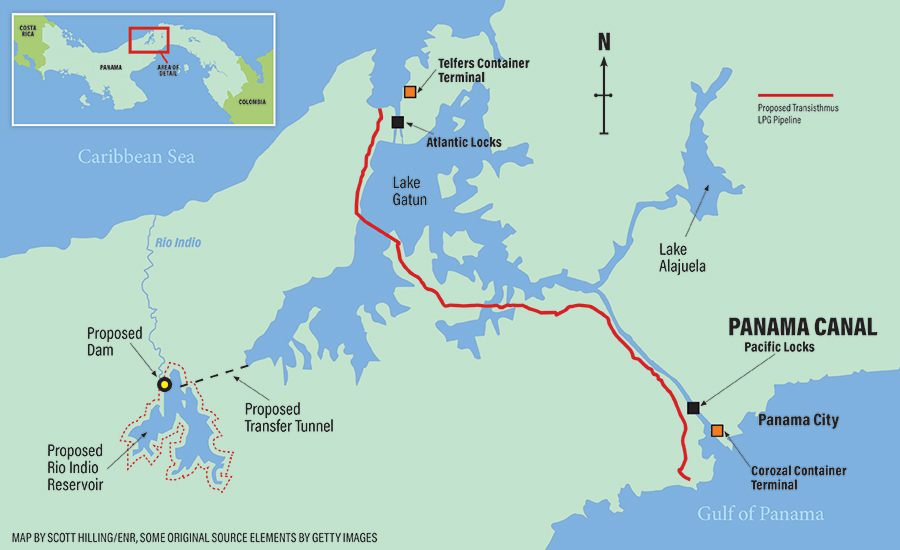
The largest project being undertaken for ACP’s planned Logistics Corridor is a 47.2-mile pipeline, sized for 2.5 million barrels per day of propane, ethane and butane. This “energy corridor” would run along the canal route connecting new terminals near each entrance. Bulk gas cargo is the canal’s second largest customer and running a portion of that overland frees additional capacity within the waterway for the No. 1 customer, containers.
"If I take some of my LPG market out by land, then I have three more slots for the locks. It's a way of increasing your throughput, increasing your transits and increasing your revenues,” Espino de Marotta says.
The cross-isthmus offload-and-reload model is not without precedent. In 1982, an 81-mile-long crude oil pipeline with a maximum capacity of 860,000 barrels of oil per day was opened near the country’s western border with Costa Rica.
Looking for quick answers on construction and engineering topics?
Try Ask ENR, our new smart AI search tool.
Ask ENR →

The new LPG pipeline functions as a scaled-up version of that approach: a bulk-energy bypass that hardens canal-water resilience by taking the highest-water-consumption cargo class off the locks entirely. The current project emerged from an unsolicited Private Initiative Proposal submitted in November 2024, the originator of which ACP has not disclosed. Last September, two dozen firms took part in an initial market engagement event held in Panama City.
Related Link:
Panama Canal Authority Energy Corridor RFQ (PDF)
RFQ submissions for the pipeline are due by July 23. The shortlisted firms and the unidentified submitter of the private proposal will then begin working with ACP to define the project’s technical and commercial scope as well as the cost. A final concession award will follow, and operations are expected to begin in 2029.
The procurement is structured as a build-own-operate concession in three phases. ACP retains ownership of the pipeline, terminals and related fixed assets from the start of construction, a callback to the expansion contracts. The actual scope and cost of the project are not expected to be finalized until after the qualified consortiums are identified.
The model for handling new domains carries from the expansion too. “We have very good advisors. We have a good team in the canal and good advisors,” Espino de Marotta says.
The contract deliberately includes an off-ramp for the concessionaire if financing or commercial commitments fall short. The contingency is in response to late-program cost disputes during the expansion project that taught ACP about leverage and timing.
A Pair of New Container Terminals
ACP has also extended an RFQ for a pair of container terminals—Corozal on the Pacific and Telfers on the Atlantic—which would add roughly 5 million TEU (20-ft equivalent units) of annual transshipment capacity. The contract award is currently targeted for 2027 and operations are expected to begin in 2029.
ACP and Panama officials say the terminals are necessary because all five ports near the canal are near capacity, increasingly limiting the options for shipping.
"We see that Panama is a huge transshipment hub," Espino de Marotta says. "We want to increase capacity for the country's sake, and we have two perfectly good locations, one in the Atlantic, one in the Pacific, to attract more transshipment into the area."
An ongoing dispute about the ownership of two ports previously owned by a Hong Kong-based company also complicates the situation. Both ports are currently operating under separate 18-month interim arrangements, with the dispute’s resolution pending before Panama's Supreme Court.
Related Link:
Panama Canal Authority Container Terminals RFQ (PDF)
ACP terminal prequalification, due July 9, is run as pure pass/fail, with every bidder meeting the technical and financial bar advancing to the next stage without a competitive shortlist. The technical bar is steep: eight years of terminal-operator experience, six terminals under operation last year and at least 6 million TEU handled in the most recent year.
“We know how to run a canal, we know how to run power-generating plants and potable-water plants, but we have never run a port,” Espino de Marotta says. “So to us it’s very important that that expertise is a lead.”
Other lessons learned are apparent here as well. The Corozal and Telfers tenders are structured to prevent any one operator from holding both new terminals plus the pipeline. The cross-concession exclusion in the qualifying documents, paired with a supply-chain diversity rule, indicates that ACP intends for the logistics corridor to be distributed across multiple distinct operators rather than vertically integrated under one provider. The institutional preference carries from the expansion: distributing risk across operators, locking accountability at the consortium leader level and reserving ACP approval over consortium changes are all responses to the leverage problems mid-program consortium reshuffling can create.
A New Reservoir to Meet Growing Demand
The planned $1.6 billion Río Indio reservoir is the linchpin for the canal’s efforts to secure sufficient water resources for its future. The 4,600-hectare (11,370-acre) reservoir would be paired with a transfer tunnel to Lake Gatun, the artificial lake at the heart of the canal route. The reservoir is designed to serve both canal operations and the roughly 2 million Panamanians who depend on the canal watershed for drinking water.
The project is still undergoing geological studies and conceptual design; its environmental impact study formally began last month. ACP is preparing to tender the project-management company that will supervise design and construction, with a separate construction tender to follow.
The current timeline calls for the reservoir construction to launch next year and water for canal operations could begin delivery by 2032.
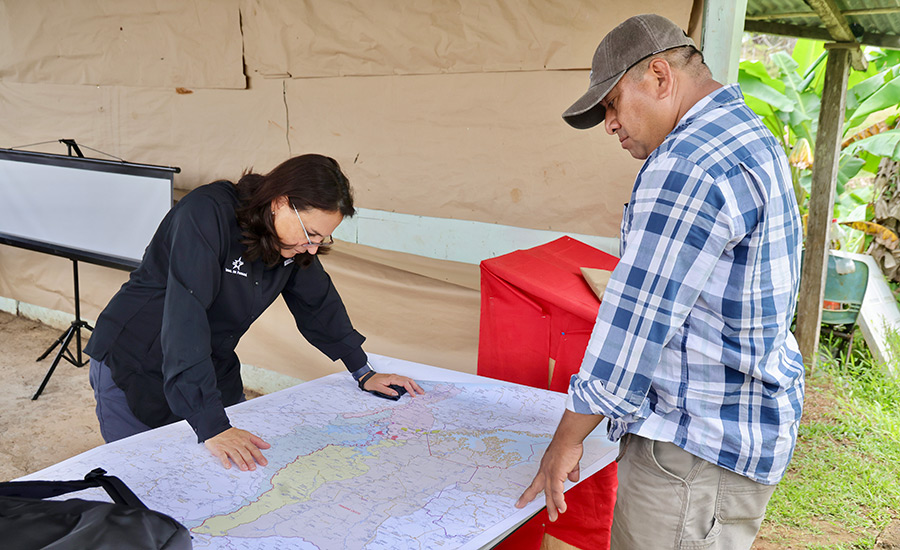
Illya Espino de Marotta made a point of coordinating outreach to residents impacted by the planned Río Indio resevioir.
Image courtesy Panama Canal Authority
ACP has allocated $400 million for compensation and resettlement of the residents who currently live within the watershed. These relocation efforts have come under the purview of Espino de Marotta.
"I am quite taken by the resettlement program because it's something totally new," she says. "How can you improve the quality of life of the 423 families that we need to relocate? A lot of dialogue, a lot of listening, a lot of empathy."
A resettlement fund was created by ACP board of directors and, in another strategy lifted from the successful expansion effort, the authority has brought on experts to embed with its staff to help handle the relocations. Espino de Marotta says the same approach will be needed for the project’s tunneling phase. “This is something we have never attempted before.”
“Even in the expansion, we had many companies that worked with us that have expertise in areas we have not dominated,” Espino de Marotta says. “They were an embedded team within our team, a mentoring role and a handoff eventually.”
A Look to the Future
The leading edge of ACP’s plan aims further than the next decade of locks-and-ports execution.
On the west-bank land corridor, a short container road already runs from the PSA terminal on the Pacific Ocean to the Centenario Bridge across the canal. ACP plans to extend that segment all the way to the Atlantic Bridge, which will open a land route for container trucks to cross the isthmus alongside the canal and the existing railroad.
Despite its scale, Espino de Marotta is already pointing past the current capital plan to the next strategic frontier.
"We're also looking into the future at green fuels," she says. "We could become a bunkering hub for green fuels in the future. We're looking at that in the sustainability arena with the port of Algeciras in Spain, and we're working with the Maersk McKinney Moller Center to visualize what else we can do."
The pipeline procurement is already anticipating that potential pivot. Berth designs will accommodate Very Large Ammonia Carriers alongside LPG vessels—positioning the corridor to handle ammonia, the leading hydrogen carrier for long-distance maritime transport.
Asked to describe the broader ambition, Espino de Marotta returns to a single word. "You become a magnet," she says. "It's not just the canal, it's the country. The country will benefit from more cargo moving through Panama."