Project Delivery
Winnipeg Awards $580M Biosolids Contract After Rethinking Procurement
Progressive design-build helped rescue a wastewater expansion by cutting costs to advance the second phase of the city's $2-billion modernization program

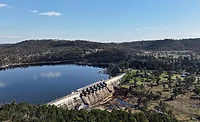
An aerial view shows construction underway at Winnipeg, Manitoba's North End Water Pollution Control Centre, where a new biosolids treatment facility will become the second major phase of the city's more than $2-billion wastewater modernization program. The plant treats about 70% of Winnipeg's wastewater and processes biosolids from all three municipal treatment facilities.
Winnipeg, Manitoba, awarded a roughly $580-million contract July 16 to an Aecon-led joint venture to build new biosolids facilities at the city’s North End Water Pollution Control Centre, launching the second major construction phase of its multibillion-dollar modernization program.
Council approved the award to Red River Biosolids Partners—a consortium of Aecon Group, MWH Constructors Canada Ltd. and Oscar Renda Contracting of Canada—after the team completed a progressive design-build development phase and negotiated the implementation contract.
Construction is expected to begin within weeks, with biosolids treatment scheduled to start in October 2030 and substantial completion targeted for March 2031. The project addresses a looming capacity constraint at Winnipeg's largest and oldest wastewater treatment plant, which treats about 70% of the city's wastewater and processes biosolids from all three municipal treatment facilities.
City reports warned the existing biosolids system could exhaust its remaining treatment capacity within five to eight years, even as Winnipeg—the seventh-largest city in Canada—is projected to approach one million residents over the next quarter century.
The biosolids facilities are the second major phase of the city's long-term overhaul of the North End Water Pollution Control Centre, following construction of new power supply and headworks infrastructure.
Winnipeg's long-term modernization program is designed to support that growth while bringing its largest wastewater treatment plant into compliance with increasingly stringent environmental requirements. The overall program is expected to exceed $2 billion and includes a future nutrient-removal phase to further reduce phosphorus and nitrogen discharged into local waterways.
Progressive Procurement Pays Off
The award concludes a procurement strategy Winnipeg fundamentally reworked after determining its original fixed-price design-build approach was unlikely to succeed.
Looking for quick answers on construction and engineering topics?
Try Ask ENR, our new smart AI search tool.
Ask ENR →
In 2023, Winnipeg consulted prospective contractors and concluded its original procurement strategy had become unworkable. Firms cited the project's scale, lengthy construction schedule, escalating costs and design risks, and by that spring only one team remained interested in pursuing the work under the city's original fixed-price design-build approach.
The city instead adopted progressive design-build, selecting the contractor primarily on qualifications before collaboratively advancing the design and negotiating a final implementation price.
Officials said the approach improved cost transparency, preserved owner involvement in key design decisions and reduced the contingencies contractors otherwise would have incorporated into fixed-price bids.
The collaborative process also enabled the project team to redesign portions of the facility—including changing the biosolids treatment process—to reduce costs before construction pricing was finalized.
Engineering Changes Reduce Costs
The construction package includes a new biosolids treatment facility, expanded digester capacity and modifications to existing plant infrastructure. The work is intended to increase treatment capacity, improve biosolids processing and expand opportunities to beneficially reuse recovered biosolids rather than dispose of them in landfills.
Stantec is leading design services, supported by Hatch Engineering.
During the collaborative development phase, the project team replaced thermal hydrolysis with thermophilic digestion to reduce project costs as part of a broader value-engineering effort. The redesign also consolidated buildings, eliminated basements where practical and substituted structural steel for portions of the original concrete design. City officials said the changes reduced project costs through engineering optimization rather than reductions in project scope or treatment performance.
"With Biosolids, we found many saving opportunities through adapting the design," said Lana Obach, Winnipeg's major capital project engineer. "What is notable about these savings is that they were not the result of cutting corners. Instead, it was about making smart design and engineering choices."
Aecon said the contract will be added to the company's third-quarter 2026 construction backlog.
"The Winnipeg North End Sewage Treatment Plant is undergoing one of the largest water infrastructure upgrades in North America," said Jean-Louis Servranckx, Aecon president and chief executive officer.
The city estimates the biosolids project will generate approximately 3,770 person-years of employment and contribute roughly $442 million to Manitoba's gross domestic product during construction. The planned nutrient-removal facilities will complete the final major construction phase of the North End Water Pollution Control Centre modernization.

Bryan Gottlieb is the online editor at Engineering News-Record (ENR).
Gottlieb is a five-time Society of Professional Journalists Excellence in Journalism award winner with more than a decade of experience covering business, construction and community issues, including finance, law and real estate. He has reported for Adweek and the San Diego Daily Transcript and led a community newsroom in Santa Monica, Calif. He served as editor-in-chief of the Detroit Metro Times and as managing editor at Roofing Contractor, where he helped shape national industry coverage. At Engineering News-Record, Gottlieb covers breaking news, large-scale infrastructure and megaprojects, regulatory developments and business trends across the U.S. and global construction sectors.
email: gottliebb@enr.com | office: (248) 786-1591