Water Infrastructure
Queensland Utility Awards $165M Stage 1 Contract for Toowoomba-Warwick Pipeline
Australian contractors will start work later this year on first segment featuring 64 waterway crossings and multiple trenchless installations
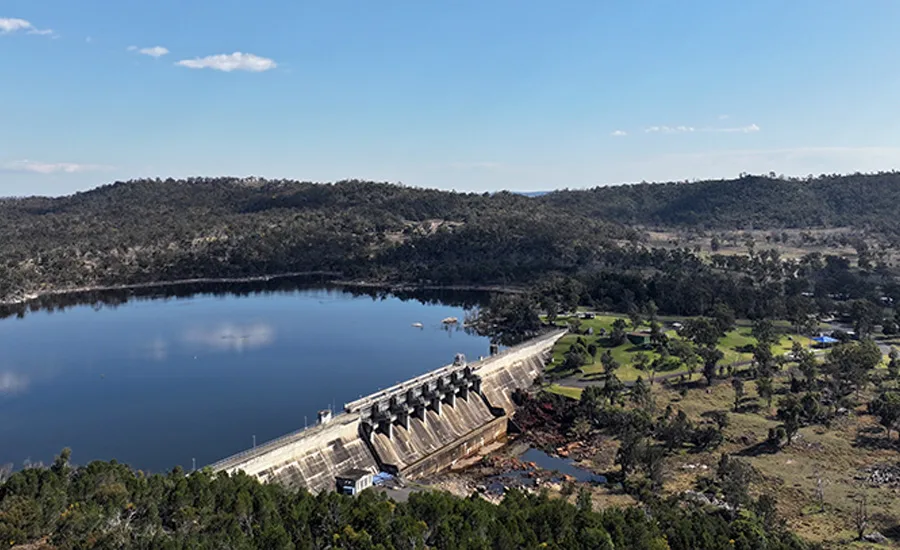
Leslie Dam near Warwick, Queensland, Australia reached critically low levels during drought in 2020, prompting development of the Toowoomba-to-Warwick pipeline to strengthen long-term water security across the region.
Australia's Queensland state-owned water utility, Seqwater, on July 9 awarded the first construction contract for the approximately $165-million Toowoomba-to-Warwick Pipeline to a joint venture between CPB Contractors and NACAP.
Stage 1 construction of the long-planned water infrastructure project is expected to begin in late 2026 on the first segment of the 69-mile pipeline connecting the inland Queensland cities of Toowoomba and Warwick, about 90 minutes west of Brisbane.
The project is expected to support about 400 construction jobs.
"Seqwater is delivering the project on behalf of the Queensland Government to strengthen water security for Toowoomba and protect the corridor for the project that could deliver long-term benefits for the Southern Downs," utility CEO Emma Thomas said in announcing the contractor award.
Project plans call for two reservoirs, two pump stations and two future offtake sites. The route is located predominantly in state and local road corridors and will use ductile iron cement-lined, mild steel cement-lined and polyethylene pipe in diameters ranging from DN125 to DN600. The alignment includes 64 waterway crossings and seven rail crossings.
Most of the pipeline will be installed using conventional open-trench construction, although trenchless methods—including horizontal directional drilling and pipe jacking—are planned at major road, rail and waterway crossings to reduce surface disruption.
The pipeline concept originated after severe drought left Leslie Dam—Warwick's principal water source—at critically low levels in 2020.
Looking for quick answers on construction and engineering topics?
Try Ask ENR, our new smart AI search tool.
Ask ENR →
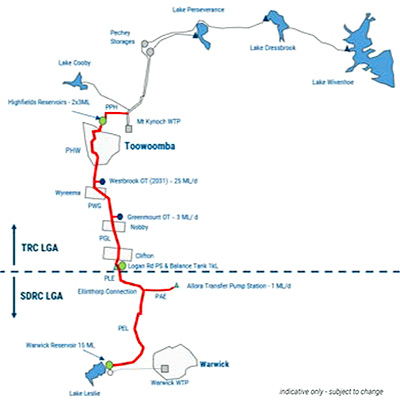
Seqwater's Toowoomba-to-Warwick Pipeline will extend approximately 69 miles between Toowoomba and Warwick in Queensland, Australia. Stage 1 will construct the northern segment to Greenmount, with a future extension continuing south to Warwick.
Map courtesy of Seqwater
According to Seqwater's Public Environment Report, the route traverses expansive clay soils for much of its northern section before transitioning to sandstone formations farther south. Project planners identified shallow weathered basalt and sandstone, steep terrain, major waterway crossings and localized land-instability areas as the principal geotechnical challenges, including 16 mapped landslide hazard zones totaling less than one mile of the alignment.
The federal environmental review drew on work by engineering consultant SMEC, environmental consultant Jacobs and ecological consultant Ecosure.
The state revised the project delivery strategy earlier this year, splitting construction into two phases after updated water-security assessments found immediate drought risk had eased.
"By progressing the pipeline in stages, we are balancing investment with long-term water security and making sure regional infrastructure keeps pace with growth, demand and future opportunities," Queensland Water Minister Ann Leahy said.
Stage 1 will deliver the pipeline to Greenmount, about 16 miles south of Toowoomba, while the remaining 40-mile section from Greenmount to Warwick will proceed under a future government decision based on regional water-security needs.
Although the first stage construction contract has been awarded, the project remains subject to Australia's federal environmental review under the Environment Protection and Biodiversity Conservation Act before work can begin.
During the public comment period, six submissions from individuals and community groups raised concerns about potential effects on koala bear habitat, threatened species, habitat connectivity and roadside vegetation.
Seqwater said successive alignment revisions and construction changes—including trenchless waterway crossings and route adjustments to avoid sensitive habitat—were made to reduce environmental impacts.
Construction is expected to take about 30 months, subject to work package sequencing, weather and regulatory approvals.

Bryan Gottlieb is the online editor at Engineering News-Record (ENR).
Gottlieb is a five-time Society of Professional Journalists Excellence in Journalism award winner with more than a decade of experience covering business, construction and community issues, including finance, law and real estate. He has reported for Adweek and the San Diego Daily Transcript and led a community newsroom in Santa Monica, Calif. He served as editor-in-chief of the Detroit Metro Times and as managing editor at Roofing Contractor, where he helped shape national industry coverage. At Engineering News-Record, Gottlieb covers breaking news, large-scale infrastructure and megaprojects, regulatory developments and business trends across the U.S. and global construction sectors.
email: gottliebb@enr.com | office: (248) 786-1591