Transportation
Amtrak’s Penn Station Shortlist Puts Delivery Risk at Center Stage
Three teams advance under a P3 model that must reconcile live rail operations, aging infrastructure and competing visions for Madison Square Garden

An aerial view shows Madison Square Garden sitting above Penn Station, where Amtrak has shortlisted three teams to rebuild and modernize the station beneath an active arena and live rail operations under a fast-tracked public-private partnership.
Amtrak on Jan. 21 released a shortlist of three finalists for New York City’s Penn Station redevelopment, moving the project into a phase that will test if a fast-tracked public-private partnership can upgrade major infrastructure under an active rail hub while maintaining daily operations.
The list follows bid submissions from four teams last December under a design-build-finance-maintain procurement. Narrowing the field to three finalists moves the Penn Station rebuild from open solicitation to a detailed evaluation as the railroad prepares to select a master developer by May and announce an award by June.
RELATED
New York Penn Station Reconstruction Will Start in 2027, USDOT Says
When Amtrak launched the search for a private partner last fall, Andy Byford, then serving as special adviser to the Amtrak board, underscored the scale of the effort. “This will be one of the biggest and most significant construction projects in U.S. history, and we want the most skilled and knowledgeable partners to help make it a success,” Byford said in comments reported by public media.
Project organizers said early construction activity could begin as soon as 2027, compressing design development, investigative work and enabling construction for one of the most operationally constrained station rebuilds in the U.S.
The three shortlisted teams are Grand Penn Partners; Halmar International; and Penn Forward Now, a development-led consortium that includes Tutor Perini, Parsons and Arup. Of the three, only two have publicly discussed design strategies.
Dig Deeper
Amtrak | Procurement Portal
Grand Penn Partners has proposed relocating Madison Square Garden to allow construction of a new above-grade station hall; Halmar International has outlined an approach that keeps the arena in place and focuses on internal reconfiguration and new access points. Penn Forward Now has not released proposal details publicly.
Looking for quick answers on construction and engineering topics?
Try Ask ENR, our new smart AI search tool.
Ask ENR →
Amtrak has characterized the project as a rebuild driven by reconfiguration rather than expansion. According to media reports, officials have ruled out any design that would require expanding Penn Station’s footprint south to add tracks or platforms, emphasizing circulation, concourse geometry, daylighting and modernization of existing systems instead.
RELATED
MTA Exec Blames Amtrak for Three-Year Delay on $2.9B Penn Station Access Project
Structural and Architectural Constraints Beneath an Active Arena
From a structural standpoint, the defining constraint remains the arena sitting directly above the rail complex and supported by a structural deck carried on a dense grid of columns and transfer elements. Federal transportation officials have said the selected master developer will be responsible for leading the delivery of a comprehensive transformation while maintaining rail operations. That mandate underscores both the scale of temporary works and the sequencing challenges inherent to either design approach.

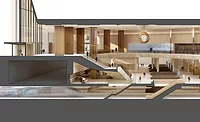
A concept rendering by Grand Penn Partners shows a reimagined Penn Station concourse with expanded circulation, higher ceilings and simplified passenger flows under a proposal that would relocate Madison Square Garden and construct a new above-grade station hall.
Rendering courtesy of the Grand Penn Partners.
Under the Grand Penn Partners concept, relocating the arena would allow demolition of the existing deck and construction of a new station hall with long-span roof systems and simplified load paths, according to proposal materials released by the team.
Supporters of that approach have argued publicly that clearing the site would reduce long-term structural constraints, though it would require extensive coordination tied to arena relocation, demolition logistics and rail protection during above-track work.
The approach outlined by Halmar International keeps MSG in place and focuses on internal reconfiguration, including new vertical openings and access points, as outlined in the firm's concept materials. Executing that strategy would typically require temporary shoring, vibration control and tightly phased construction directly above active tracks and platforms.
Project officials have not publicly endorsed either approach but have said proposals involving arena relocation remain under consideration. The arena’s operating permit expires in 2028.
RELATED
Amtrak Disputes MTA on Penn Station Access Delay, Demands Retraction
Concourse Reconfiguration and Systems Implications
A core requirement set by the project sponsor is replacement of the current multi-level passenger environment with a single-level concourse, a change officials have described as central to improving circulation and wayfinding.
Achieving that outcome would likely involve demolishing existing slabs, rerouting utilities and reconstructing fire-rated separations while maintaining code-compliant egress during construction.

A diagram illustrates how Penn Station could function as part of a through-running rail network, showing the station’s relationship to Moynihan Train Hall and adjacent corridors as federal officials study operational changes that could affect track layouts and design flexibility.
Graphic courtesy of the Penn Station Capacity Expansion Project.
For engineers and constructors, consolidating circulation into a single plane would concentrate mechanical, electrical and life-safety systems into a tighter vertical envelope. HVAC distribution, smoke control, emergency power and redundant communications systems would typically need to be rebuilt incrementally, with temporary systems maintaining operations during phased cutovers.
Project requirements also emphasize new entrances and increased natural light, changes that would generally require new penetrations through exterior walls and roof structures while protecting live rail infrastructure below.
Below the concourse, existing track and platform layouts present additional constraints, including limited clearances, aging interlockings and shared use by Amtrak, the Long Island Rail Road and NJ Transit.
Officials said operational improvements are being studied within the existing arrangement, including potential reconfiguration of interlockings and platform use. Federal transportation officials have also said the Federal Railroad Administration plans to commission a study on through-running, an operational concept that would allow commuter trains to operate across the station rather than terminate there.
Construction under any scenario would rely on coordinated outages, overnight work windows and temporary traction power, signal and communications systems to maintain daily service. The rebuild overlaps with the MTA’s Penn Station Access project, now under construction and scheduled for completion in 2027.
Procurement Structure and Risk Allocation
The P3 bid structure conceives that the selected team will design, build, partially finance and maintain the rebuilt station. Federal grants and loans are expected to cover a substantial portion of project costs, though no cost estimate or financing breakdown has been released. New York state officials have said the state will not contribute funding.
Penn Station Deep-Dive
Engineering Feasibility Study Executive Summary
Penn Station Capacity Expansion Fact Sheet
Amtrak has not released a cost estimate for the Penn Station rebuild, but previous planning studies and public commentary have cited figures upward of $6 billion for various redevelopment concepts, but officials have not tied the current procurement to a defined budget or scope-based cost range.
Under a design-build-finance-maintain structure, bidders must price not only construction but long-term operations and maintenance obligations. Some transit advocates have questioned whether the schedule is realistic at all.
“There are some decided red flags around the Penn Station realignment,” Sean Jeans-Gail, vice president of government affairs and policy at the Rail Passengers Association, told WNYC, reflecting broader concerns about project delivery and oversight as the procurement advances.
Amtrak officials have said the P3 model is intended to impose delivery discipline on a project that has stalled under prior governance approaches.
What Remains Unresolved
Proposal documents, preliminary designs, cost ranges and phasing plans have not been released. Nor have officials disclosed how unforeseen conditions—common in work at the station—would be managed under the P3 contract or how construction and operational risks would be allocated between the public owner and private developer. Those details are expected after the master developer is selected. For now, the shortlist announcement is a mile marker indicating momentum from concept to delivery.
What is clear is the scale of the undertaking: rebuilding Penn Station without an expanded footprint—beneath an active arena and within one of the most complex rail environments in the country—will test whether a P3 structure can manage sequencing, systems integration and risk at a level rarely demanded of U.S. transportation projects.

Bryan Gottlieb is the online editor at Engineering News-Record (ENR).
Gottlieb is a five-time Society of Professional Journalists Excellence in Journalism award winner with more than a decade of experience covering business, construction and community issues, including finance, law and real estate. He has reported for Adweek and the San Diego Daily Transcript and led a community newsroom in Santa Monica, Calif. He served as editor-in-chief of the Detroit Metro Times and as managing editor at Roofing Contractor, where he helped shape national industry coverage. At Engineering News-Record, Gottlieb covers breaking news, large-scale infrastructure and megaprojects, regulatory developments and business trends across the U.S. and global construction sectors.
email: gottliebb@enr.com | office: (248) 786-1591


.webp?height=200&t=1761982292&width=200 "Penn Station Access Project Delay")