Buildings
Buckling Columns on NYC Pfizer HQ May Chill Broader Office-to-Residential Conversion Trend
There is history of safety violations at Manhattan project site, including penalties for unreported injuries
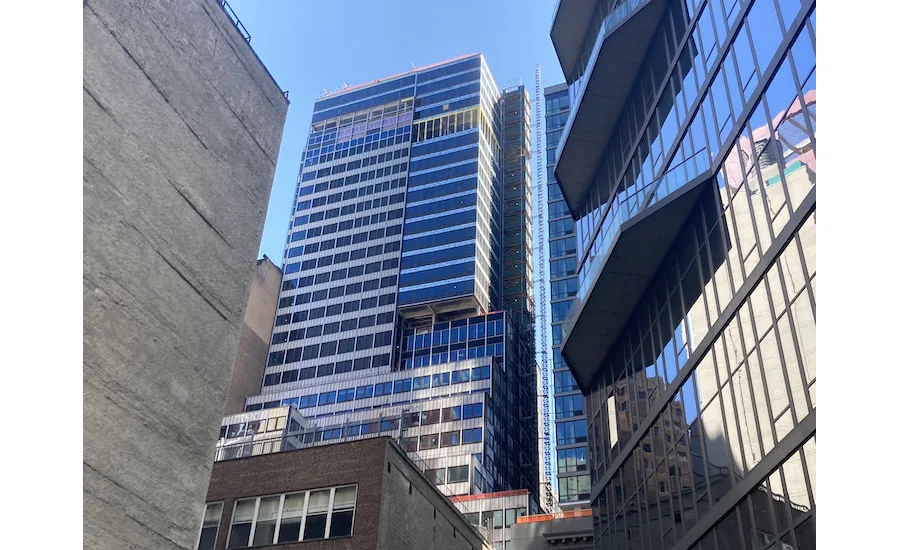
Streets remained closed surrounding the former headquarters building of pharmaceutical giant Pfizer in midtown Manhattan (seen at center) after July 7 emergency when structural columns were found to have buckled, during office-to-residential conversion under way..
Office-to-residential conversions have been picking up steam in large cities as older office buildings sit empty while housing demands rise—but the buckled-column emergency at developer Metro Loft's 235 E. 42nd Street project in New York City has potential to increase the risk profile of conversions as real estate investors reassess their involvement and risk appetite.
The conversion of the former Pfizer headquarters in midtown Manhattan is one of the largest office-to-residential conversion projects in the U.S. It involves both the Pfizer building, built in 1960, and an adjoining office tower built much earlier that was being added onto, with the goal to develop 1,600 rental apartments and amenities such as a rooftop pool and fitness center.
When the project began last year, it was overseen by 235 GC LLC, a single-purpose entity general contractor created specifically to deliver the project by Metro Loft and co-developer David Werner Real Estate Investments.
Only two subcontractors on the project, the fire protection and elevator installation firms, were union contractors, which is unusual for major construction in Manhattan.
There were a total of seven project safety violations totaling $32,000 issued by the city's Office of Administrative Trials and Hearings in 2025, according to New York City Dept. of Buildings. These included citations for a worker falling 6 ft off a ladder, one for not reporting the accident to department officials, one for a piece of debris falling onto the street below and one for work not adhering to construction documents on the project.
More than a dozen workers have filed lawsuits against the contractor, alleging they were seriously injured on the job in different incidents.
Cliff Johnsen, a business agent for Steamfitters Local 638 in New York City, told ENR his union's crews were on the project doing fire protection installation when the buckling columns were discovered.
"All we want is responsible construction in the City of New York, we want them to be union workers," Johnsen says. "They did not shore up the job correctly. The beams started crumbling, the floors started crumbling."
According to documents filed with the department, the conversion of 235 E. 42nd Street involved adding four new floors, raising the building from 33 stories to 37. The project also called for 19 new floors atop the adjoining building, a 10-story tower at 219 E. 42nd Street, reportedly built in 1905.
Metro Loft did not immediately respond to questions for this story, but Nathan Berman, its founder and managing principal, told The Wall Street Journal that "at some point, the design team identified that the existing structure, perhaps with some minor reinforcement, could support the addition above," he said. "Clearly, based on what we're seeing, that's not the case."
While city officials say the building has been stabilized, it has continued to shift since its evacuation.
Complex Conversions, Faster Turnarounds
Last October, Bloomberg spoke with Metro Loft about the Pfizer headquarters and office-to-residential conversions in general. At the time, Robert Fuller, principal at project architect Gensler, said, “It’s quite a bit of surgery. There’s just a lot of technical challenges and unique conditions from floor to floor. All those things collectively make this quite a unique endeavor and I would argue probably more challenging than any other one I can think of."
 A rendering of the planned office-to-residential conversion of the former Pfizer headquarters in midtown Manhattan.
 Image courtesy Gensler
Unlike other large cities, incentives for office-to-residential conversions in New York City that were passed during former Mayor Eric Adams' administration—and backed at the state level by Gov. Kathy Hochul—are focused almost entirely on tax breaks and abatements at the end of a conversion project, rather than on money from tax increment financing or other public money to support conversions.
One particular incentive is New York City's rule 467-m, which allows tax abatements for up to 35 years. To qualify for the tax benefits, at least 25% of housing units have to be affordable, which the Pfizer conversion was approved to obtain.
In the Bloomberg interview, Berman said the speed and ability to get conversions done quickly, compared to new construction, is what makes them attractive.
"That’s what makes conversions exciting for us—the immediacy of it. You buy a building and maybe 18 months later, you’re renting apartments. That type of schedule doesn’t exist for ground up. You’re lucky if it’s year seven that you rent it," he told Bloomberg.
Construction lenders are concerned that the incident will affect the popularity of office-to-residential conversions beyond New York City.
"It’s going to make everyone a little bit more conservative," Paul Rahimian, CEO of Parkview Financial, a real-estate lender that has financed both office-to-residential and hotel-to-residential projects, told Fox News. "Maybe we do the easy ones, but let’s not do the super complex ones."