Stadiums
D.C.'s RFK Campus Master Plan Maps Streets, Transit and Utility Work
Phased approach taken for proposed redevelopment of the 180-acre site
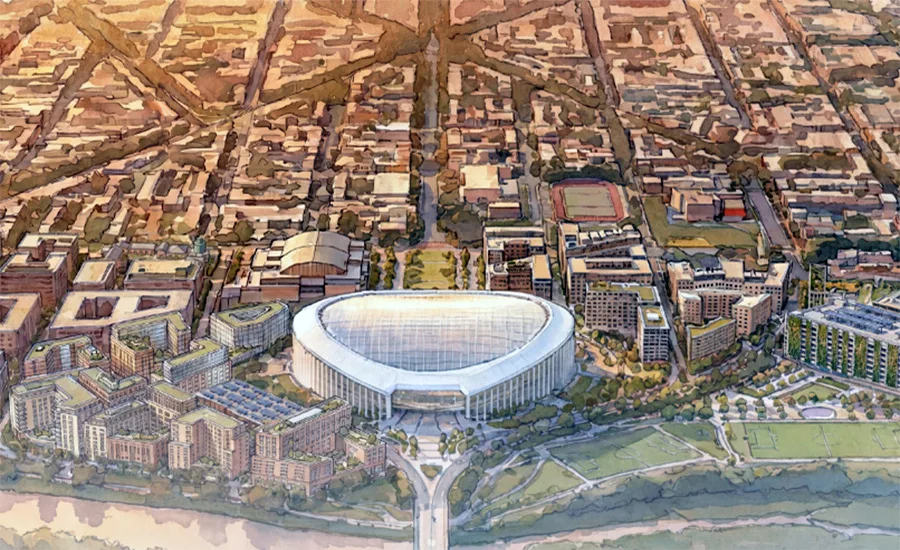
A draft master plan by the District of Columbia outlines redeveloping the 180-acre RFK campus, including a new Washington Commanders stadium, mixed-use districts, new streets, transit upgrades and expanded public access along the Anacostia River.
The District of Columbia released a draft master plan June 30 outlining the infrastructure framework for a new Washington Commanders stadium and redevelopment of the 180-acre Robert F. Kennedy Memorial Stadium campus.
The plan calls for transportation, utility and environmental improvements needed to support phased redevelopment, from street and transit upgrades to riverfront restoration and new public infrastructure.
Mayor Muriel Bowser and the D.C. Office of Planning say the public comment draft divides the former stadium property into six districts connected by new streets, parks, transit improvements and utility infrastructure.
"We are taking another step forward in our promise to District residents and businesses—to plan not just for a world-class stadium, but for a community-centric 365-day campus that will drive growth for years to come," Bowser said in announcing the draft. "Now, let's work together toward the final goal—to finalize a plan rich in amenities like housing, parks, and entertainment."
Office of Planning Director Anita Cozart said the draft reflects more than a year of planning, public engagement and interagency coordination and is intended to guide future zoning, environmental review and phased redevelopment of the site.
Transportation, Utilities Drive Redevelopment
Campus circulation would be reorganized by converting Independence Avenue SE and C Street NE to two-way operation, establishing a hierarchy of arterial, collector and local streets while adding protected bicycle facilities. The proposal also expands pedestrian links between neighborhoods and the Anacostia waterfront, creating new streets and slower local roads to improve circulation and replace large surface parking with structured parking in future developments.
The plan embraces a transit-first approach by incorporating WMATA's recommendation to expand capacity at the Stadium-Armory Metrorail station, which the agency determined could not accommodate projected event-day demand. A future multimodal transit center includes a dedicated Bus Rapid Transit connection between Union Station and the campus via H Street NW and Benning Road.
Looking for quick answers on construction and engineering topics?
Try Ask ENR, our new smart AI search tool.
Ask ENR →
WMATA's recommended transit improvements are advancing through alternatives analysis, engineering feasibility and constructibility studies as broader redevelopment planning continues.
Substantial utility demand accompanies the proposal as well. The draft estimates a daily increase of 1.3 million gallons of water to accommodate the project's scope, with electrical demand that could require expansion of existing substations or construction of a new one.
Non-wires alternatives, including battery storage and solar generation, would also be evaluated in coordination with electric utility Pepco during later engineering and project design.
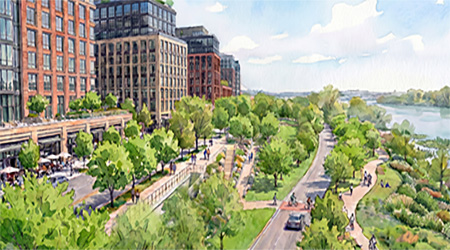
A rendering from D.C.'s draft RFK Campus Master Plan depicts the proposed Esplanade and riverfront promenade, where expanded public access, wetlands restoration and green infrastructure would reconnect redevelopment with the Anacostia River.
Rendering courtesy of D.C. Office of Planning
Along the Anacostia River, the proposal builds on the long-running Anacostia Waterfront Initiative by expanding public access while incorporating wetlands restoration, green infrastructure and stormwater management into the riverfront.
The eastern edge of the site would be reorganized around a restored riverfront, featuring a pedestrian-oriented River Street that connects the stadium district to the water and an elevated Esplanade overlooking wetlands, green infrastructure, stormwater management features and expanded public access.
The proposal also preserves a 200-ft riparian corridor, strengthens connections to Kingman and Heritage islands and adds recreation centered on a new SportsPlex.
Surface parking would be consolidated into two structured garages as mixed-use development advances, while at least 30% of the campus would remain dedicated to parks and publicly accessible open space.
Depending on final development density, the project would include between 5,000 and 6,500 housing units, along with hotel, retail and commercial spaces distributed across the six districts.
The opening phase, targeted for 2030, includes the stadium, the two parking garages, selected roadway improvements and the SportsPlex.
Subsequent phases would extend mixed-use development through the Plaza District, Riverfront District and other portions of the campus over a decade.
RELATED
Planning Commission Clears Work on White House Ballroom, Commanders Stadium
What Comes Next
The project now shifts to regulatory review. Under legislation transferring the federally owned property to the District, construction cannot proceed until planning is completed and environmental review under the National Environmental Policy Act and National Historic Preservation Act is finished.
The District and National Park Service serve as joint lead agencies preparing the environmental impact statement.
"Throughout this process, our team met with hundreds of residents and received over 4,000 comments online," Cozart said. "We've created this draft plan with you in mind—whether you're a neighbor, a business owner, a sports fan, or excited to see the redeveloped campus as a new hub in the District."
Public comment runs through Aug. 14 before the Office of Planning prepares a final plan for consideration by the D.C. Council.

Bryan Gottlieb is the online editor at Engineering News-Record (ENR).
Gottlieb is a five-time Society of Professional Journalists Excellence in Journalism award winner with more than a decade of experience covering business, construction and community issues, including finance, law and real estate. He has reported for Adweek and the San Diego Daily Transcript and led a community newsroom in Santa Monica, Calif. He served as editor-in-chief of the Detroit Metro Times and as managing editor at Roofing Contractor, where he helped shape national industry coverage. At Engineering News-Record, Gottlieb covers breaking news, large-scale infrastructure and megaprojects, regulatory developments and business trends across the U.S. and global construction sectors.
email: gottliebb@enr.com | office: (248) 786-1591