Rail
California High-Speed Rail Authority Eyes Next $2.4B Phase
RFQ process begins for 30-mile Merced-to-Madera alignment
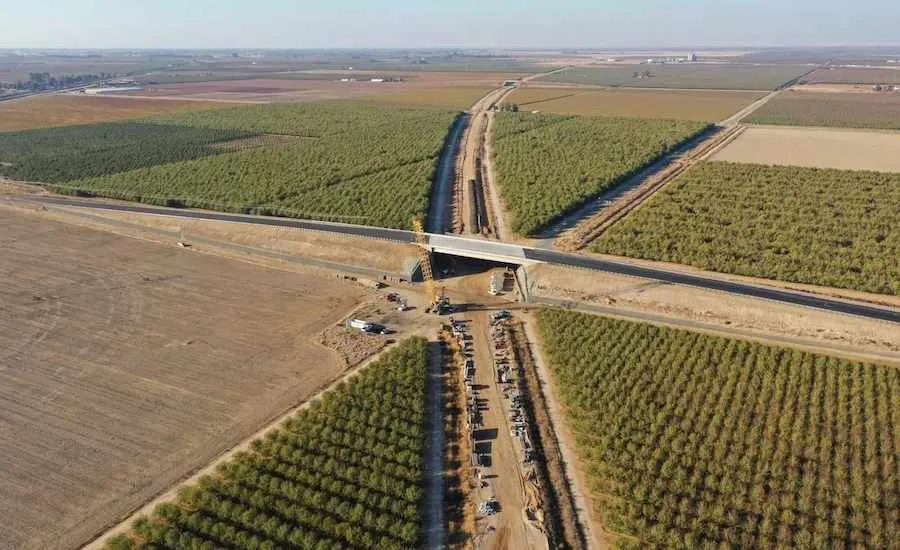
CHSRA plans collaborative project delivery for next 30-mile phase of construction.
The California High-Speed Rail Authority (CHSRA) on June 24 approved a Request for Qualifications (RFQ) for the $2.4-billion Merced-to-Madera (M2M) civil works contract. The move officially expands construction beyond the project’s original, decade-long 119-mile Central Valley footprint, pushing the total project area under active design and construction to 171 miles from Merced to Bakersfield.
The procurement follows a collaborative design-build process, allowing the Authority and competing teams to work together during project development to refine design, reduce risk and improve cost and schedule certainty before a final contractor is selected. The Authority says it is using "collaborative design-build" to avoid schedule delays and budget overruns that have previously affected the project.
Under this method, the shortlisted contractor teams will sign a Pre-Proposal Collaboration Agreement (PPCA) to work on blueprints together before a final price is locked in.
"This agreement will govern their work during the proposal and design‑development period, which will culminate in the submission of a firm‑fixed‑price proposal for completing both design and construction," says spokesperson Daniela Contreras. "The selected contractor team will ultimately serve as the designer of record."
CHSRA previously awarded a $41-million design services contract for the project to Stantec, which advanced the early design to approximately 30%. This work will serve as the reference design for the M2M procurement, adds Contreras.
The upcoming heavy civil package for the 30.3-mile M2M contract will focus on grading, drainage, retaining walls, animal crossings, irrigation structures, utility relocations, and quality management, as well as major roadway overpasses to eliminate existing freight and vehicular crossings. The authority says the segment will not include any tunnels and will employ both elevated and at-grade structures.
One of the rail project’s biggest challenges has historically been right-of-way acquisitions. On early segments, construction contracts were awarded before the state fully owned the land parcels, resulting in contractor delays. To mitigate this risk on the Merced-to-Madera extension, CHSRA says it is actively advancing ROW acquisition.
Looking for quick answers on construction and engineering topics?
Try Ask ENR, our new smart AI search tool.
Ask ENR →
"We anticipate securing approximately 70 percent of the required right‑of‑way by the end of 2027, which aligns with the level of design completion needed to begin construction," says Contreras.
Additionally, the contract framework is expected to enforce strict geographic checkpoints to stop construction until land is secured. "The main areas for the scope of work will be staged with multiple Notices to Proceed," says Contreras.
Statements of Qualifications are due in November 2026, and the authority says it expects to shortlist two major joint-venture contracting teams by December 2026. The formal Pre-Proposal Period and design collaboration will run from January 2027 through October 2027, culminating in a proposed award in November 2027. Major field mobilization is scheduled to span from late 2027 through 2030.
At the same time this contract is underway, the Board also advanced its Cal CLEAN Partnership Agreement solicitation. This separate public-private partnership (P3) RFQ seeks a private developer to design an independent, "behind-the-meter" clean energy utility alongside the tracks. The plan includes a 552-acre solar infrastructure network combined with 62 megawatt-hours of battery storage to insulate the trains from commercial grid blackouts and slash long-term electricity overhead.
As far as timing for the clean energy to be in place, the Authority says it is too early to “determine the specific configuration for how the route‑adjacent solar generation and battery storage would interface with the rail line’s traction power substations.” Contreras says these elements remain under evaluation, and no final decisions have been made.
Like much of the rail infrastructure work, construction on the clean energy portion will be phased. Similar to the recently executed co-development agreement with Momentum Alliance Partners—a global consortium evaluating broader expansion and private investment opportunities—the Cal CLEAN partnership would begin with a predevelopment and assessment phase, says Contreras.
"During this phase, the selected partner would analyze options, refine the scope, and bring recommendations back to the Authority and the Board of Directors for consideration. Final decisions—including whether the private partner would construct the storage asset—would be made following that evaluation."
The project represents the next phase of extending California’s high-speed rail system north through the Central Valley, building on a systemwide foundation where 80 miles of guideway and 61 major structures are already complete, and track installation is slated to begin later this year.