Leadership
Fix Industry Challenges by Beating Your Own Workplace Fears, CEO Tells GWIC Audience
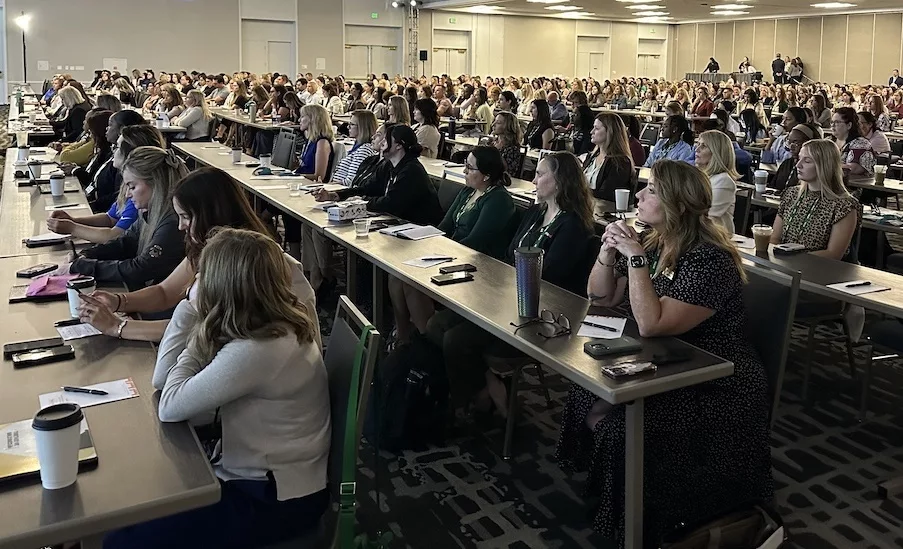
Groundbreaking Women in Construction approached its quarter-century mark earlier this month in San Diego still advocating for industry professionals to take risks and claim their wins.
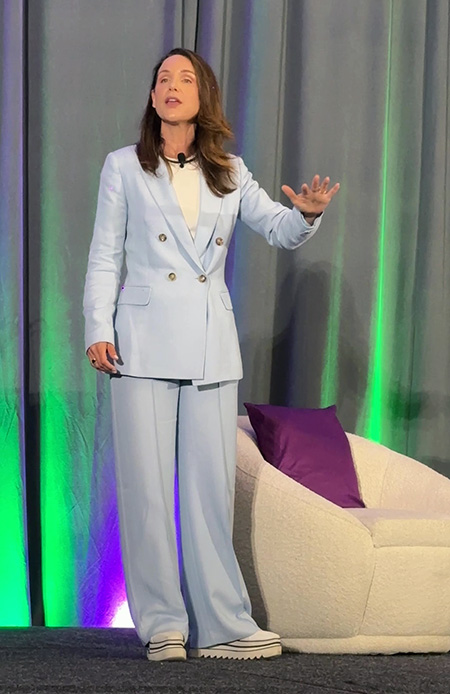
Emily Cohen, CEO of California's major union construction group United Contractors, shared her career momentum. “I had to be willing to push past the fear of failure alongside me for the entire ride," she told attendees at GWIC 2026 in San Diego.
Photo by Scott Blair/ENR
At the Groundbreaking Women in Construction conference held earlier this month in San Diego, attendees were urged to transfer their determination and confidence from solving their own workplace crises to risktaking necessary to tackle economic, project and workforce complexities across the industry.
“How we lead ourselves ultimately determines how we change this industry—through self-limiting beliefs … fear of criticism or judgement from others, moments of permission that no one is giving and … in spite of the voice in our own head,” said Emily Cohen, CEO of United Contractors, one of California’s largest and most influential contractor groups, in sharing her career momentum with the more than 660 people attending the event.
“I had to be willing to push past the fear of failure alongside me for the entire ride," said the chief of the trade group with more than 800 union contractor and associate members representing 40,000 employees who was elevated to CEO last year. “The key is knowing how to hide it, when to overcome it, and when to use that fear as fuel to take the big risks. This lesson in managing fear has been as much a part of my leadership journey as anything.”
Veteran industry C-suite members said industry leadership needs are generating change. "Leadership in the industry really is past the stereotypes, and all the bravado," said Bob Clark, executive chairman of contractor Clayco. "Leaning into technology is really super critical and will level the playing field, absolutely."
Developing and sustaining the right culture also is key, others said.
"Really strong culture allows people to not only be who they are, but also who they want to be, and for me that's really been so empowering," said Krista Twesme, senior vice president of Mortenson. "It's taken a little bit of time for construction to really figure out that culture is not programmatic, it is lived."
Three C-suite chiefs—Dina Kimble, president and CEO of Royal Electric Co., Mary Teichert, CEO of Teichert Inc. and Staci Woolsey, CFO of Granite Construction—recalled that overcoming bumps in their leadership journeys has led them to smooth and expand paths for next-generation women. Teichert said she urged company managers to focus on people, not just numbers.
"What I learned is how to use my agency—starting small in areas or departments that I could influence, she said. "If you lead for people and take care of people, the numbers will come.”
Looking for quick answers on construction and engineering topics?
Try Ask ENR, our new smart AI search tool.
Ask ENR →
Living in Miami, Anya Freeman knew well the impacts of rising seas and climate change, so her motivation was clear in a career switch from government prosecutor to founder and CEO of Kind Designs, a tech startup that installs its own 3-D printed “living seawalls” at U.S. coastal sites, with growing buy-in from customers and investors.
Noting cost savings to install a living seawall compared to a traditional one, she said the firm ended its first year in 2025 with $1 million in revenue and a nearly $150-million work pipeline.
Freeman said her push for startup funding benefited from access to “many VCs and competitions that specifically invest in women tech firm founders. "I've really been able to leverage a lot of that to bring on bigger investors," she said. Freeman moved her first project into construction by convincing the contractor to invest in the firm. "Nobody wanted to be the guinea pig," she said, noting liability fears then. Now, Freeman emphasized, "We're working on something so cool and so transformative, and I am able to transfer that excitement to my team and attract the best of the best.”
GWIC Creates Scholarship
Aiming to propel the next generation of women tech and business innovators, construction law firm Peckar and Abramson, for which ENR produces GWIC, announced the annual Melinda S. Gentile Future Groundbreaker Scholarship. It recognizes the firm's retiring partner who launched the conference 23 yeas ago and who has since been a key orchestrator of its content and execution.
It’s a team effort.
Monetary awards will be given to a student, a high school teacher and a mentor who help inspire future industry professionals selected by the ACE Mentor program of America to support education and to attend the GWIC conference. The program links high school students with design and construction sector experts to encourage pursuit of careers.
Academic and company chiefs also focused on how students and emerging professionals are using artificial intelligence.
"I encourage our students to actually use AI not just as a tool, but also as a collaborator. It is truly important that students and the future workforce understand that they have to know how to maintain critical thinking with regard to AI,” said Doris Espiritu, district-wide Dean of Engineering at the City Colleges of Chicago. “Otherwise, you're going to have bridges that fall apart if we just believe in AI."
Added Lucy M. Labruzzo, CEO of San Diego-based Engineering Partners Inc., "We can solve the technical issues in a day, but managing stakeholders, communication and collaboration takes months, and that's really where we're focusing our team. We use AI, but that doesn't mean we're going to lose positions, it's to create opportunities for more growth."
Using AI for technical tasks such as data management "allows our people to get in the field, learn construction and how to connect," emphasized Emily Kay, CEO of Balfour Beatty California operations.
Experts also focused on new industry diversity approaches such as keeping career opportunities open for those with neurodiversity challenges such as autism, ADHD, dyslexia and dyspraxia. Meredith Adragna, director of talent acquisition at The Haskell Co., said her firm evaluates applicants’ job descriptions, leadership tracks and how they talk about neurodivergence.
“You are supported at each level, you master each level, and then you move on. You feel your wins and the team sees this,” she said. Added Shana Francesca, founder of Concinnate, which partners with organizations to promote neurodiversity inclusion, “There's a lot of power in that, and [the AEC industry can] do the uncomfortable work that it will require.”
Expanding Leadership Niches
Speakers also weighed in on efforts to expand women's leadership in key niches. Through the Women Building Airports initiative at Los Angeles International Airport, “It’s important to push out important information about the women of influence within your organization … whenever there’s an opportunity,” said Amy Imamura, director of capital program outreach and engagement at LAX owner agency Los Angeles World Airports.
The initiative sponsors events where women can share achievements and meet industry peers, with some hosting more than 300 attendees, she said. The group also sponsors a formal mentoring program that matches newer employees with more seasoned professionals.
Amy Henningfield and Lizabeth Howard, Superior Construction rising managers, are developing women craft workers and others into future company leaders through emphasis on intentional upskilling, cross-functional understanding and strong peer support systems. Now in its third year, the program boasts 70% of participants coming from the field and focuses on bridging gaps between roles.
“If somebody needs to understand who to call, why to call them, or be an advocate, then you've got a group around you,” Henningfield said. With the current labor shortage and women a key source, support is crucial to the industry’s future. “We know we aren’t going to change the industry by ourselves,” Howard said. “It’s a team effort.”
Valeria Wright, project director at contractor J.A. Watts and immediate past president of the Chicago chapter of the National Association of Women in Construction, emphasized to attendees the importance of “owning” their wins and seeking deserved recognition.
“Your work cannot speak for itself,” she told the audience. “You have to give it a voice. Advocate for your accomplishments … and ensure your contributions shine in any environment."