Women Take Their Place to Meet New Construction Challenges
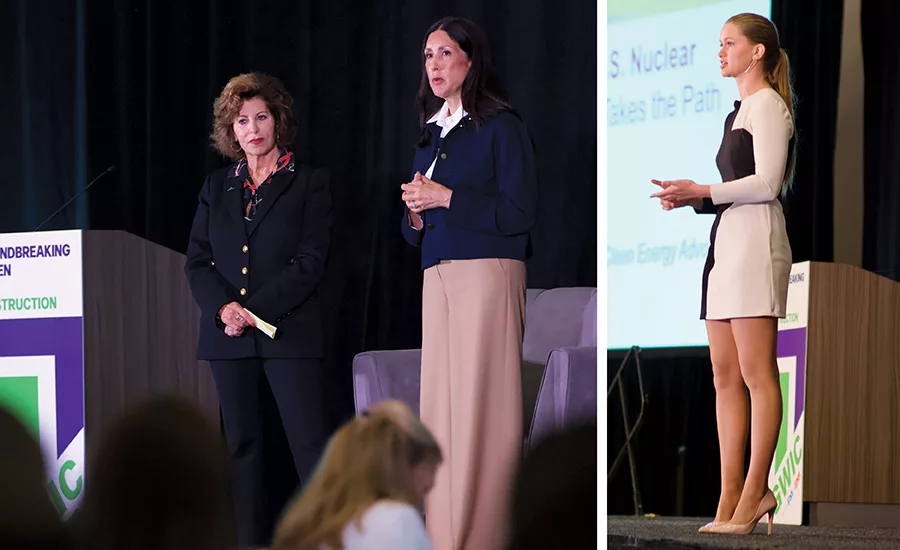
C-suite leaders Jacqueline Hinman, CEO of Atlas Technical Consultants, far left, and Terri Mestas, deputy CEO for megaproject delivery at Seattle area regional transit agency Sound Transit, (left, center), offered veterans' career wisdom to attendees while newly degreed nuclear engineer Grace Stanke (right) shared her nontraditional choices.
Photo by Audrey Alba Films
Showcasing determined effort and new-age tools to deliver complex projects and bottom-line returns in an increasingly challenged industry market, women leaders delivered strong messages at the ENR Groundbreaking Women in Construction conference held June 9-10 in San Diego. Despite unfolding uncertainties linked to court rulings and Trump administration edicts targeting company diversity, equity and inclusion policies, presenters—including C-suite chiefs—voiced need for and commitment to expanded career and leadership roles for all in construction.
Turner Construction’s DEI strategy “has not changed, and we’re not going to change it,” Peter Davoren, chairman and CEO of the building construction giant, told nearly 600 conference attendees. “Do we run the risk of going afoul of the federal government? We all do. No one’s exempt, but inclusivity makes sure we give people an opportunity, so we evaluated the [Trump] executive order and we are within the law.”

Turner Construction’s DEI strategy “has not changed, and we’re not going to change it,” Peter Davoren, chairman and CEO of the building construction giant, told nearly 600 Groundbreaking Women in Construction conference attendees June 9. All photos by Audrey Alba Films
Noting a current construction workforce gap of about 500,000, which could rise to 750,000 next year, he said “we won’t meet that demand unless we make the industry a place for everyone from every background [to] feel welcome and see a future for themselves. What matters most isn’t just what we build, it’s the culture we create when building it.”
Noting that 53% of people in any job leave because they “don’t like the environment,” Stephanie Schmidt-Lehman, Associated Builders and Contractors executive vice president and former president of Poole Anderson Construction pushed attendees at GWIC—produced by ENR for law firm Peckar & Abramson—to “lead change” in workplaces, from ensuring women have personal protective equipment specific to their size to offering wellness benefits for all employees.
CEOs: Study Admired Leaders
While changing policies and economics make it a tough time to be a C-suite leader in construction, chiefs Jacqueline Hinman and Terri Mestas advised younger professionals on the leadership path to advocate for themselves and to study leaders they admire. “I love watching how other leaders get people to be energized and follow them,” said Hinman, "Those skills are really critical." The CEO of Atlas Technical Consultants, who formerly rose to be chief of one-time industry design and construction management giant CH2M.
For Mestas, who now is deputy CEO for megaproject delivery at Seattle-based regional rail agency Sound Transit embarking on a major system upgrade, “Confidence is key. If you don’t ask, you don’t get,” she said, but “how you help people will be your legacy.”
With a 40-plus-year career as an owner and construction advisor who faced pushback at many points, Greatness Consulting CEO Gretchen Gagel shared candid stories and leadership lessons that also now fill her new book, Building Women Leaders: A Blue print for Women Thriving in Construction, which includes input from 129 industry veterans, real-world case studies, experiences of successful women leaders and actionable strategies.
Also founder and CEO of Women Thriving in Construction, a global institute created to lead and fund collaborative efforts to promote women in the industry, Gagel advised attendees “to back yourself” in making “hard decisions you feel are in your best interest [and] surround yourself with people who back you.”

As a Black woman contractor who has faced jobsite harassment, Jennifer Todd shared how she gained courage to “disrupt” the status quo and a 16 year industry track record, is a recognized influencer as president of a Florida demolition firm.
As a Black woman contractor who has faced jobsite harassment, Jennifer Todd shared how she gained courage to “disrupt” the status quo. Now, after 16 years in the industry, she is a recognized influencer as president of a Florida demolition firm and founder of nonprofit A Greener Tomorrow that connects women, minorities and youth to industry craft and technical career training. “I didn’t see women like me who were young, bold and ambitious leading jobsites or on the front lines in boardrooms and on stage,” she said. “It wasn’t because we couldn’t do it. It was because industry didn’t expect it from us.” Added Todd: “That’s when disruption happened. Disruption isn’t noise, it’s clarity.”
Todd debuted in March “Breaking Barriers, Women at Work,” a five-part YouTube docuseries she produced—with equipment giant John Deere as a financial sponsor— that highlights industry women changing construction culture. “It’s scary times to say DEI because you might get canceled, and people and organizations don’t know what to do and are afraid of the word 'diversity,'” she said. “Women were stuck into this box of being DEI and some didn’t even know until this news came out.” But “the industry is ripe for women who are courageous … with a desire to lead,” Todd said. “You have to show up … or you’re just going to get what’s handed to you.”
Women managers from contractors Mortenson and Hensel Phelps and tech giant Meta didn’t wait to take lead roles in the rush to build U.S. data centers, they told attendees. Mortenson Executive Vice President Maja Rosenquist noted the tech firm’s Louisiana project on which women are 30% of its craftworkers. “Women that I … work with at Meta have different roles but all are doing something new,” said Meta preconstruction manager and chief estimator Katie Freed, “from rethinking how to scale design and work with multiple partners to being responsible for financials of one of the largest capacity projects in the U.S.” Hensel Phelps Chief Estimator Sarah Forrest added, “We’re doing something that’s changing the world.”

On a data center in Louisiana being developed by tech giant Meta, women make up 30% of craft workers for a 350 person-workforce site, Mortenson Executive Vice President Maja Rosenquist (left) said at GWIC, She joined project leaders, Meta preconstruction manager Katie Freed (center) and Hensel Phelps Chief Estimator Sarah Forrest in discussing the sector.
Talking Tech
Women leading construction technology as innovators, implementers and investors are showing up for larger pieces of a growing pie, with $5 billion invested globally last year, said Julieta Moradei, managing partner of investor Overlay Capital. “But less than 1% of venture capital funding goes to female founders, so we have a lot of work still to do, and women are going to do that work and pioneer the future.”
Katie Bond, senior vice president of Alice Technologies, an AI-powered construction scheduling software firm, is one. “We need infrastructure, clean energy, affordable housing, and it’s become incredibly expensive and hard to build, with 80% of megaprojects over time or over budget,” she said. “We have to do better … .the only path forward is for builders and technologists to come together and build the future we want to see. I'm very excited to be part of it.”
Thst is critical with workforce shortages, added Jenny He, a PhD computer engineer who founded California startup Ergeon, which makes technology core in home renovation and to support small contractors. “We take on the responsibility of doing all the front and back office work, allowing them more time to do the building,” she told attendees. “It's a really exciting space to be, and there are many, many ways to solve this problem. Ergeon has raised about $65 million in five funding rounds and announced a partnership last year with Sears 'Home Services. Said He: "What we see as necessary to have that collaborative culture is an open mindset to change"
Added Erin Khan, a former Suffolk Construction manager who founded her own tech consulting firm: “I loved collaboration but was horrified by having stacks of paper, literally as tall as I was on the job site, and iPads that my team didn't really know how to get the most out of.” As an entrepreneur, she aims to support more organizations to find the right solutions and scale them for client businesses to gain competitive advantage “where folks aren't afraid to try something new.”
But related to tech, Khan cautioned attendees not to “fall for the shiny object syndrome," which now with artificial intelligence in the mix, "is way, way more shiny. So you really need a guide post to keep you on track.”
What's on the Horizon?
In a deeper dive on AI, industry users noted the breadth of developing applications to expedite data searches and other time-consuming tasks. Michael McGrattan, chief information officer of consultant Dudek, said the firm is “really looking at it as a key enabler to our innovation. We’re trying to leverage it … across our enterprise, so we can use it in consistent ways.”
Best Contracting 'Services has used AI tools "to create customized training videos that hone in on our specific company policies, procedures and practices in a way we couldn't do before," without spending thousands of dollars to produce each, said Jesse Torres, firm chief administrative officer. "They really empowered us to create tools to educate and train our folks, who get information the way they want it received ... and very economically and very quickly."
But McGrattan noted "absolutely, absolutely the risk of AI quality in underlying data that it's using," adding that "we are seeing more and more in our contracts ... disclaimers that you cannot use artificial intelligence to produce deliverables." He noted need for "subject matter experts to really vet what's getting produced and make sure it is accurate, or you're going to get into legal and ethical situations you don't want to be in."
In response to fears AI will eliminate jobs, STV digital advisory analyst Azita Morteza emphasized that “we still need humans in the loop, we still need strategic thinking. It’s about embracing this change and learning these new tools.”
Grace Stanke, a 23-year-old nuclear energy fuels engineer and sector advocate for developer Constellation Energy, related her decisions to choose that engineering career path before its current resurgence to meet new global power demands, and to opt for an equally unlikely approach to financing her education—winning the Miss America pageant in 2023, which provided her thousands of dollars in scholarships to support her University of Wiscnosin engineering degree and currently, pursuit of an MBA.
Despite different engineering career tracks taken by her brother, an electrical engineer, and her father, a civil engineer and former vice president of Top 400 bridge contractor Kraemer North Americs, Stanke was intrigued by the developing nuclear comeback: “In 2022, a Gallup poll said public perception of [it] was at about 47% acceptance in the U.S.” she said, with that metric reaching 54% in 2023 and 61% in 2024.
“Women just need to work on taking up their space,” Stanke urged attendees, “You worked for it, you did the job, you accomplished it. Take that space.”