Clean Energy
UPDATED Trump Offshore Wind Energy Buyout Deals Grow to Nearly $2.6B, With More Tumult
California said June 23 it intends to sue US Interior Dept. and developer Golden State Wind LLC for an "unlawful agreement" to cancel $120M Morro Bay lease for 2-GW floating wind project.
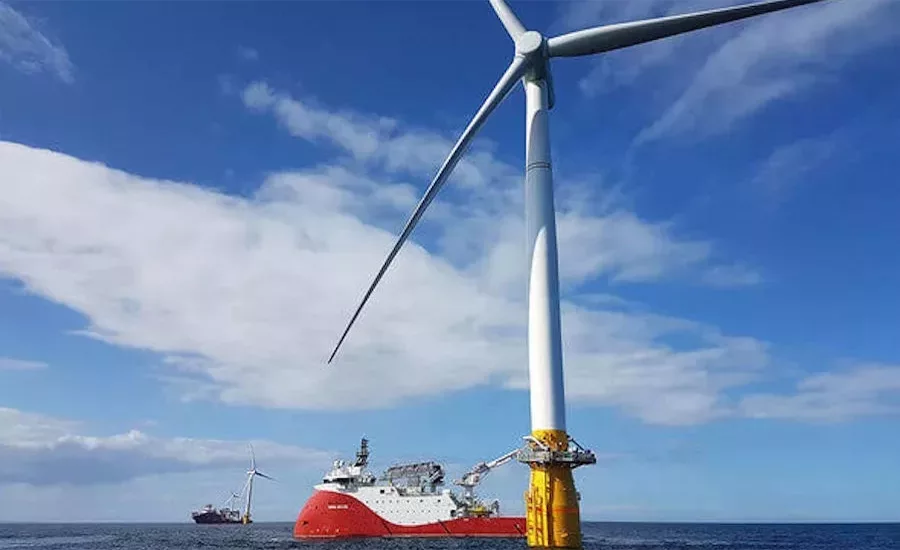
Administration wind energy site lease buyouts include deep-water areas in California, where floating wind technology similar to this turbine, seen in Scotland, was set to be used.
Even as seven states sue the Trump administration in federal court to challenge the legality of its deal with energy developer TotalEnergies to convert two U.S. East Coast offshore wind site leases valued at $928 million to oil and gas projects in other states, new buyout agreements have been made.
The U.S. Interior Dept. said June 17 it reached a deal to pay developer Invenergy about $765 million to “voluntarily terminate” four ocean tract leases off New Jersey, Maine and central California that were procured in auctions during the Biden administration. Invenergy will redirect the money “toward other domestic energy sources,” the agency said, including natural gas-fired power plants in Indiana, Wisconsin, Iowa, Kansas and Missouri and geothermal power projects in western states. Invenergy expects to start exploratory drilling this year at geothermal sites in California, Idaho, Nevada and other states, according to the Los Angeles Times.
Invenergy and partner energyRE had intended to build the 2.4-GW Leading Light Wind project in its offshore lease area adjacent to New York and New Jersey, with power originally intended to support both statss. But it was cancelled in November 2025 due to cost and supply chain challenges “that have made the development of new offshore wind energy projects extremely difficult,” according to a NJ state filing by the developers. Invenergy's other lease areas, two in the Gulf of Maine and one off Morro Bay, Calif., had potential of 4.8 GW in power capacity.
The company “will deploy additional capital into projects that can be delivered on a commercially reasonable timeline and meet customer demand while continuing to evaluate opportunities as market conditions evolve,” said Daniel Runyan, Invenergy senior vice president for development.
“Rather than supporting large-scale, homegrown energy solutions which are already delivering savings for Northeast residents, these actions undermine local economies and threaten American jobs and energy affordability,” said offshore wind advocacy group Oceantic Network. It estimates that cancelling one 1-GW offshore wind project permanently removes up to $9.5 billion in U.S, economic output.
But Invenergy is still proceeding to build Grain Belt Express, an estimated $11-billion high-voltage transmission line set to cross 800 miles in four Midwest states to deliver solar and wind power to the eastern U.S., despite the administration revoking last year a $4.9-billion conditional federal loan guarantee. Now as a privately financed project, preconstruction and engineering is underway on the project's first phase in Kansas and Missouri. The line also will be built in Indiana and Illinois. Quanta Services and Kiewit Energy Group are major first-phase contractors, under $1.7 billion in combined contracts awarded last year.
Meanwhile, regulators and public officials from nine northeast states and Washington, D.C. issued three new reports in June to advance plans for an Atlantic coast offshore wind high-voltage direct current transmission network to link power from existing and soon to complete projects. The reports offer technical standards and policy recommendations for states, grid operators and power sector firms and associations to work "from a shared framework, " said Weezie Nuara, Massachusetts deputy secretary for federal and regional energy affairs.
Looking for quick answers on construction and engineering topics?
Try Ask ENR, our new smart AI search tool.
Ask ENR →
The collaboration, which launched last year, also includes those from Connecticut, Delaware, Maine, Maryland, New Jersey, New York, Rhode Island and Vermont. Reports also offer network design and reliability standards for regional offshore transmission, and procurement and contracting strategies. “At a time when the federal government is doing all it can to sow chaos and disrupt our energy supply, New Jersey is committed to pursuing new generation,” said state Board of Public Utilities President Christine Guhl-Sadovy, adding that consortium members are “committed to doing the hard technical and policy work now so ... the region is ready to move without delay when conditions change.”
States also gained new legal support in mid June from actions by two Boston federal courts. An appellate court judge granted Interior's request to no longer fight a suit by 17 states against a 2025 Trump executive decree to ban all U.S. offshore and onshore wind projects, and a district court judge said clean energy developers had grounds to continue their suit against department and US Army Corps of Engineers policies they claim hinder solar and wind power projects.
Invenergy Deal Follows Others
The Invenergy wind buyout deal follows ones reached in April with developers of Bluepoint Wind and Golden State Wind projects to give up their offshore wind leases respectively, off New York-New Jersey and off California—and redirect investment of about $885 million to "LNG projects, oil and gas assets and other energy infrastructure" in Gulf Coast areas, Interior said. Funds include about $765 million for the Bluepoint Wind lease and $120 million for the Golden State lease, set for the Morro Bay. Calif., wind energy area. Both developers then “decided not to pursue any new offshore wind developments in the U.S.” Interior claimed.
UPDATED: In a June 23 announcement, California Attorney General Rob Bonta and California Energy Commission Chair David Hochschild notified the Interior and developer Golden State Wind LLC of an intended lawsuit against them for an "unlawful agreement that puts at risk California’s clean energy gains, thousands of high-quality jobs, and more than $100 million in public investments in the offshore wind industry, including voter-approved climate funds." They said, if the deal proceeds, it "threatens to set back California’s burgeoning offshore wind industry by years." The firm had planned a 2-GW floating wind project and earmarked $30 million for workforce training, supply chain development and local investment.
Bonta and Hochschild also said an investigative subpoena was issued to Invenergy that demands a copy of its agreement with Interior for its California site, which it claims the agency has not released, and seeks added detail on its "negotiation and impact."
The Trump administration did not comment on the California lawsuit if the action did not change in 60 days. In announcing the Invenergy deal, Associate Attorney General Stanley Woodward had said his agency "looks forward to continued cooperation from companies that are reevaluating their energy investments."
In its TotalEnergies deal, Interior said funding from cancelled leases offshore of New York-New Jersey and North Carolina would be diverted to build new trains at the Rio Grande LNG terminal project in Texas, develop “upstream conventional oil" in the Gulf of Mexico and into shale gas production. Interior Secretary Douglas Burgum has said the agreement was voluntary.
According to Interior, the settlement agreements. estimated to now total $2.6 billion, would be paid from the U.S. Treasury Dept. taxpayer-funded Judgment Fund. But according to the June 2 suit by attorneys general form New York, New Jersey, Connecticut, Maine, Massachusetts, Rhode Island and Vermont, "no statute authorizes Federal Defendants to use a sham settlement agreement to unlawfully cancel an offshore wind lease and redirect the money paid for the lease to a separate, unauthorized use favored by the President."
Sierra Club Senior Advisor Nancy Pyne called the agreements “shady backroom deals.”
Meanwhile, TotalEnergies may have more difficulty trying to recover recent offshore wind energy investments in Germany, as it seeks to withdraw from one project due to what it said is delays in grid connections and lagging economic conditions, according to European press reports.
TotalEnergies said it is in talks with the German government related to an estimated $7 billion payment for several leases won in a 2023 auction, according to the reports. The firm said it is "actively working on the realization of our projects" and is seeking "practical solutions."