Confidence Index
1Q 2026 Cost Report: Data Centers Propping Up a Fragile Construction Market
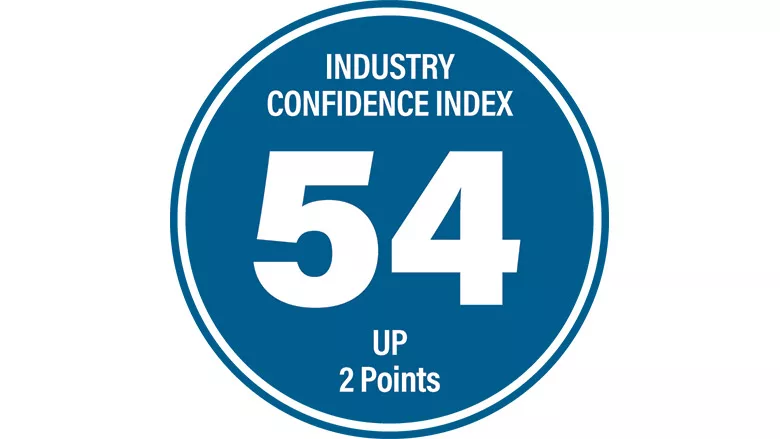
ENR’s Construction Industry Confidence Index rose modestly between Q4 2025 and Q1 2026, up two points to a 54 rating. The index has been climbing slowly and steadily since Q2 2025, up seven points since that reading. ENR’s economic index stayed flat at a slightly pessimistic 48 rating.
The confidence index measures executive sentiment about where the current market will be in the next three to six months and over a 12- to 18-month period, on a 0-100 scale. A rating above 50 shows a growing market. The measure is based on responses by U.S. executives of leading general contractors, subcontractors and design firms on ENR’s top lists to surveys sent between Feb. 9 and March 16.
Confidence in the current market and the market 3-6 months from now remains strong, but execs report more pessimism about the market 12-18 months from now. Last quarter 53.5% of respondents saw an improving market in 12-18 months. This quarter that percentage has dropped to 44%. The percentage of firms who foresaw an improving economy 12-18 months from now also fell, down to 33.3% from 44.7%.

Design firms remain more pessimistic than either GC/CMs or subcontractors. Confidence for designers came in at a 41 rating, down three points from last quarter, with 43% of design firms seeing a declining market 3-6 months from now. GC/CMs rose eight points to 55. Subcontractors remain the most confident, coming in at a 58 rating.
The largest and smallest firms reported significantly different levels of confidence in the market. Confidence among firms who self-reported $250 million or more in revenue came in at a 61 rating. Firms who reported under $50 million in revenue came in at a 43.
ENR’s results are largely mirrored in the Confindex survey from Princeton, N.J.-based Construction Financial Management Association (CFMA). Each quarter, CFMA polls CFOs from general and civil contractors and subcontractors on markets and business conditions. The resulting Confindex is based on four separate financial and market components, each rated on a scale of 1 to 200. A rating of 100 indicates a stable market; higher ratings indicate market growth.
The overall Confindex rose four points to a 110 rating. The business conditions index rose eight points to 113 and the current confidence index rose seven points, to 104. The financial conditions and year ahead outlook indices stayed virtually flat, coming in at 108 and 118 respectively. All indices are down in comparison to Q1 2025, except the business conditions index, which saw no change.
Looking for quick answers on construction and engineering topics?
Try Ask ENR, our new smart AI search tool.
Ask ENR →

Neil Shah, CFMA’s CEO, sees a still growing but potentially fragile construction market. “We’re not diversified in asset classes from a construction perspective,” he says. Data centers and energy projects aside, most construction sectors “aren’t in great shape,” he explains. “And from a federal perspective, I don’t see where the money comes from to reauthorize more infrastructure spending when we’re spending on a lot of other things, including a war in the Middle East.”
CFMA advisor and Sage Policy Group CEO Anirban Basu concurs: “The critical aspect to 2026 in my mind, has been bringing down interest rates so that interest rate sensitive project types can move forward. Those projects are still sidelined in many cases.” Basu echoes the sentiment for the U.S. economy as a whole: “When you’ve got such a narrow foundation, the entire U.S. macro economy can wobble, and that’s why there’s so much concern out there. Costs keep rising. Interest rates stay high, and the economic expansion is narrowing to include a smaller and smaller constellation of economic actors,” he says.
“Coming into the year, the expectation had been two or three rate cuts in 2026, which would have brought the upper limit to the federal funds rate down to around 3%,” he says. “Instead, what we’re getting is 10-year treasury yields rising.” The Sage CEO expects at most one rate cut this year.
Still, Basu does not foresee a recession in 2026 as the data center boom shows no sign of abating. “You see Mark Zuckerberg announcing layoffs on the one hand and more expenditures than anticipated in AI infrastructure on the other hand. The commitment to spend on AI infrastructure is increasing, not decreasing,” he says.
Those firms hoping for more public dollars to flow into the construction sector are likely to be disappointed, opines Basu. “State level government finances have really deteriorated the last year or two. Last year, for instance, you had debt downgrades in Chicago, Los Angeles [and other places]. You just don’t have as much state money.” The federal government has shown no signs of authorizing a new public works package. “We had a $1.2-trillion package, [with] $550 billion of new money under Biden. The Trump administration talked about $20 billion and the rest as public-private partnerships. Who knows if that works or not?” Basu says.
Basu has been advising those public works and heavy civil contractors to sell their business soon if they want to maximize their value. “Your financials are great right now, but in four or five years, I think the money is gone,” he explains. “[In a few years] the Social Security trust fund goes insolvent; Medicare trust fund goes insolvent; and you’re not going to look as good on paper or in reality. I’ve yet to have one contractor say: ‘You’re dead wrong about that.’”
Related links:
Economics: Non-building Work Leads Industry Starts Through First Quarter
Confidence Index: Data Centers Propping Up a Fragile Construction Market
Labor: Executive Compensation Increases Continued to Drop Last Year Following 2023 High
Equipment: Equipment Pricing Maintains Stability, but Rising Fuel Costs May Impact Fleet Refreshes
Methodology: Tariffs Contributed to Price Hikes for Many Materials in 2025