Ports of Entry
Trump Threatens to Block Opening of Gordie Howe Bridge
The $4.4-billion Detroit–Windsor megaproject faces political uncertainty despite nearing completion and handling a quarter of U.S.–Canada trade
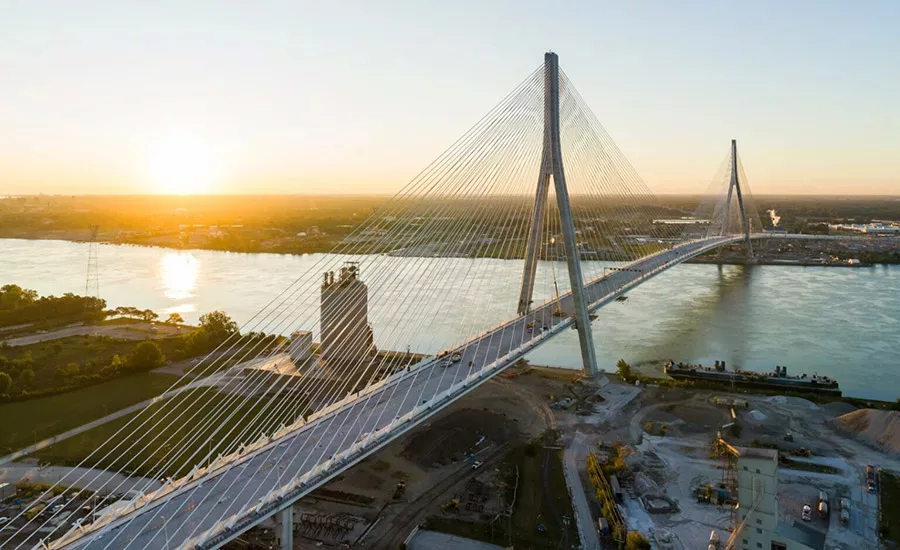
The Gordie Howe International Bridge spans the Detroit River between Detroit and Windsor, Ont., a nearly completed $4.4-billion crossing whose planned 2026 opening has been thrown into uncertainty by President Donald Trump’s threat to block the project’s launch.
Updated 8:53 PM EST, Feb. 11, 2026
President Donald Trump has threatened to block the opening of the Gordie Howe International Bridge, a nearly completed U.S.–Canada megaproject slated to open in 2026, prompting swift pushback from Michigan officials who say the crossing is vital to regional trade and jobs.
In a Feb. 9 post on the Truth Social platform, Trump said he would not allow the bridge to open unless the United States is “fully compensated” for what it has provided to Canada and suggested the U.S. should have an ownership stake in the asset. The comments inject political uncertainty into a project that is already built and entering final commissioning.
Since then, U.S. Customs and Border Protection has published a final rule in the Federal Register formally establishing the Gordie Howe International Bridge as a Class A port of entry for immigration purposes and designating it as part of the port of Detroit for customs purposes, effective March 2.
The rule states CBP will notify the public when the crossing is fully operational and open to traffic.
RELATED
Opening of $5.9B US-Canada Gordie Howe Bridge Set for Next Year
Michigan officials warned the threat puts economic interests at risk. Sen. Elissa Slotkin, a Democrat, said blocking the bridge would have “serious repercussions,” the Associated Press reported, raising costs for businesses, weakening supply chains and costing jobs in a state that relies heavily on cross-border trade with Canada.
Looking for quick answers on construction and engineering topics?
Try Ask ENR, our new smart AI search tool.
Ask ENR →
Gov. Gretchen Whitmer’s office struck a more defiant tone. A spokesperson said the bridge was built with union labor on both sides of the border and will strengthen Michigan’s auto industry and manufacturing base, adding, “It’s going to open one way or another.” The governor, the spokesperson said, is looking forward to the ribbon cutting. Rep. Debbie Dingell described the project as critical to the national economy and said she is “looking forward to the bridge’s opening,” while Rep. Shri Thanedar said blocking the crossing would be “crazy.”
Local reporting in Detroit also indicates the White House has “doubled down,” with officials telling WDIV-TV that Trump has authority to amend the bridge permit. The statement follows Trump's post on Truth Social, in which he said he would prevent the bridge’s opening until Canada treats the U.S. with “fairness and respect.”
In Canada, Prime Minister Mark Carney said he expects the issue to be resolved, Reuters reported on Feb. 10, adding that Ottawa remains committed to the project’s planned 2026 launch. The Windsor-Detroit Bridge Authority said in a statement that the bridge remains on track for an early 2026 opening.
"The development of the Gordie Howe International Bridge has been underway since 2000, with representatives from U.S. and Canadian federal, Michigan, and Ontario governments collaborating to optimize the movement of people and goods through the critical Windsor-Detroit trade corridor," the statement read, in part.
The Last Mile
Gordie Howe Bridge | Testing and Commissioning Explained
The cable-stayed bridge over the Detroit River is being delivered under a public-private partnership by Bridging North America, with construction led by Fluor. The roughly $4.4-billion project includes the bridge span, new U.S. and Canadian customs plazas and highway connections. Major construction is substantially complete, with remaining work focused on systems installation, testing and operational readiness.
Canada, through the Windsor-Detroit Bridge Authority, is financing the project and plans to recover its investment through toll revenues. The crossing is intended to relieve congestion at the privately owned Ambassador Bridge and provide redundancy along the Detroit–Windsor corridor, which handles roughly a quarter of all U.S.–Canada trade by value, making it one of the most critical freight gateways in North America.
While Canada has funded the project, the bridge cannot open to traffic without approval as an international port of entry by U.S. Customs and Border Protection, giving the U.S. federal government a procedural role in the final steps toward opening.
Under federal law, CBP does not approve or certify bridge construction itself, but is responsible for designating and staffing ports of entry. Statutes governing that process focus on operational readiness, security and inspection capacity, including the functionality of inspection facilities, staffing and systems required to process traffic.
Ownership structure, financing arrangements or broader trade disputes are not among the criteria CBP is authorized to consider when certifying a port of entry. In its final rule, CBP reiterated that its authority centers on inspection capacity, staffing and operational readiness, not project financing or ownership structure.
RELATED
Port of Entry Facility Opens in San Ysidro
That framework is consistent with how CBP has handled other major crossings. ENR has previously reported that at the San Ysidro Land Port of Entry in California, new inspection facilities opened in phases as construction wrapped up and staffing and systems were brought online, rather than being blocked outright once the project was physically complete.
As a result, any federal action to delay the Gordie Howe bridge’s opening would likely need to be tied to administrative or operational determinations by CBP or other homeland security officials, rather than the physical status of the bridge itself.
As of Feb. 11, neither the U.S. Dept. of Transportation nor the Dept. of Homeland Security had announced any action to alter the bridge’s anticipated 2026 opening timeline beyond the previously published port-of-entry designation.
This is a developing story and will be updated as federal agencies and Canadian officials respond.

Bryan Gottlieb is the online editor at Engineering News-Record (ENR).
Gottlieb is a five-time Society of Professional Journalists Excellence in Journalism award winner with more than a decade of experience covering business, construction and community issues, including finance, law and real estate. He has reported for Adweek and the San Diego Daily Transcript and led a community newsroom in Santa Monica, Calif. He served as editor-in-chief of the Detroit Metro Times and as managing editor at Roofing Contractor, where he helped shape national industry coverage. At Engineering News-Record, Gottlieb covers breaking news, large-scale infrastructure and megaprojects, regulatory developments and business trends across the U.S. and global construction sectors.
email: gottliebb@enr.com | office: (248) 786-1591