Federal Government
States’ Uncertainty Grows as FEMA Eyes More Staffing Cuts
Agency could be impacted by possible partial shutdown in light of growing displeasure over recent actions of the Dept. of Homeland Security
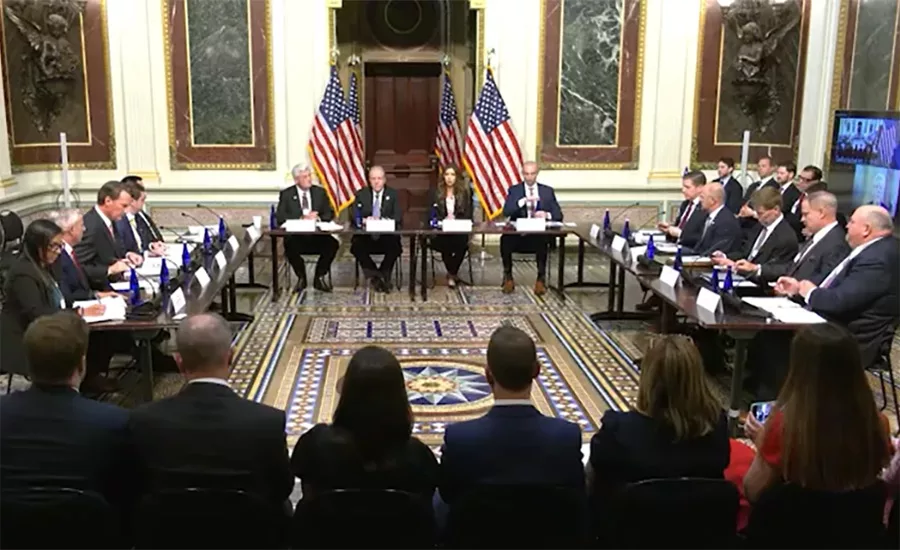
A presidentially appointed panel tasked to revamp FEMA and shown here at a fall 2025 Washington, D.C. meeting, still has yet to release a report with recommendations that was promised last November. In a Jan. 24 executive order, the president said the FEMA Review Council is “continued” until March 25.
This story was updated Jan. 29 to include a response from a FEMA spokesperson.
States will likely face even greater challenges in providing timely disaster response and recovery aid to communities if more staffing cuts are ordered for the Federal Emergency Management Agency, a former senior agency official told ENR.
The agency, known as FEMA, which lost more than 2,000 jobs last year through layoffs and voluntary incentives, is set to allow contracts of 1,000 of its cadre of On-Call Response/Recovery Employees (CORE) to expire by the end of January, according to media reports. The New York Times reported that it obtained an administrative document from FEMA parent, the U.S. Dept. of Homeland Security, calling for elimination of up to 50% of positions at the agency.
States with disaster and recovery projects currently underway will likely face major slowdowns if designated CORE workers must leave the job because their contracts are not renewed, the official said. Fewer FEMA staff will be on hand to interact with state and local authorities, helping them move projects through the system and getting them reimbursed for the rebuilding.
The move follows President Donald Trump’s announcement at the start of the 2025 hurricane season in June that he planned to phase out the disaster-relief agency and have state and local governments take on more responsibility.
In an email, a FEMA spokesperson said that the CORE positions are term-limited, designed to fluctuate based on disaster activity, operational needs and funding availability. "We are confident that our staffing decisions are consistent with the program's design and mission." Currently, FEMA is focusing its efforts on responding to the current winter storm that has impacted much of the U.S., the spokesperson said.
The former FEMA official, who requested anonymity, said that although the administration is focused on financial responsibility, it is both unrealistic and inefficient to have states build up their own resources and essentially take over the federal agency's job, because they lack the same economy of scale and are unable to maximize support through a centralized logistics system.
Looking for quick answers on construction and engineering topics?
Try Ask ENR, our new smart AI search tool.
Ask ENR →
The situation “is really problematic” because more than half of the workforce consists of disaster workers who are paid from the disaster recovery fund and are vital in seamless disaster response, the official said. About half of these employees are reservists called up during disasters, and about half are CORE employees who work in specialized roles including managing recovery programs. They serve for two- to four-year terms, but many have had their contracts renewed for ongoing work for years, the official said.
“These positions require a lot of training and time on the job and understanding of how the system works,” the official said. “If their contracts are not renewed on an indiscriminate basis, then it’s going to decrease the available assistance for the people who have been impacted by disasters and lead to the loss of critical skills and critical expertise that is going to be hard to restore.”
Chad Berginnis, executive director of the Association of State Floodplain Managers, said that CORE employees play a critical role in disaster response and are used extensively in the field.
While the group advocates for state and local governments to have strong roles in disaster recovery, “the fact remains that what FEMA is ultimately asking is for state and local governments to basically take the full responsibility of implementing programs” that they are not equipped to do, Berginnis said.
He noted the agency’s pullback on funding of major mitigation programs last year, including cancellation of its Building Resilient Infrastructure and Communities program. In addition, the president has not granted any Hazard Mitigation Grant Program requests since last March, he said.
“There is no good explanation for why any of this is happening, even with the overall idea of having more going to the states and communities,” Berginnis said. “At the end of the day, the disaster assistance programs that FEMA administers need the staff to help get that disaster aid to survivors in a timely way, and these cuts will make it harder for that to happen, hands down. … The reality is, you need boots on the ground to help make these programs work.”
One major frustration with FEMA in the last year has been its lack of official communication with stakeholders, Berginnis said. “Communications have all but ground to a halt from the very agency whose core mission is to coordinate with state and local agencies and other entities,” he said. “It is incredibly frustrating because we do not hear, nor understand even, any logical framework or approach that the administration is taking right now.”
Berginnis said that Congress appropriated funds for FEMA in fiscal 2025 and is getting ready to appropriate funds for fiscal 2026.
“Congress is saying, ‘Wait a minute, Mr. President,” Berginnis said. “Why are you not implementing the programs and funding that we have authorized you to do?' ”
Moving Toward Partial Government Shutdown?
The House narrowly passed a Dept. of Homeland Security funding bill on Jan. 22 that includes an 18% increase in FEMA’s budget.
The department spending bill had been expected to be considered by the Senate the week of Jan. 26 as part of a package funding also for the Depts. of Defense, Transportation and Housing and Urban Development. Although the Senate was poised to approve the bill, the Jan. 24 fatal shooting of Alex Pretti, 37, in Minneapolis by agents of the federal Immigration and Customs Enforcement agency—also a Homeland Security unit—following the Jan. 7 death of Renee Good at the hands of those agents, has spurred congressional concern and thrown passage into question, which also could push the government toward a partial shutdown.
The bill is the last of the annual funding bills to clear the House. To date, the House and Senate have passed several of the 12 must-pass bills.
Several Democratic leaders have said they will block the department spending bill, among them Senate Democratic leader Charles Schumer (D-N.Y.); Democratic Whip Dick Durbin (D-Ill.), ranking member of the Senate Judiciary Committee and a member of the Senate Appropriations Committee; and Sen. Patty Murray (D-Wash.), vice chair of the appropriations committee.
Schumer said Senate Democrats would not provide the votes needed to allow the appropriations bill to advance if the Homeland Security spending bill was included in the minibus package and suggested that the DHS funding bill be reworked separately. “The appalling murders of Renee Good and Alex Pretti on the streets of Minneapolis must lead Republicans to join Democrats in overhauling ICE and CBP to protect the public," he said in a statement.
“I will NOT support the DHS bill as it stands," Murray said in a post on X. "The DHS bill needs to be split off from the larger funding package before the Senate—Republicans must work with us to do that. I will continue fighting to rein in DHS and ICE.”
Republicans will need at least a few Democratic defectors to be able to advance the bills. At press time, several Republicans expressed outrage at the killing, with some calling for an investigation.
In September, the House Transportation and Infrastructure Committee approved bipartisan FEMA reform legislation that, among other things, would remove the agency from within the department and elevate its administrator to a cabinet-level position.