The Uncertainty for Climate Mitigation Amid FEMA's Shaky Future
September 25, 2025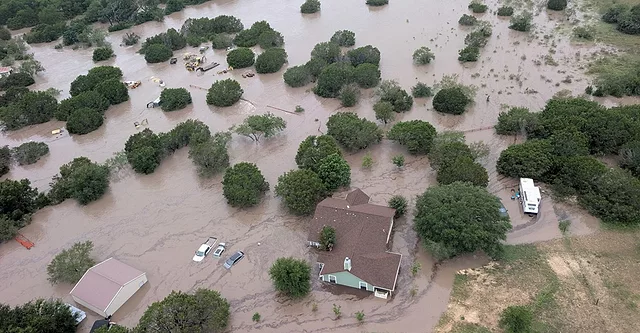
The Uncertainty for Climate Mitigation Amid FEMA's Shaky Future
September 25, 2025Flash flooding as in Texas this year has increased exponentially over the past decade, with costs rising along with the waters.

While a presidentially appointed panel deliberates the fate of the Federal Emergency Management Agency, and as Donald Trump’s administration and Republican lawmakers both call for drastic cuts to the state revolving loan fund program —the bread and butter for financing U.S. water and wastewater infrastructure projects —water-sector firms and municipal program managers say they are worried about whether and how they can still implement large infrastructure programs to reduce coastal and stormwater flooding.
Many public works departments and the design and construction firms that work for them already see fallout from the April suspension of FEMA’s Building Resilient Infrastructure and Communities (BRIC) program. Dan Buckley, a mid-Atlantic region preconstruction executive at Garney Construction, says some multiple-award task order contracts with various federal agencies for firms like his could be “in jeopardy.” Sunny Simpkins, executive director of the National Association of Flood and Stormwater Management Agencies, says the group “definitely has members that have lost BRIC money or had it put on hold, or projects stopped.”
A Portland, Ore., water quality district applied for a BRIC grant in 2023 but was told by FEMA staff to resubmit the application with minor adjustments. District staff collaborated with the agency and other departments over the next two years and reapplied before the deadline earlier this spring—only to learn a short time later that the BRIC program had been suspended. “It’s unlikely we’ll find a comparable source of funding,” a district spokesperson says.
The disruption in federal funding has created challenges for many communities trying to build large-scale coastal and stormwater flood protection projects, says Charles Corpening, chief investment officer and managing partner of private equity firm West Lane Partners, which aims to acquire or invest in firms that are active in perceived design and construction growth markets.
In some areas, including the cities of Norfolk, Va., and Miami, already-funded work on major stormwater management programs continues. In the latter, initial funding for a comprehensive stormwater management plan developed by CDM Smith has been distributed through general obligation bonds sold in a $400-million bond program and through community development block grants, says Juvenal Santana Jr., Miami’s director of public works.
The award in Norfolk for first construction contracts in Phase IA—the downtown portion of a group of levees, floodwalls and nature-based solutions that are part of the city’s $2.6-billion Coastal Storm Risk Management program in collaboration with the U.S. Army Corps of Engineers—are expected this fall, funded largely by the 2021 federal Infrastructure Investment and Jobs Act.
New York City announced Sept. 16 that it was beginning construction on a $218-million project in the Red Hook section of Brooklyn to protect residents from storm surge, which has received funding from a variety of sources, including FEMA’s Hazard Mitigation grant program. But millions of dollars in unallocated funds across the country have been called back or suspended, leading to project cancellations and confusion.
The Florida Dept. of Emergency Management recommended in a memo to “mitigation stakeholders” that they consider applying for funding opportunities other than BRIC, such as the Hazard Mitigation grant program, if they needed more funding to continue to advance critical projects.
Looking for quick answers on construction and engineering topics?
Try Ask ENR, our new smart AI search tool.
Ask ENR →

Calls to cut back or eliminate FEMA are coming at a time when damage from natural disasters continues to escalate. Rob Bhatt, an insurance specialist and licensed agent at ValuePenguin, says that according to his firm’s research in collaboration with LendingTree, lack of sufficient federal support could significantly hinder communities’ ability to respond to natural disasters.
“We’ve seen an ongoing increase in the frequency and severity of natural disasters over the past two decades,” he says. “Most states don’t have the financial resources to entirely cover escalating costs of rebuilding after a disaster, on their own. Cutting back FEMA or phasing it out is ultimately going to reduce the financial resources that individuals and local governments have to rebuild after future disasters.”
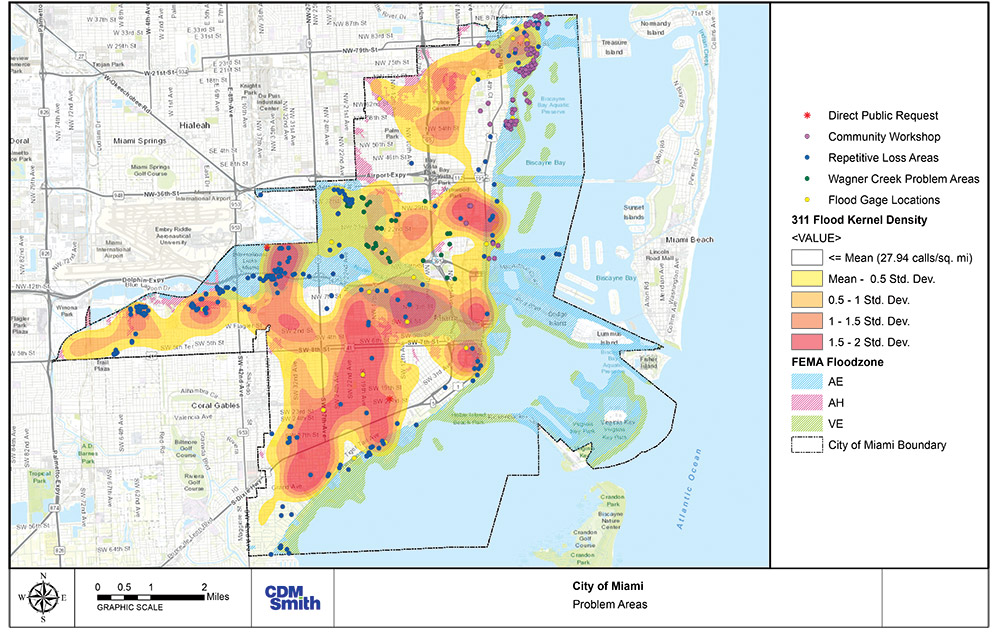
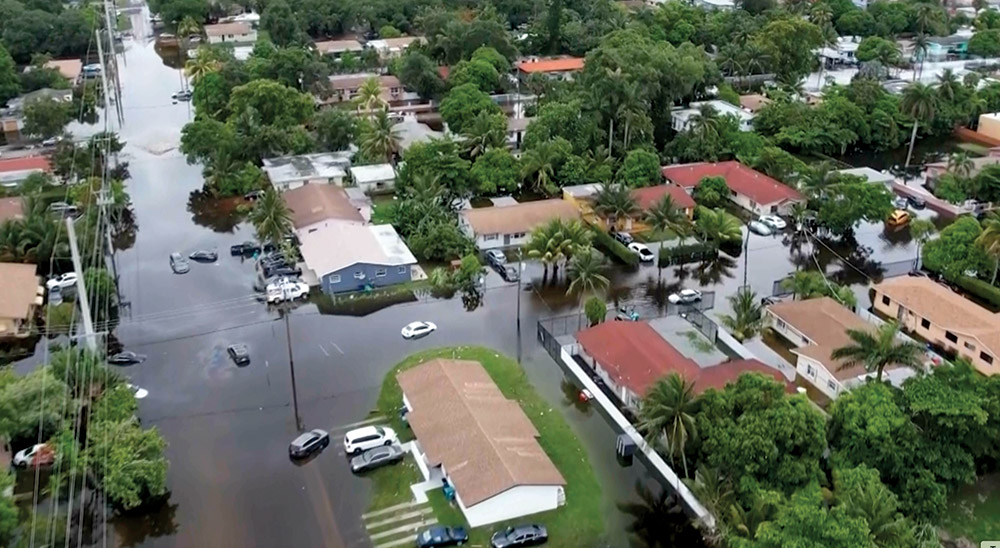
Photo: AP Photo/Daniel Kozin

Photo courtesy of City of Miami
CDM Smith took the lead on a stormwater master plan for Miami that integrated mapping tools and scientific projections to identify flood-prone areas (map, top). Construction has begun on some stormwater projects (above, right) in some of the city’s most flood-prone and vulnerable neighborhoods (above, left).
Map courtesy of CDM
FEMA Under Fire
The agency has been widely criticized for what some describe as a glacial pace in disaster relief and response, and for the maze of bureaucratic hoops that communities and individuals must jump through to receive funding. At congressional hearings this summer, U.S. lawmakers recited a litany of concerns about agency inefficiencies in responding to natural disasters. While many contend FEMA needs to be revamped, few lawmakers from either party support its complete eradication, which the Trump administration has proposed.
The FEMA Review Council, co-chaired by U.S. Dept. of Homeland Security Secretary Kristi Noem and Defense Secretary Pete Hegseth, has met three times since April and plans to release a report in November with recommendations on whether FEMA should be shuttered, or how it could be recast to be more efficient. At meetings, Noem has echoed Trump’s calls for shifting disaster response responsibility to states, with FEMA having a secondary role to support state efforts only as needed.
“We have definitely had members that have had [FEMA BRIC] money put on hold.”
—Sunny Simpkins, Executive Director, National Association of Flood and Stormwater Management Agencies
Trump administration officials announced in early April that FEMA’s BRIC program—which provides funding for climate adaptation and mitigation infrastructure projects—would be eliminated and that unallocated grants from 2020-2024 would be cancelled. In an April 12 memo, agency officials outlined other planned changes, including increasing the eligibility threshold for federal aid and requesting that the president refrain from automatically approving hazard mitigation grants when federal disasters are declared.
In the memo, then-acting administrator Cameron Hamilton characterized the changes as necessary to “reduce federal costs [and] concentrate FEMA’s efforts on large-scale disasters.” But Association of State Floodplain Managers Executive Director Chad Berginnis warns that the hazard mitigation program could also become less of a FEMA resource for states, according to how Trump has responded to disaster declaration requests since returning to office in January.
Under the program, the president must approve requests for funds to make proactive upgrades on infrastructure as a percentage of the aid a state receives when a disaster has been declared.
“Right now, all FEMA is doing is paying for disaster assistance, and they’re not making the more incremental investment in making sure that whatever we’re repairing isn’t going to be damaged in the future,” Berginnis says, adding that the administration’s current approach seems to be “penny wise and pound foolish.”
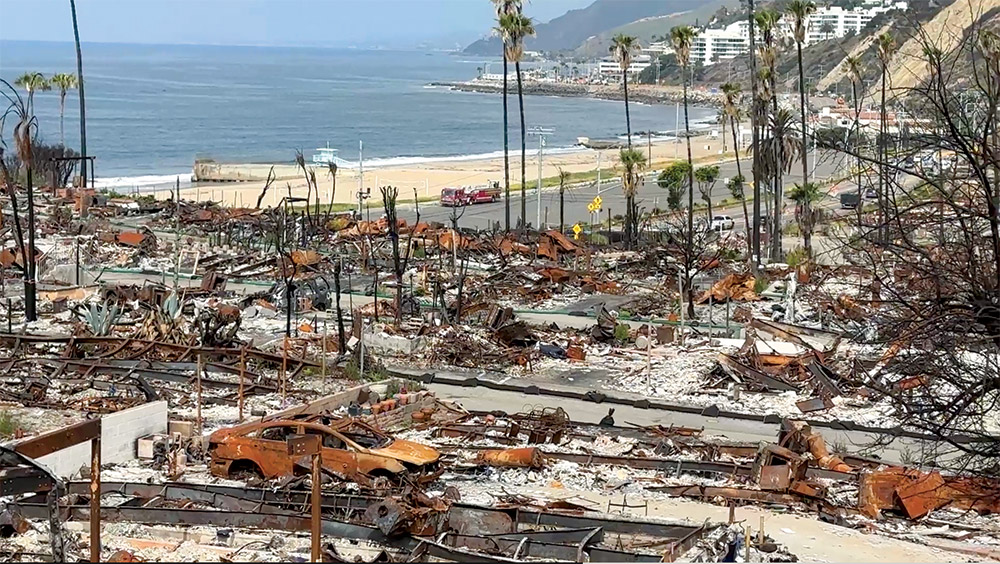
With the Trump administration denying requests for funds from FEMA’s hazard mitigation grant program, some states, including California, are taking matters into their own hands, such as related to the Los Angeles region wildfire disaster, above. In June, Gov. Gavin Newsom (D) announced availability of $185 million in state wildfire prevention grants.
Photo by Scott Blair for ENR
Funding Cuts
The scrutiny on FEMA is at the heart of a political environment in which funding is being slashed for any federal programs related to climate change, particularly in smaller or vulnerable communities where poverty levels are higher than average.
Berginnis notes that wastewater treatment plants are frequently located in low-lying areas that are naturally prone to flooding, and, especially in small communities, are built to “whatever the lowest standard is at the time.” With repeat flash flooding on the rise even in non-coastal communities, “We need to make sure that these facilities are not just protected, but also protected to a very high level of flood resistance,” he explains. “That investment is going to pay off in spades in the future.”
Funding cutbacks for climate adaptation and mitigation projects expand beyond the Trump administration in states where governors are in lockstep with the White House. Louisiana in July cancelled work on the $3.1 billion Mid-Barataria Sediment Diversion project, the lynchpin of the state’s coastal restoration plan, which was already permitted and under construction.
The administration’s current approach to hazard mitigation grants is “penny wise and pound foolish.”
—Chad Berginnis, executive director, Association of Floodplain Managers
The group overseeing disbursement of funds from the $20.8-billion settlement in 2016 related to the Deepwater Horizon oil spill in the Gulf of Mexico said the project was cancelled due to rising costs, permit revocation in June by the U.S. Army Corps of Engineers and ongoing litigation, but environmental advocates suggest the move was politically motivated.
In a statement released shortly after the cancellation was announced, advocacy group Restore the Mississippi River Delta said the project’s demise was “the culmination of a year and a half-long campaign of misinformation and political arm-twisting by [Louisiana] Gov. Jeff Landry (R) and his coastal team to undermine and finally kill the state’s largest ecosystem restoration project.”
Pahl, a senior coastal resources scientist for Louisiana’s Coastal Restoration Authority, said on a Pew Charitable Trusts webinar that the timeline for coastal restoration projects in the state faces a “fiscal cliff” when the financing program set up through the settlement sunsets in 2032. The coastal master plan calls for $50 billion over the next 50 years, much higher than funding allotted through the settlement.
State Efforts
While the BP settlement in Deepwater Horizon continues to fund other coastal restoration projects in Louisiana for now, many states rely on the state revolving loan program to pay for necessary infrastructure.
The White House’s fiscal 2026 proposal calls for a nearly 90% cut to the drinking and clean water state revolving fund programs. The House passed a continuing resolution that maintains the funding at 2025 levels through Nov. 21 to avoid a government shutdown, but the Senate has not yet considered a comparable extension.
In some cases, states are taking action themselves to pay for resilience projects. According to Perry Fowler, executive director of the Texas Water Infrastructure Network, more state leaders are acknowledging that increased flood and other water infrastructure investments are critical.
“I think that even before [the current] administration there’s been a view that the federal contribution toward infrastructure is diminishing, and we’re on the losing end of it here via state revolving fund allocations, earmarks, whatever it may be,” he says.
In November, Texas voters will weigh a ballot initiative to provide $1 billion annually over the next 20 years to the state Water Development Fund to support water supply, flood-risk reduction and other water infrastructure projects.
California Gov. Gavin Newsom (D) signed into law in 2021 a bill authorizing $100 billion for a variety of programs, including a $3.7-billion climate package that is focused on shoring up the state’s resilience against extreme heat and sea-level rise, and to increase coastal protection and adaptation efforts, as well as a $5.1 billion measure to help finance drought resilience, water supply and natural habitat restoration projects. New York voters approved a $4.2 billion bond measure in 2022 to fund climate adaptation and resilience projects.
But some states are better equipped to finance large resilience program initiatives than others.
“One of our big concerns with turning all money [for disaster response] over to the states is that some states don’t have capacity to oversee those projects” adds Simpkins of the National Association of Flood and Stormwater Management Agencies.
A July 2025 analysis by the Urban Institute found that many states, particularly those most at risk from natural disasters and with the fewest resources, would be unprepared to respond effectively to natural disasters in the absence of federal funds, based on data from the National Association of State Budget Officers.
The analysis found that of 31 states that received federal disaster response and recovery resources in 2019, only five had enough set aside to be able to cover their share of costs for disaster response, including paying for critical infrastructure repairs.

The public-private FEMA Review Council deliberates over the agency’s future existence.
Photo Courtesy of FEMA Review Council
Innovative Funding Mechanisms

Legislation to restore FEMA BRIC funding sailed through the House Transportation and Infrastructure Committee Sept. 3, and bill sponsors hope to bring it to the House floor for a vote.
Photo courtesy of House Transportation and Infrastructure Committee
Maryland has had some success using a novel procurement mode—environmental outcomes-based contracts—for smaller water quality projects, said Rachel Lamb, a senior climate advisor for the Maryland Dept. of the Environment, during the Pew Trust webinar.
For these projects, a project developer, often supported by a private investor, will be paid by the state only after a third-party verifies that the project will be able to achieve the environmental outcomes desired after it is complete, and over time.
In March, the Maryland environment agency announced that it would award a total of $47 million in outcomes-based contracts to a mix of shoreline restorations, aquaculture, fertilizer application best practices and other techniques.
“Pay for Success and innovative private financing approaches may not be the right fit in every situation, and in some cases, in our environmental justice areas, it may be that traditional [community block] grants may be the better tool,” Lamb pointed out. “But we have to look at all the tools in the toolbox to see which ones may fit and which ones can help us achieve outcomes faster, especially because [environmental justice ] communities may often be on the front lines” of extreme weather and climate-change impacts. She added that the state is considering expanding the program to attract additional investors to Maryland.
West Lane Partners’ Corpening says that private equity firms like his will be “intrigued” by infrastructure investment opportunities where significant returns can be generated for investors. In some cases, investors are acquiring design and related firms that work on resilience and climate mitigation projects.
Corpening adds, “We are very excited about pursuing the growth that we believe is going to continue for another 15 years in infrastructure investment spending as well as in power and electrical spending.”
Corpening expects to see more municipal and utility bonds in communities that have traditionally relied on federal funding with cutbacks in federal investment.
In the transportation sector, private equity has long been a player in funding highway projects and netting returns through toll financing mechanisms. But the water sector lags behind transportation in enabling public private partnerships, according to Garney’s Buckley.
“There’s a cap on private activity bonds that limits the amount of investment that can come in each jurisdiction,” which also limits return on investment and interest from potential private firms, he says.
Bipartisan Support for BRIC
While the Trump administration mulls over its next steps for FEMA, legislation is making its way through the U.S. House of Representatives that would, among other things, restore the BRIC program and elevate the agency to cabinet level so that its secretary would report directly to the president.
The bill, introduced in July by Transportation and Infrastructure Committee Chairman Sam Graves (R-Mo.) and ranking member Rick Larsen (D-Wash), passed the panel by an overwhelming 57-3 vote on Sept. 3. Members now hope to bring it to the floor, but there is no timeline yet for that, according to a committee aide.
Similar legislation has been introduced in the Senate, but the bills are not direct companion measures and are not as comprehensive, the aide said.
This bipartisan support for FEMA among lawmakers largely mirrors public sentiment shared in comments gathered prior to each FEMA Review Council meeting this year.
Association of State Floodplain Managers’ Berginnis says the tenor of public sentiment has shown that “overwhelmingly, people believe that FEMA does an important job and wants to keep an intact [agency], by and large.
He adds: “My hope is that the [agency review] council actually factors in the comments, as opposed to having this be nothing more than a political exercise.”