News Analysis
Texas Water Vote Expands Financing—but Not the Project Pipeline
Approval of a voter-led financing amendment shifts focus to which water projects are ready to advance under the state’s planning framework
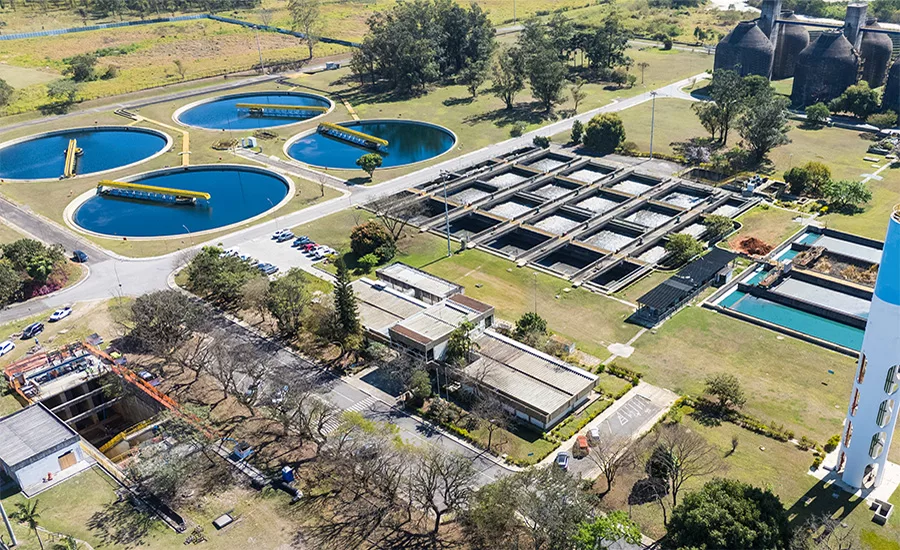
A large municipal water treatment facility illustrates the scale and long planning horizons that shape how Texas finances water infrastructure statewide.
Last November, Texas voters approved Proposition 4, a constitutional amendment intended to strengthen the state’s ability to finance water infrastructure as population growth, aging systems and long-term supply pressures converge across much of the state.
The initiative, approved by more than 70% of voters according to official results from the Texas Secretary of State, directs the comptroller of public accounts to deposit $1 billion of state sales and use tax revenue into the Texas Water Fund each fiscal year, provided total collections in that tax category exceed $46.5 billion.
The duty to deposit expires after 20 years, setting a two-decade runway for the new revenue stream. The constitutional language requires funds be kept in a separate account and transferred only through legislative appropriation, giving lawmakers ongoing control over when and how the money is deployed.
Beyond the financing infusion, Prop. 4 also hardwires guardrails that shape how quickly the money can translate into projects moving toward procurement.
Language in the amendment authorizes the Legislature to prescribe how portions—even all—of the deposited revenue are allocated among funds and accounts administered by the Texas Water Development Board (TWDB). Those allocation decisions generally cannot be altered during the first 10 years, except through a temporary suspension during a declared state of disaster.
RELATED
Federal Loan Programs Can’t Keep Pace with Growing Clean-Water Needs
The amendment also prohibits using deposited revenue to build infrastructure for transporting fresh groundwater, narrowing the range of eligible supply strategies and sharpening long-running regional debates over what constitutes “new supply” in practice.
Looking for quick answers on construction and engineering topics?
Try Ask ENR, our new smart AI search tool.
Ask ENR →
Supporters argued the amendment was necessary because Texas’s water infrastructure needs have outpaced periodic appropriations and one-time funding infusions. It is an argument reinforced by long-standing state planning documents and federal infrastructure assessments warning that population growth, drought exposure and aging assets are straining both potable supply and the systems required to deliver it.
The U.S. Environmental Protection Agency’s most recent Drinking Water Infrastructure Needs Survey and Assessment estimates that Texas drinking water systems will require roughly $61 billion over the next 20 years for transmission, distribution, treatment and storage improvements.
A broader assessment by Texas 2036, a nonpartisan public policy group, using EPA drinking water and wastewater surveys and the state water plan, projects at least $154 billion in combined water supply, drinking water and wastewater infrastructure needs statewide through midcentury.
That estimate includes more than $3 billion per year through 2041 just to maintain and rehabilitate existing drinking water systems, underscoring that while Prop. 4 expands financing capacity, it addresses only a portion of long-term demand.
Prop. 4 in the Real World
Prop. 4 functions more as a financing pivot than a construction trigger, as Texas’s project selection discipline is more prescriptive than in states relying on ad hoc appropriations or discretionary infrastructure programs.
The state’s planning framework divides Texas into 16 regional water planning areas, each required to identify needs and recommend strategies on a five-year cycle. Those regional plans roll up into the state water plan, which serves as a gatekeeper for eligibility across multiple Texas Water Development Board-administered financing programs.
The following regional snapshots illustrate how that planning discipline translates into differing project profiles and levels of readiness across Texas.
Explore Regional Water Project Readiness

North Dallas Region

Upper Gulf Coast Region

Central Texas/Austin I-35 Corridor Region

South Central Texas Region

East Texas/Piney Woods Region

Panhandle/High Plains Region

South Texas/Border Region
Eligibility for the State Water Implementation Fund for Texas (SWIFT) illustrates that structure. The revolving financing program generally requires that proposed projects include recommended water management strategies from adopted regional plans and be part of the most recent state water plan when applications are submitted.
Even after projects clear the planning threshold, spending remains contingent on legislative appropriation, and lawmakers’ allocation decisions can shape what TWDB can support for years at a time. TWDB then operationalizes those appropriations through program rules, application cycles, prioritization criteria and board actions, much of which unfolds on a public schedule through board agendas, implementation plans and periodic funding updates.
Projects that advance through Texas’s planning gate still face constraints that can affect delivery schedules and risk profiles. Many large water projects trigger layered environmental review and permitting requirements, including state-level environmental assessments embedded in certain TWDB financing programs. Applicants are also commonly required to demonstrate conservation planning and compliance with drought contingency plans as conditions of assistance.
Industry executives working downstream of the planning process say those regulatory layers, combined with long procurement cycles and equipment lead times, are increasingly where projects stall—even after financing pathways are identified.
Financing capacity at the local level can further shape outcomes. TWDB assistance is frequently structured around revenue pledges and market-referenced interest rates, and smaller or nonrated utilities may still face higher borrowing costs, even when participating in programs designed to reduce rates or provide principal forgiveness.
Federal dollars add another layer of complexity. Utilities pursuing Drinking Water or Clean Water State Revolving Fund assistance must align applications with annual intended use plans and federal compliance requirements, including domestic content rules and, for some categories, conditions tied to Bipartisan Infrastructure Law funding.
In practice, that sequencing can force local owners to braid state financing with federal capitalization grants and other allocations while navigating differing eligibility standards, reporting obligations and procurement rules.
RELATED
McCarthy Launches $202.5M Expansion of North Texas Water Treatment Plant
What Does This Mean for Contractors and Designers?
Against those procedural realities, rural-urban tensions are likely to shape how the expanded financing translates into work: while need is widespread, delivery capacity is not.
Fast-growing metropolitan areas tend to focus on treatment capacity, rehabilitation and system redundancy within existing footprints. Regions facing longer-term supply constraints are more likely to pursue conveyance, pumping and nontraditional sources, which carry higher capital costs and longer delivery timelines. Prop. 4 does not flatten those differences; it amplifies them by favoring regions that have already translated need into defined, finance-ready projects.
Texas 2036, citing Texas Commission on Environmental Quality (TCEQ) data, reports an average of 2,883 boil water notices issued annually from 2019 through 2023. Most are linked to line breaks or service disruptions, with smaller systems experiencing higher rates of water loss, a pattern often associated with limited maintenance and capital capacity.
Additional TCEQ estimates indicate at least 572,000 acre-feet of water—roughly 186 billion gallons—lost statewide each year, highlighting the tension between high-growth urban systems that prioritize redundancy and smaller communities struggling to stabilize basic infrastructure.
Private industrial demand is following a different trajectory. Kevin Gast, CEO of Austin-based VVater, said industrial owners tend to move faster than public utilities because regulatory compliance pressures and production risk leave little tolerance for multiyear delays.
“These industrial players are struggling to meet regulatory compliance, which means they have to spend money to meet those requirements,” Gast said. “They can’t have a problem dragging on for years and years.”
Gast said industrial users are also more likely to redesign projects or pursue reuse-focused approaches to avoid extended permitting and pilot timelines, while some smaller or rural public systems—facing failing infrastructure and limited capital—are more willing to adopt nontraditional solutions than larger cities with deeply embedded assets.
RELATED
‘Pipes-First’ Strategy Gains Ground in Texas as Cities Prep Sites for Industry
The practical takeaway for the industry is that the projects most likely to advance in the near term are not newly conceived concepts but those that have already moved through feasibility studies, preliminary engineering and regional consensus. Treatment plant expansions, transmission upgrades, reuse systems and phased conveyance projects are among the categories best positioned to compete for assistance.
For firms positioning for work in 2026 and beyond, the clearest signals are likely to emerge through TWDB’s public process. Board agendas, implementation plan updates, annual intended use plans, project rating reports and public comment periods can serve as early indicators of procurement pacing, particularly in years when demand for assistance exceeds available funding.

Bryan Gottlieb is the online editor at Engineering News-Record (ENR).
Gottlieb is a five-time Society of Professional Journalists Excellence in Journalism award winner with more than a decade of experience covering business, construction and community issues, including finance, law and real estate. He has reported for Adweek and the San Diego Daily Transcript and led a community newsroom in Santa Monica, Calif. He served as editor-in-chief of the Detroit Metro Times and as managing editor at Roofing Contractor, where he helped shape national industry coverage. At Engineering News-Record, Gottlieb covers breaking news, large-scale infrastructure and megaprojects, regulatory developments and business trends across the U.S. and global construction sectors.
email: gottliebb@enr.com | office: (248) 786-1591