Water Infrastructure
Engineers COWI, GFT Win $25.4M Contract on $291M Syphon Reservoir Upgrade
Joint venture to oversee construction management of California water district’s largest-ever capital project

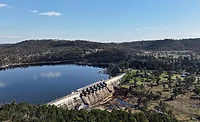
Syphon Reservoir, located in Irvine, Calif., will undergo a significant capital improvement upgrade with engineers COWI and GFT securing a $25M contract for construction management. The Irvine Ranch Water District plans to expand recycled water storage capacity from 500 acre-ft to 5,000 acre-ft.
Engineering firms COWI and GFT, in a joint venture, have secured a $25.4-million contract to deliver construction management and inspection services for the Irvine Ranch Water District Syphon Reservoir improvement project in Orange County, Calif.—the largest capital program in district history, according to board records.
Learn More:
Syphon Reservoir | Improvement Project Overview
The $291-million expansion will replace the existing 59-ft dam with a new 136-ft embankment dam and boost recycled-water storage from 578 acre-ft to 5,000 acre-ft. District officials say the upgrade, set for completion in 2028, will strengthen drought resilience, reduce reliance on imported supplies and save customers an estimated $85 million over 50 years.
“This is a significant milestone for COWI in Southern California,” Arun Parsons, vice president of COWI North America, said in announcing the contract on Sept. 30. GFT is the entity rebranded earlier this year that was formed by the combination of Gannett Fleming Inc., TranSystem Corp. and other firms.
Expansion Scope and Oversight
The district's environmental filings, reviewed by ENR, call for demolishing the current dam and building a 136-ft embankment, raising the crest from 388 ft to 466 ft above mean sea level.
Planned improvements include a new spillway, seepage drainage system, upgraded outlet and circulation works, and filtration and disinfection facilities at the dam toe. New access and maintenance roads will be built, along with wetland and riparian mitigation areas.

A schematic map shows the planned Syphon Reservoir Improvement Project in Irvine, Calif., including the footprint of the new 136-ft dam, proposed treatment facilities, spillway, intake and outlet works, and inundation area. Image courtesy of Irvine Ranch Water District/EIR.
To reinforce public confidence, the district convened an independent design and safety review panel in 2021 of nationally recognized dam engineers. They conducted staged design reviews and site visits, issuing a closure letter in February that confirmed concerns had been resolved and met California Division of Safety of Dams requirements.
Construction is expected to last two to three years. The district has not yet awarded a prime contractor, although permitting and the design by AECOM are complete. ESA is the environmental consultant managing CEQA compliance.
Looking for quick answers on construction and engineering topics?
Try Ask ENR, our new smart AI search tool.
Ask ENR →
To reduce community impacts, the district plans to restrict truck access during peak hours, limit most activities to weekdays and enforce dust and noise controls.
Financing and Long-Term Value
Funded through an existing capital facilities assessment already collected on property tax bills, the $291-million program will not raise drinking water rates, the district says.
Federal support includes a $12.25-million award under the Bipartisan Infrastructure Law WaterSMART program. At the funding announcement, then-Interior Secretary Deb Haaland said the Syphon Reservoir expansion “underscores the federal commitment to strengthening drought resilience in California.”
The district projects long-term customer savings by reducing its purchases of imported water from Northern California and the Colorado River. “[T]he Syphon Reservoir Improvement Project is expected to save customers approximately $85 million over 50 years,” the district stated.
Because the expanded reservoir will allow storage and reuse of nearly 100% of recycled water produced, the increased supply could be deployed in summer months for irrigation, industrial cooling, dust control and fire suppression, enhancing long term water reliability, the district noted.
The district's recycled water network spans 570 miles of “purple pipe”—the industry-standard color used to distinguish non-potable water lines—and serves more than 6,200 water accounts, or 28% of total deliveries.
COWI has worked on other California reservoir and dam projects, including Anderson Dam, Lafayette and Briones Reservoirs, Chabot Dam and Folsom Dam.

Bryan Gottlieb is the online editor at Engineering News-Record (ENR).
Gottlieb is a five-time Society of Professional Journalists Excellence in Journalism award winner with more than a decade of experience covering business, construction and community issues, including finance, law and real estate. He has reported for Adweek and the San Diego Daily Transcript and led a community newsroom in Santa Monica, Calif. He served as editor-in-chief of the Detroit Metro Times and as managing editor at Roofing Contractor, where he helped shape national industry coverage. At Engineering News-Record, Gottlieb covers breaking news, large-scale infrastructure and megaprojects, regulatory developments and business trends across the U.S. and global construction sectors.
email: gottliebb@enr.com | office: (248) 786-1591