Forensic Engineering
How Engineers Will Determine Why NYC's Pfizer HQ Conversion Buckled
Structural engineers, construction lawyers and risk specialists explain how major structural failures are analyzed before investigators reach conclusions
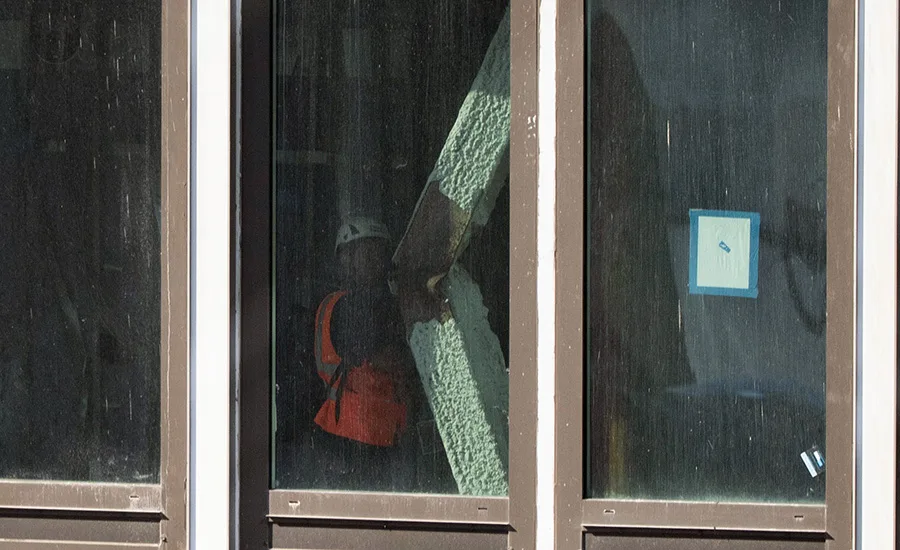
A worker examines a buckled load-bearing structural member inside the former Pfizer headquarters redevelopment at 235 E. 42nd St. in Manhattan on July 8 as engineers begin investigating the cause of the structural failure that halted one of the nation's largest office-to-residential conversions.
Construction crews have stabilized the former Pfizer headquarters redevelopment in Midtown Manhattan after two load-bearing structural columns buckled on the 21st floor July 7.
The focus has now shifted from emergency response to determining what caused the office-to-residential conversion to suffer a major structural failure.
The incident happened on E. 42nd St., where MetroLoft Developers and David Werner Real Estate Investments are transforming the former drug maker’s headquarters into about 1.3 million sq ft of residential space, including more than 1,600 apartments. The project also involves an 11-story vertical expansion of the 33-story tower, making it one of the largest adaptive reuse projects in the country.
With the immediate danger having subsided, engineering questions have only begun and city officials have cautioned against drawing early conclusions.
New York City Dept. of Buildings Commissioner Ahmed Tigani told the public during the emergency’s initial hours that the conversion underwent an "extensive, exhaustive review" during the past two years before construction began. He added that investigators will determine whether the structural distress stemmed from design, construction sequencing or another factor.
Reconstructing the Failure
For Ronald Hamburger, chairman and senior principal at Simpson Gumpertz & Heger—who helped lead the ASCE/FEMA structural engineering investigation following the Sept. 11 terrorist attacks—the first questions are not about assigning blame.
"I would like to understand as best I can what the load was on the columns at the time the failures occurred, and if there had been any recent modifications by the contractor doing work in the building," Hamburger says. "It's possible that some of the modifications ... resulted in weakening or softening some of the beams ... and it's also possible that columns just simply were overloaded."
Looking for quick answers on construction and engineering topics?
Try Ask ENR, our new smart AI search tool.
Ask ENR →
Only after answering those questions can investigators begin answering the larger one—why did the columns fail?
"You start by looking at the original drawings for the building," Hamburger says. "If shop drawings were available, I'd want to look at those.... I'd want to look at the drawings for the modifications that were underway at the time of the failure and then photographs of the building post-failure."
Taken collectively, those drawings, contractor records and post-failure photographs provide investigators with the best opportunity to reconstruct the building's condition at the moment the columns buckled.
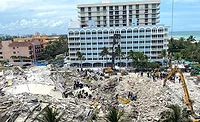
Greg Batista, president of G. Batista Engineering & Construction, who was interviewed by the National Institute of Standards and Technology during its five-year investigation into the Champlain Towers South collapse in Florida, says investigators cannot assume the answer lies exclusively with either the design or the construction.
"It could be one, it could be the other, or it could be both at the same time," Batista says. His inquiry would begin on two parallel tracks.
"From a design standpoint ... I would immediately go to the drawings," he says. Engineers review design assumptions, shoring plans, load calculations and code requirements while simultaneously documenting field conditions, interviewing workers and preserving evidence before the site changes.
"You shut down the entire job and ... investigate, take a lot of pictures, talk to people, and treat it like a crime scene," Batista adds. "That is the very first step in what will end up likely being a very complicated and possibly a lengthy process."
Drawings and photographs record the aftermath. Reconstructing the path to that moment is far more difficult..
Hamburger compares the structural system to a pair of suspenders backing up a belt. "As those two columns buckled, and the weight above them settled, then the beams that were directly connected to those columns were deformed downward and carried some of that load back to surrounding framing, much like suspenders would, in the case of a failed belt," Hamburger says. "That works fine unless that redistribution of load then starts to overload those other elements and they start to fail."
Batista cautions against assuming the visibly buckled columns necessarily define the extent of the damage. Drawing on lessons reinforced during the Surfside investigation, he says structural failures rarely remain isolated because every major load-bearing element is connected to others.
"If one part ... of a column buckles, there's something that's attached to it that's going to buckle also," he says.
Comparing the building to a fractured femur, he says the initial failure forces surrounding structural elements to assume additional load. "Does that mean that you're going to die? No ... but it could lead to something catastrophic." And that concern helps explain why emergency responders spent hours monitoring the structure before engineers entered to begin shoring operations.
"Once you get that three-dimensional data, you can tell if it's stable," he says of the technology likely employed to verify stabilization, including using networks of sensors to gauge movement.
The inquiry becomes even more complicated because engineers are evaluating an existing building rather than one designed entirely from scratch. Daren Shumate, founder and managing principal of Shumate Engineering, whose firm designs adaptive reuse projects nationwide, says existing conditions must be verified rather than assumed.
"We didn't take any chances or make any assumptions," Shumate says, recalling an earlier federal renovation project in which engineers physically tested structural capacity before relocating heavy electrical equipment.
That verification extends well beyond structural framing. Adaptive reuse projects routinely require engineers to compare original design drawings with fabrication drawings, field measurements and existing conditions before new work begins.
"Probably every time," Shumate says when asked how often existing buildings differ from historical drawings.
Parallel Paths
Brian Waller, who leads Peckar & Abramson's White Collar, Regulatory Compliance and Investigations practice, says the engineering review and the legal process unfold on parallel tracks from the earliest hours after a structural failure.
"The structural and engineering investigation does start first, and obviously the first priority when there's a structural failure is always life safety," Waller says. "But from a construction law perspective, a parallel legal process begins almost immediately, within minutes to hours of a structural incident."
Waller adds that those parallel investigations quickly begin competing for the same physical evidence.
"You have the city or the regulators who want to come in and fix the problem to make sure that everything is safe," he says. "And then you have the legal teams who come in and want to preserve evidence and make sure everything is documented before things are changed."
Waller compares the process to securing a crime scene before investigators begin collecting evidence. "The crime scene team comes in and takes pictures to make sure that everything is preserved before they clean it up," he says.
Responding to questions from ENR by email, Robert Alfert, a board-certified construction lawyer with Nelson Mullins, says project participants immediately begin preserving work product, including contracts, insurance policies, structural and shop drawings, contractor daily reports, inspection records, BIM models, photographs and other documentation while retaining independent engineering experts to conduct their own root-cause analyses.
"Construction tends to be messy like that," Alfert says. The various parties responsible for bringing a project of this scale—owners, contractors, structural engineers, architects, peer reviewers and inspectors—often have overlapping responsibilities, he adds.
"The project team fractures very quickly after an incident," Waller says. "Everybody ... circles the wagons." Rather than immediately assigning blame, he says each organization tries to understand and limit its own exposure, while attorneys often centralize communications through designated representatives.
"Everyone wants to cooperate," Waller adds. "But really what happens is everyone is looking to ... take responsibility away from them[selves]."
Commercial risk advisors Mason Dwinnell and Rob Townley of Townley Kenton say the transition into engineering, legal and insurance reviews effectively places projects into a holding pattern while the technical work proceeds. They note that adaptive reuse projects inherently entail additional uncertainty because engineers work with existing conditions that cannot always be fully understood before construction begins.
Patience Required
For all of the evaluations now underway, Hamburger says the industry's greatest challenge may simply be resisting the urge to reach conclusions too quickly.
"What's least understood in the 24 hours or so after a failure is what the exact conditions were at the time just before the failure," Hamburger says. "It takes some amount of investigation to understand that."
Even then, certainty comes slowly.
"It will take months, if not longer, to understand exactly what happened and why," Hamburger says.
And by then, the engineering review will almost certainly be unfolding alongside another process. "I would not be surprised if litigation ensues between the parties," he adds.
Once that begins, he says, each participant typically retains its own experts, information becomes more difficult to obtain, and the engineering, legal and insurance inquiries continue moving forward together, each searching for the answer to the same question — What happened?

Bryan Gottlieb is the online editor at Engineering News-Record (ENR).
Gottlieb is a five-time Society of Professional Journalists Excellence in Journalism award winner with more than a decade of experience covering business, construction and community issues, including finance, law and real estate. He has reported for Adweek and the San Diego Daily Transcript and led a community newsroom in Santa Monica, Calif. He served as editor-in-chief of the Detroit Metro Times and as managing editor at Roofing Contractor, where he helped shape national industry coverage. At Engineering News-Record, Gottlieb covers breaking news, large-scale infrastructure and megaprojects, regulatory developments and business trends across the U.S. and global construction sectors.
email: gottliebb@enr.com | office: (248) 786-1591