Clean Energy
California Set to Become World’s Largest Solar-Battery Storage Hub
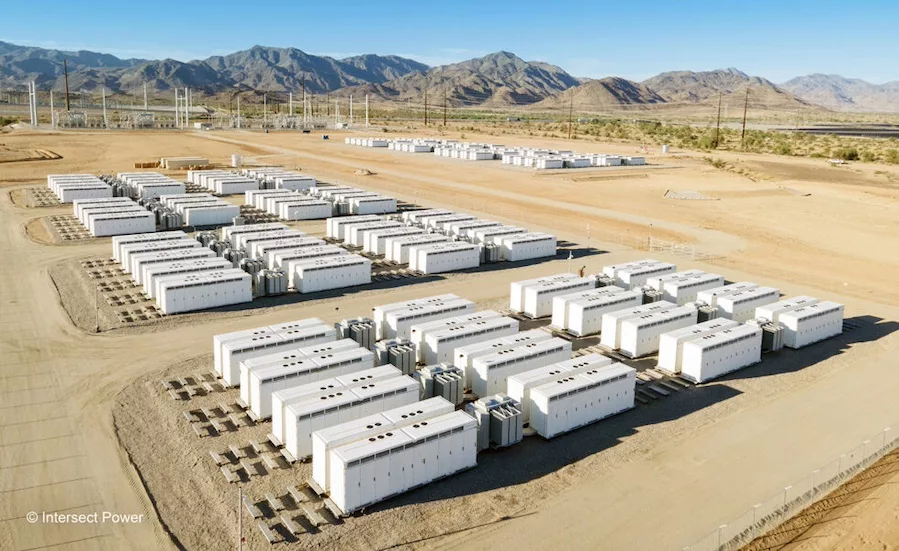
Battery system developer Intersect built the smaller Oberon solar and storage facility in Riverside County, Cali. in 2023.
Photo courtesy of Intersect
California already has the most utility-scale battery storage systems nationwide but it is about to set a new record. According to developer Intersect Power, the company aimse to build the world's largest solar and battery storage project in western Fresno County.
Intersect’s Darden project will have a battery energy storage system of up to 4.6 GW-hours and a 1.15 GW solar facility with about 3.1 million panels that also will include a 34.5-500 kV grid step-up substation, a 15-mile 500-kV generation intertie line and a 500-kV utility switchyard, according to the company. Set to interconnect to the existing Pacific Gas and Electric Co. Los Banos-Midway #2 500 kV transmission line, it is expected to generate enough energy to power 850,000 homes for four hours.
“This is a huge project and a huge step forward” for battery energy storage, said Zack Perconti, vice president of government affairs at the National Utility Contractors Association, commenting on what he described as an emerging market that is growing quickly. “While it may be the largest in the world when complete ... it will not hold that title for long” he added, due to growing U.S. need for energy storage, with more systems located at solar and wind project sites.
“Solar-plus-storage energy systems such as Darden harness abundant clean energy resources to reliably power the grid through the day and well into the night, and are helping California build a more reliable, affordable and resilient grid,” said Brian Turner, regulatory director at advocacy group Advanced Energy United.
Intersect told ENR in an email that it plans a continuous construction schedule that will begin in late 2025 and expects the facility to fully operate in late 2027 or early 2028. The company has declined to provide the total project cost or to disclose a contractor selection but said the project would create more than 2,000 prevailing-wage construction jobs. Its similarly sized proposed Perkins renewable energy project, which includes a 1.1-GW solar and battery storage facility that is located on both private and federal land east of El Centro, Calif., was reported by local media as a $2.5-billion project.
Intersect did not respond by ENR story posting time to a query as to why an originally proposed 800-MW green hydrogen production facility, described on a state agency website as part of the Darden project, now appears to have been dropped.
On a Fast Track
Darden is the first project located in California that is being permitted under the state’s new Opt-In Certification process. The program is part of the state's Build More, Faster initiative that aims to speed up permitting of critical infrastructure, a spokesperson for the California Energy Commission told ENR.
Looking for quick answers on construction and engineering topics?
Try Ask ENR, our new smart AI search tool.
Ask ENR →
The Perkins project remains under an Opt-In review, the agency said. The commission has approved two other projects under Opt-In—Fountain Wind, a 205-MW wind project in Shasta County, and Compass Energy Storage, a 250-MW battery storage project in San Juan Capistrano, Orange County. Opt-In deals only with energy permitting and supports California’s mission to transition to 100% zero-carbon retail electric sales by 2045, she said.
Under the Opt-In program, the commission has a 270-day clock to complete a project environmental review unless significant project changes arise that require more time, said Perconti. The Darden project was cleared in 265 days, the spokesperson said. By comparison, a U.S. government environmental review under the federal NEPA law, “is supposed to be completed in two years but reviews can drag on for an eternity,” he said. “Permitting delays drive up costs tremendously” and delay projects.
The spokesperson said Opt-In Certification “does not subsume federal permits, unless allowed by federal law, but we are not aware that Darden requires any federal permits.”
The 300MW Cornucopia Hybrid Project was approved in the spring under the Build More, Faster initiative.
Fire Prevention & Safety
Intersect’s massive storage project comes amid an ongoing investigation of a major fire that broke out in January near San Jose that destroyed most of a 300-MW, lithium-ion battery array at Vistra Energy’s 750-MW Moss Landing storage facility. The cause of the blaze remains unknown, according to an investigation report on Vistra’s website.
When asked what steps are being taken to help prevent such fires, Intersect said the chemistry, design and safety requirements for its battery complex “are entirely different from those associated with the Vistra facility at Moss Landing.” Darden will use only the Tesla Megapack 2 XL battery system that has been rigorously tested and designed, it said, adding that “there has never been a thermal event associated with the Tesla MP2 XL, despite wide commercial deployment.”
The company also said the project will follow a robust construction health and safety program and emergency response plan to ensure safety of workers and nearby communities throughout site construction and long-term operation. The commission spokesperson said that as part of the Opt-In process, Darden underwent a thorough technical and environmental review, including a detailed fire safety analysis.
The project will use “a containerized design, meaning batteries are housed in separate, enclosed units, similar to a shipping container,” the spokesperson said, adding that this approach is now recognized as safer and more manageable in the event of a fire. “This design contrasts with that of facilities like Vistra’s, where batteries were in a large building that allowed thermal events to spread,” she said. Darden’s containerized system "helps isolate potential incidents, minimizing the risk of escalation,” said the spokesperson.
Darden’s fire prevention features also will include deflagration panels in the event of gas accumulation; thermal infrared cameras installed around the site; a construction, operations and maintenance fire protection program; and a dedicated command and control center outside of the storage facility. Intersect said the project will be funded through a blend of equity, debt and federal tax credits for solar and storage assets, which it said is consistent with industry practices for solar and battery storage projects.
California leads the U.S. in battery storage capacity, trailing only China globally. The state has more than 200 utility-scale systems, and more than 250,000 commercial and residential installations, totaling about 15.7 GW statewide.