In a recent presentation at a San Francisco conference on optics and photonics, researchers presented papers describing their successful tests of optical data transmission tools, which soon may replace current data centers’ thousands of miles of fiber-optic cables with overhead layer of infrared laser beams, lenses and mirrors.
It started simple enough: a wireless camera mounted on the hook block of a tower crane, allowing the operator in the cab to see the rigger on the ground and the area around the hook.
Colorado's RoadX program illustrates what can be achieved when everyone—and everything—is in gear, listening, innovating and collaborating for the public good.
This year’s judges for ENR’s photo contest were shadowed by a machine-learning, artificial-intelligence system being developed to flag safety hazards in construction photos and video.
National Grid, which serves New York, Massachusetts and Rhode Island, is set to be the second U.S. natural-gas utility to use technology advanced by Google Earth, the Environmental Defense Fund (EDF) and Colorado State University to boost large-scale methane-leak detection.
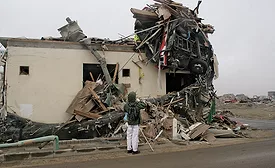
A new study of high-sensitivity gravimeter and seismometer data—recorded just before and during the magnitude-9.0 earthquake on March 11, 2011, in Tohoku-Oki, Japan—describes a promising new data collection and analysis methodology that could give authorities time to issue advance warnings and secure vulnerable systems before earthquakes strike.
 RSS
RSS