In Louisiana, a new administration has put a temporary hold on the state’s annual coastal restoration plan as it reviews the most ambitious tasks to date: two projects to divert Mississippi River sediment to restore the state’s disappearing wetlands.
Even as drilling crews are getting closer to capping a natural-gas well that has spewed thousands of metric tons of methane since last fall, Los Angeles County District Attorney Jackie Lacey has filed criminal charges against utility Southern California Gas Co. for failing to immediately notify authorities of the rupture within the largest underground natural-gas storage facility west of the Mississippi River.
CH2M Hill and the Central Texas Regional Mobility Authority are “in active, productive discussions,” focused on “resolving issues and completing” an important toll-lane project in the Austin area, according to a joint statement issued on Feb. 4.
Ontario transportation officials have made some initial findings on what triggered the deck split and nearly 2-ft upward displacement on one span of the province’s first cable-stayed bridge.
A spate of rare winter tornadoes across Texas and the Southeast has rekindled long-standing concerns about construction quality and building code enforcement, particularly in areas that appear increasingly vulnerable to severe weather.
The fallout from Colorado’s Gold King Mine spill in August continues to spread. In mid-January, New Mexico state officials served a “notice to sue” to the Environmental Protection Agency and several other parties for their roles in causing the 3-million-gallon deluge that poisoned the Animas and San Juan rivers with acidic mine water.
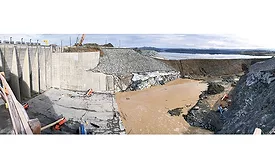
After a Kiewit employee detected a leak early on Jan. 20 in a temporary cofferdam protecting workers and downstream interests on the $900-million Folsom Dam Auxiliary Spillway Project in California, the U.S. Army Corps of Engineers evacuated a dozen crew members and equipment while the U.S. Bureau of Reclamation (USBR) closed the bulkhead gates to prevent catastrophic flooding in the event of a cofferdam failure.
Three ocean engineering firms in January completed testing of wave energy converters in a unique wind-wave test basin at the University of Maine, gauging how they will respond to severe offshore storms.
 RSS
RSS