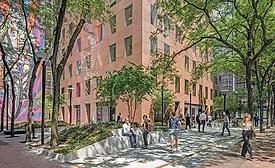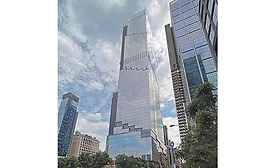
The towering office high-rise that occupies a full city block in midtown Manhattan includes distinctive terraces that twist up the building from Level 7 to the roof.
Revitalization of the 48-story, 1980s-era office building included a full upgrade of the lobby, plaza, restaurant, interconnecting stairs and communal spaces with sleek, high-end finishes as well as replacement of key mechanical and fire suppression equipment.
Upgrading an atrium, part of the Henry Bendel luxury retailer’s store for decades, allows it to connect with a neighborhood building on its west side and another building on its south side to expand across four floors.
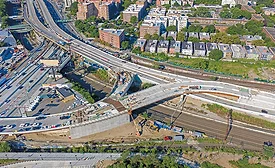
A new interchange and four new bridges serve the more than 78,000 daily vehicles that access area industrial and commercial properties, including the Hunts Point Food Distribution Center, and remove thousands of trucks from local streets.
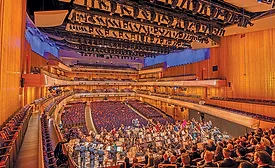
Set to become a hub for artistic expression in lower Manhattan, the 129,000-sq-ft building houses three theaters separated by moveable acoustic walls, allowing up to 11 different configurations.
Located on the northern edge of the Belmont Park redevelopment site, the 19,000-sq-ft, three-level station is the Long Island Rail Road’s first new passenger facility in nearly 50 years.
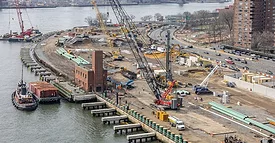
In densely populated cities surrounded on all sides by water—the borough of Manhattan in New York City as a prime example—the risks from sea level rise and climate change are not just hypotheticals; they are existential threats.
New York State Bridge Authority and Office of Mental Health representatives gathered state lawmakers, local emergency response teams and community leaders for a suicide prevention summit last month to raise awareness, discuss better collaboration and review suicide prevention and emergency mental health response practices around the state’s vehicular and pedestrian bridges, parks and other public spaces.
Now set to augment transportation construction projects underway across New York and New Jersey, officials are fast developing programs to expand infrastructure to meet climate change, resilience and sustainability needs, fueled by billions in more recent federal funding.