Adaptive Reuse
NYC Halts Second Office-to-Residential Conversion as Scrutiny Widens
Full construction halt at 222 Broadway followed two previously unreported partial stop-work orders

The former office tower at 222 Broadway is being converted into 788 apartments with a newly added 32nd floor and rooftop amenities. New York City halted construction July 24 as regulators expanded scrutiny of adaptive-reuse projects following the structural emergency at the former Pfizer headquarters.
For the second time this month, New York City has halted a major office-to-residential conversion, issuing a full stop-work order at 222 Broadway in Lower Manhattan as adaptive-reuse projects face heightened scrutiny following the structural emergency at the former Pfizer headquarters in Midtown.
Records reviewed by ENR show the July 24 enforcement action followed an inspection by the New York City Dept. of Buildings' Forensic Engineering unit the day before. The department alleged the permit holder failed to immediately notify DOB of an incident involving cast-in-place concrete elements and said changes to the repair plan were not properly filed, resulting in a full stop-work order while the project undergoes additional engineering review.
The Wall Street Journal, which first reported the stop-work order, said two concrete beams on the project’s newly constructed 32nd floor cracked in March.
DOB told ENR in an email that contractors informed inspectors about the earlier beam cracking during a proactive enforcement inspection July 11. Inspectors found the beams had already been repaired using through rods installed in the concrete and steel plate strapping that fully encased the damaged members under a repair plan developed by engineer of record DeSimone Consulting Engineers.
The department said inspectors also received DeSimone's attestation that the building was stable and that the repaired beams posed no safety concerns.
The project, being developed by GFP Real Estate and TPG Real Estate, will convert the former office tower into 788 apartments. The redevelopment includes a newly added 32nd floor with rooftop amenities. Leeding Builders Group is serving as general contractor, and DeSimone Consulting Engineers is the structural engineer of record.
GFP Real Estate told The Journal the issue was a "reporting timeline discrepancy," not an ongoing safety concern, and that project engineers believed immediate notification to the city was not required.
Looking for quick answers on construction and engineering topics?
Try Ask ENR, our new smart AI search tool.
Ask ENR →
DOB records also show the full stop-work order followed two previously unreported partial stop-work orders issued July 13 after the July 11 inspection by the same Forensic Engineering unit.
One complaint alleged work did not conform to approved construction documents. The second alleged the project failed to provide professional engineer design drawings required under Building Code Chapter 33. Both prompted partial stop-work orders.
Those orders prohibited additional loading of the concrete and steel frame, along with nonstructural framing and finishing work while the structural issues were evaluated.
Full Stop-Work Order Escalates Enforcement
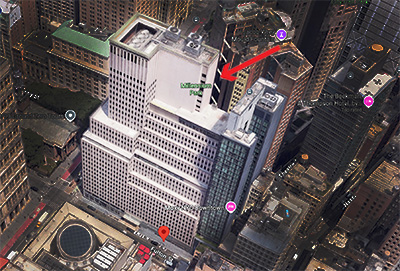
An aerial view identifies 222 Broadway in Lower Manhattan, where the New York City Dept. of Buildings issued a full stop-work order at the office-to-residential conversion after alleging the permit holder failed to immediately report an incident involving cast-in-place concrete elements.
Courtesy of Google Maps
In its response to ENR, DOB said inspectors found no conditions during either the July 11 or July 23 inspections that warranted issuing a Vacate Order. Instead, the department said contractors and engineers failed to notify DOB when they first became aware of the beam cracking and did not properly file revisions to the repair plan.
During the July 23 follow-up inspection, DOB engineers again requested a complete package of engineering reports explaining how the cracks developed. The department upgraded the previously issued partial stop-work order to a full stop-work order while awaiting documentation demonstrating the project could safely proceed.
DeSimone submitted the remaining engineering reports July 24; DOB said its engineers are auditing those documents before determining whether construction can safely resume. The agency said it will not lift the order until it is fully satisfied construction can safely continue.
Broader Scrutiny of Office Conversions
The enforcement comes less than three weeks after DOB halted work at the former Pfizer headquarters conversion in Midtown Manhattan, where two buckled structural columns prompted an evacuation and emergency stabilization effort.
The Pfizer emergency has prompted city officials to expand scrutiny of office-to-residential conversion projects as investigators work to determine the cause of the structural failure.
Office-to-residential conversions have become an increasingly important redevelopment strategy in New York and other cities, but the Pfizer emergency has raised questions throughout the industry about structural due diligence, construction sequencing and oversight of complex adaptive-reuse projects. Insurance executives and construction specialists previously told ENR the findings from the Pfizer investigation could influence future regulation and risk assessments for similar projects.
Representatives of the project team did not immediately respond to after-hours requests for comment.

Bryan Gottlieb is the online editor at Engineering News-Record (ENR).
Gottlieb is a five-time Society of Professional Journalists Excellence in Journalism award winner with more than a decade of experience covering business, construction and community issues, including finance, law and real estate. He has reported for Adweek and the San Diego Daily Transcript and led a community newsroom in Santa Monica, Calif. He served as editor-in-chief of the Detroit Metro Times and as managing editor at Roofing Contractor, where he helped shape national industry coverage. At Engineering News-Record, Gottlieb covers breaking news, large-scale infrastructure and megaprojects, regulatory developments and business trends across the U.S. and global construction sectors.
email: gottliebb@enr.com | office: (248) 786-1591