Tunnel Construction
Documents Flagged Methane Risk Before Fatal India Hydropower Tunnel Blast
Twenty-five people reported dead at Teesta VI as investigators examine gas controls at 500-MW project
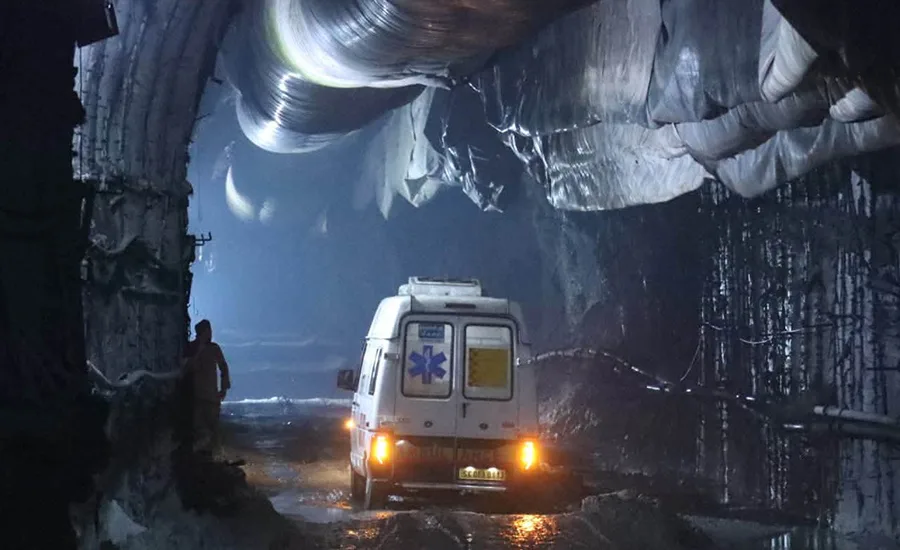
An ambulance sits inside the Teesta Stage-VI Hydroelectric Project headrace tunnel in Sikkim during rescue operations following the July 20 explosion that killed 25 workers and project officials. Investigators are examining whether documented methane hazards contributed to the disaster.
Rescuers on July 23 recovered the final victims from a suspected methane-gas explosion at India's 500-MW Teesta Stage-VI Hydroelectric Project in the Himalayan state of Sikkim, about 400 miles north of Kolkata, near the border with Bhutan and Tibet.
The four-day operation ended with 25 workers and project officials dead as investigators began examining what caused the underground construction disaster.
The explosion occurred July 20 inside the project's headrace tunnel. Civil contractor Patel Engineering Ltd., which is constructing that section of the tunnel, said a sudden release of suspected methane trapped within surrounding rock generated a gas burst that filled the passageway with dense, toxic fumes.
Project documents issued 10 days before the explosion identified methane gas, water ingress, cavity formation and unstable ground as active construction hazards in the same section the accident occurred. The documents called for enhanced gas monitoring, ventilation and operating procedures during excavation. There is no indication whether those measures were in place when the explosion occurred.
"We heard a loud sound and then debris came rushing through," survivors told Namchi district officials, according to the Associated Press.
The precise sequence—including whether the gas explosion caused the tunnel to collapse or was compounded by one—has not yet been publicly established.
According to the AP, 21 laborers were working underground when the explosion occurred, while six project officials entered during the initial response. Two workers escaped.
Looking for quick answers on construction and engineering topics?
Try Ask ENR, our new smart AI search tool.
Ask ENR →
Federal and state rescue teams recovered the final victims through toxic gases, standing water and poor visibility. Methane, carbon monoxide and hydrogen sulfide limited rescuers equipped with breathing apparatus to short underground rotations, the Associated Press reported.
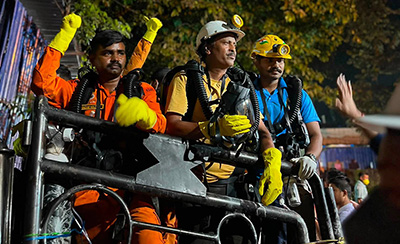
Members of India's National Disaster Response Force and other rescue agencies prepare for overnight operations at the Teesta Stage-VI Hydroelectric Project in Sikkim, where crews searched for workers trapped after the July 20 tunnel explosion.
Photo courtesy of the Government of Sikkim
NHPC Ltd., India's state-owned hydropower developer, said senior management remained at the site coordinating with federal and state rescue agencies throughout the recovery effort.
The Sikkim government has formed a high-level committee to determine the cause of the explosion and recommend safety improvements. Patel Engineering said a "detailed investigation will be undertaken to ascertain the cause of the incident."
According to the state order establishing the inquiry, investigators will examine the source of the gas release, tunnel ventilation, atmospheric monitoring, emergency procedures and compliance with applicable safety requirements.
Sikkim Chief Minister Prem Singh Tamang said the state would act if the inquiry identifies negligence.
"A thorough inquiry will be conducted," Tamang said in remarks reported by Indian media. "If any negligence is found on the part of the executing company, strict action will be taken."
NHPC acquired the unfinished Teesta Stage-VI development in 2019 after original developer Lanco Teesta Hydro Power Ltd. entered insolvency proceedings.
RELATED
India Tunnel Project Landslide Prompts Spoil Management Probe
The government-approved run-of-river project is being built on the Teesta River and includes twin headrace tunnels that will carry water to an underground powerhouse housing four 125-MW generating units. NHPC currently expects commercial operation to begin in September 2029.
Neither NHPC nor Patel Engineering had said when underground construction might resume or whether the accident would affect the project's planned 2029 completion.
Investigators have not determined what triggered the explosion or whether documented methane-control measures were operating when it occurred.

Bryan Gottlieb is the online editor at Engineering News-Record (ENR).
Gottlieb is a five-time Society of Professional Journalists Excellence in Journalism award winner with more than a decade of experience covering business, construction and community issues, including finance, law and real estate. He has reported for Adweek and the San Diego Daily Transcript and led a community newsroom in Santa Monica, Calif. He served as editor-in-chief of the Detroit Metro Times and as managing editor at Roofing Contractor, where he helped shape national industry coverage. At Engineering News-Record, Gottlieb covers breaking news, large-scale infrastructure and megaprojects, regulatory developments and business trends across the U.S. and global construction sectors.
email: gottliebb@enr.com | office: (248) 786-1591