Tunnel Construction
India Tunnel Project Landslide Prompts Spoil Management Probe
State officials allege excavated material had accumulated near the work area before fatal slope failure
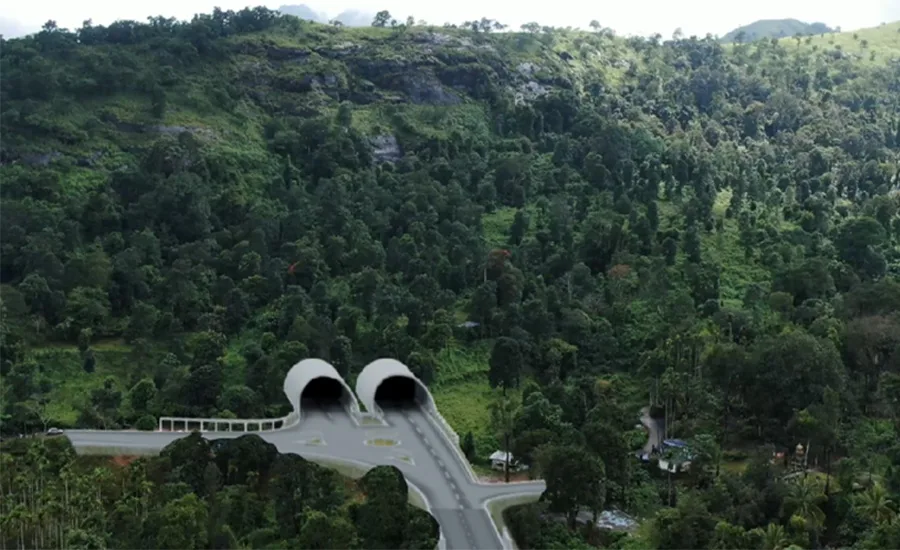
Concept illustration of the Anakkampoyil-Kalladi-Meppadi highway tunnel project in Kerala. A landslide outside the project site on July 7 killed at least three workers and remains under investigation.
A landslide triggered by heavy monsoon rain struck an active highway tunnel construction project in southern India on July 7, killing at least three workers.
The slide occurred in Kerala, a state on India's southwest coast, just outside the Anakkampoyil-Kalladi-Meppadi twin-tube highway tunnel project. According to local media reports, Kerala Fire and Rescue Services, police and other agencies continued searching the site after earth and rock engulfed part of the construction area.
Video broadcast by NDTV and other Indian television outlets showed a large section of hillside collapsing onto the work zone and sweeping away construction equipment and vehicles.
Konkan Railway Corp., the project's executing agency, says the project includes approximately 5 miles of twin unidirectional highway tunnels, four-lane approach roads and associated bridges intended to improve year-round transportation through the mountainous Western Ghats.
According to Konkan Railway project documents, Kerala authorities periodically close existing mountain highways in the region because of landslides and heavy monsoon rainfall.
Konkan Railway is executing the project under a tripartite agreement with Kerala's Public Works Department and the Kerala Infrastructure Investment Fund Board.
According to a regulatory filing by Dilip Buildcon Ltd., Konkan Railway awarded the company the engineering, procurement and construction contract for the tunnel works. Konkan Railway and Dilip Buildcon place the overall project value at about $250 million, with the tunnel contract valued at approximately $157 million.
Looking for quick answers on construction and engineering topics?
Try Ask ENR, our new smart AI search tool.
Ask ENR →
Konkan Railway project documents say construction began in 2024 and is expected to take about four years.
Authorities have not determined what triggered the slope failure or whether construction activity contributed to the landslide, nor have engineering findings been released. State officials said they would investigate whether spoil management at the construction site contributed to the disaster.
Sunny Joseph, a member of the Kerala Legislative Assembly, told The Indian Express that the district collector had previously ordered the accumulated excavated soil to be removed from the site.
"The order was not considered, and the construction company went ahead with the tunneling work," he said.
Speaking to reporters at the scene, Wayanad district's minister in charge, T. Siddique, called the incident "a man-made landslide" and "a clear case of lapse," alleging excavated material had accumulated near the work area despite earlier warnings. Those allegations have not been substantiated through the official investigation.
The project traverses the Western Ghats, a UNESCO World Heritage mountain range extending along India's southwest coast that is prone to landslides during the annual monsoon. Wayanad drew international attention in 2024 when catastrophic landslides elsewhere in the district killed hundreds of people.
Konkan Railway says the tunnel is being built using the New Austrian Tunneling Method, a staged excavation technique widely used for tunnels through rock. Preparatory excavation and reinforcement work had been underway at the Meppadi portal before Tuesday's landslide.
Neither Konkan Railway nor Dilip Buildcon had publicly commented on the incident by publication time or responded to requests for comment regarding construction activities, slope stabilization measures or spoil disposal practices.
Authorities had not released a final casualty count by publication time as rescue operations continued.

Bryan Gottlieb is the online editor at Engineering News-Record (ENR).
Gottlieb is a five-time Society of Professional Journalists Excellence in Journalism award winner with more than a decade of experience covering business, construction and community issues, including finance, law and real estate. He has reported for Adweek and the San Diego Daily Transcript and led a community newsroom in Santa Monica, Calif. He served as editor-in-chief of the Detroit Metro Times and as managing editor at Roofing Contractor, where he helped shape national industry coverage. At Engineering News-Record, Gottlieb covers breaking news, large-scale infrastructure and megaprojects, regulatory developments and business trends across the U.S. and global construction sectors.
email: gottliebb@enr.com | office: (248) 786-1591