Investigation
Structural Engineer Claims Reinforcement Was Never Installed on Troubled NYC Tower
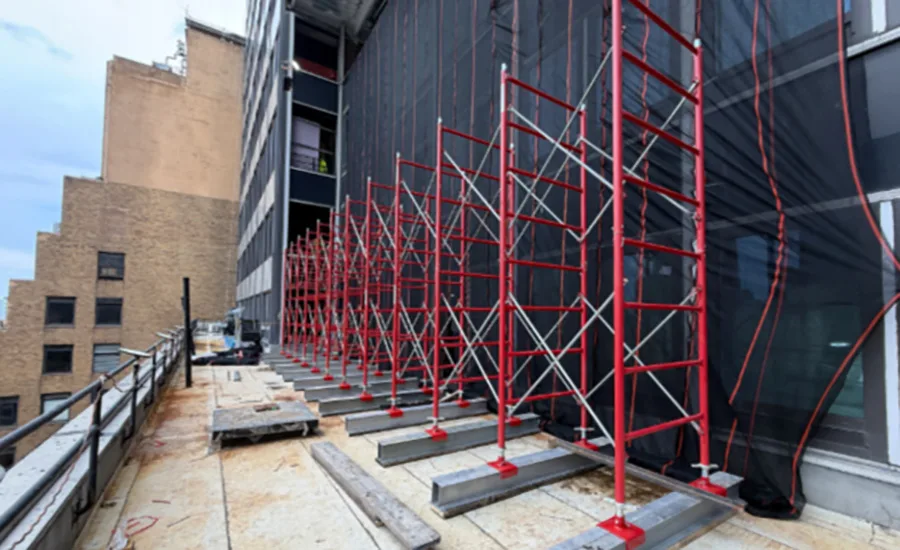
Temporary shoring stands along the exterior of the former Pfizer headquarters redevelopment at 235 E. 42nd St. in Manhattan as New York City continues its investigation into the July 7 structural failure and engineers work to stabilize the building before non-emergency construction can resume.
New York City has expanded its investigation into the structural failure at the former Pfizer headquarters tower in Midtown Manhattan as the Dept. of Investigation confirmed a parallel inquiry and the Dept. of Buildings directed the property owner to retain third-party engineering oversight.
These developments came as the project's structural engineer alleges that required reinforcing steel was never installed.
DOB directed the project’s owners to retain Thornton Tomasetti as a third-party engineering firm to oversee stabilization efforts and conduct a forensic review.
The department also required the owner to retain Special Testing & Consulting as a third-party special inspection agency, adding oversight beyond the project's existing engineering and inspection teams.
While there has been no official conclusion reached yet about why columns buckled in the former office tower earlier this month, GACE Consulting Engineers, the project’s structural engineer, claims that steel reinforcement specified in its design was omitted in construction.
“The reinforcement from the 19th floor to the top of the 21st floor, which would have significantly increased the columns' strength, was never installed,” GACE Principal Engineer Chris Behan told Gothamist on July 16. “The structure was not reinforced as GACE's design required.”
Gothamist's own review of city-approved structural drawings found that the original steel columns beneath the building's vertical expansion were specified for reinforcement.
Looking for quick answers on construction and engineering topics?
Try Ask ENR, our new smart AI search tool.
Ask ENR →
Christopher Raebel, vice president of engineering and research at the American Institute of Steel Construction, who is not involved in the investigation, said contractors typically are responsible for construction means and methods, and may retain specialty engineers for temporary works, while the project's engineer of record designs the completed structure and should remain informed as construction proceeds.
"The engineer of record should always be involved," Raebel said. "They should know what's going on. Even if it's during construction, they should at least be involved."
DOB declined to comment on GACE's claims. The department told ENR by email its investigation remains ongoing and that civil enforcement actions are pending its findings.
The July 7 failure halted one of the nation's largest office-to-residential conversion projects after inspectors found two buckled load-bearing columns and sagging floors on the 21st floor of the former Pfizer headquarters at 235 E. 42nd St.
While the root cause of the incident is still being determined, there are contractual and insurance disputes likely brewing as involved parties attempt to limit their liability exposure.
"While most of the stakeholders will initially appear to be very collaborative, eventually everyone tends to back into their respective camps," Robert Alfert, a board-certified construction attorney at Nelson Mullins, told ENR.
"The gravity, the risk and the liability exposures are so significant that it's simply human nature: each party tends to look to its own self-interest and be very protective of itself," he added.
City officials have cautioned against drawing conclusions while investigators determine whether the failure resulted from design, construction sequencing or another factor.
GACE Consulting Engineers and Thornton Tomasetti did not immediately respond to ENR's requests for comment.

Bryan Gottlieb is the online editor at Engineering News-Record (ENR).
Gottlieb is a five-time Society of Professional Journalists Excellence in Journalism award winner with more than a decade of experience covering business, construction and community issues, including finance, law and real estate. He has reported for Adweek and the San Diego Daily Transcript and led a community newsroom in Santa Monica, Calif. He served as editor-in-chief of the Detroit Metro Times and as managing editor at Roofing Contractor, where he helped shape national industry coverage. At Engineering News-Record, Gottlieb covers breaking news, large-scale infrastructure and megaprojects, regulatory developments and business trends across the U.S. and global construction sectors.
email: gottliebb@enr.com | office: (248) 786-1591


