Confidence Index
2Q 2026 Cost Report: Construction Exec Confidence Unchanged Despite Iran Conflict
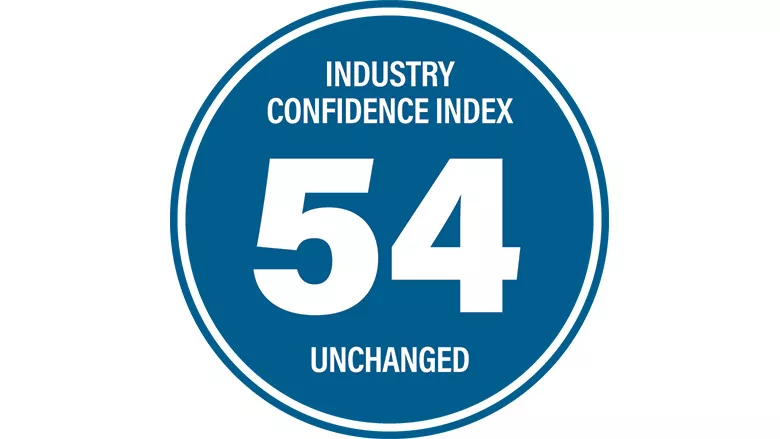
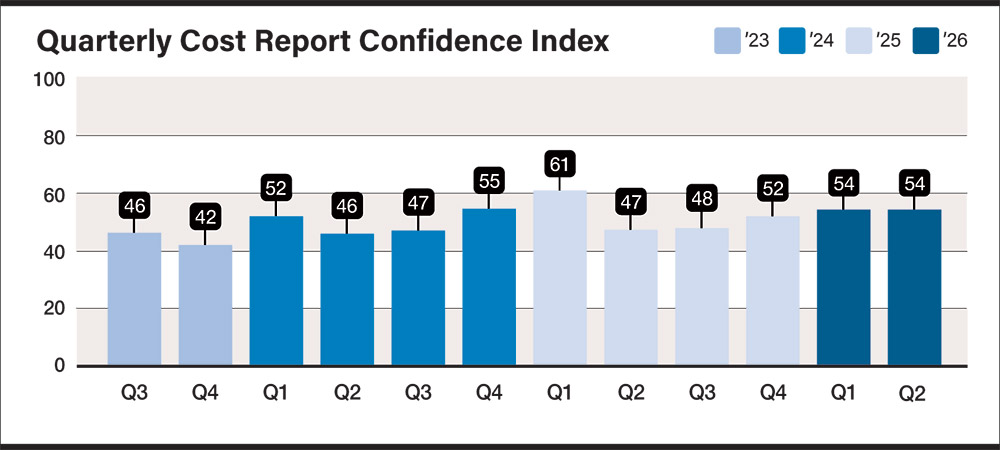
Construction industry executives report no change in industry confidence between Q1 and Q2, as ENR’s Construction Industry Confidence Index stayed at a slightly optimistic 54 rating this quarter. ENR’s Economic Index stayed static for a third straight quarter at a 48 rating.
The confidence index measures executive sentiment about where the current market will be in the next three to six months and over a 12- to 18-month period, on a 0-100 scale. A rating above 50 shows a growing market. The measure is based on responses by U.S. executives of leading general contractors, subcontractors and design firms on ENR’s top lists to surveys sent between May 4 and June 8.
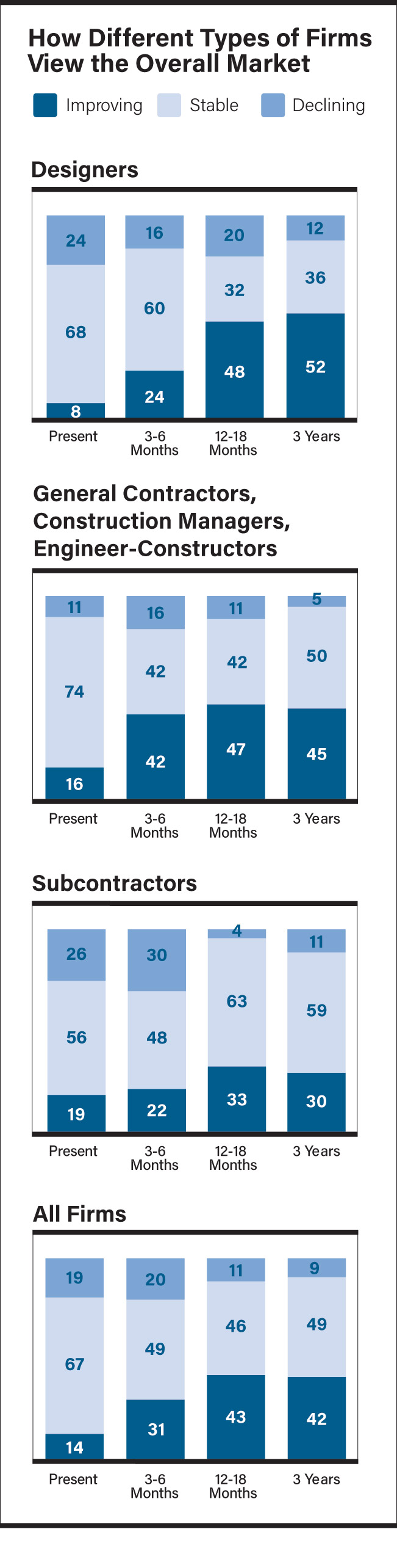
Firms report slightly less confidence in the current construction market than last quarter, but slightly more confidence in how the market will look 12-18 months from now. In Q1, 18.5% of firms saw an improving current market, but that number has dropped to 14.4% in Q2. Conversely, in Q1 nearly 20% of firms foresaw a declining market in 12-18 months. That number has dropped to 11.1% this quarter.
GC/CMs report the highest confidence levels. Taken separately, they came in at a 59 rating in Q2, four points higher than in Q1. Design firms remain the most pessimistic group but still reported a nine-point upswing in confidence, jumping to a stable 50 rating. Confidence among subcontractors moved in the opposite direction however, falling eight points, down to a 50 rating. Larger firms report more confidence in both the construction market and the economy overall than smaller firms.
Firms self-reporting more than $250 million in revenue registered a 55 rating for both the confidence and economic indices. Firms that reported revenue of less than $50-million had 48 and 45 ratings, respectively.
Results of the ConfIndex survey from Princeton, N.J.-based Construction Financial Management Association tell a slightly different story than that of ENR. Each quarter, the group polls CFOs from general and civil contractors and subcontractors on markets and business conditions. The resulting Confindex is based on four separate financial and market components, each rated on a scale of 1 to 200. A rating of 100 indicates a stable market; higher ratings indicate market growth.
All indices that the association tracks fell between Q1 and Q2, with the exception of its “current confidence” index, which rose 1% to a 105 rating. The overall Confindex fell 2.7% to a 107 rating. The “business conditions” index fell 3.5% to 109 and the “financial conditions” index fell 1.9% to a 106 rating.
Looking for quick answers on construction and engineering topics?
Try Ask ENR, our new smart AI search tool.
Ask ENR →
The biggest drop was in the “year ahead outlook” index, which dropped 6.8% to a 110 rating after three stable quarters, close to its June 2025 reading. “A year ago, what are these controllers staring at? They’re staring at the tariffs,” says Anirban Basu, CEO of Sage Policy Group and an association Advisor. “[CFOs] were deeply pessimistic a year ago, and they’re roughly as pessimistic now.”
With the war in Iran passing the 100-day mark without a clear end in sight, Basu sees recognition from finance professionals working in construction that inflation effects could be longer lived. “[In Q1] our financial professionals could look forward to two or three rate cuts this year. Now they’re hearing there’s going to be a rate increase in December, and then another one the next meeting after that, and another one the next meeting after that,” he says. “You’ve gone from three rate cuts to three rate increases in the bond market, 1.5% higher than expectation. To me, that’s a difference maker.”
The consumer price index rose to 4.2% in May, its highest level since April 2023, said the U.S. Bureau of Labor Statistics.
More than 75% of respondents to ENR’s survey report that they are experiencing upward price pressure, up from 63% last quarter. “Almost 80% of [association] respondents say materials prices are worse for them now than they were a year ago, up from 52% at the start of the year,” adds Basu. No association respondents report an improvement in materials prices.”I don’t think I’ve ever seen a result like that before,” he opines, adding: “This inflation is really broad-based along the dimension of construction inputs.”
An Overheating Economy
Basu does not see a recession anytime soon. “For a recession, either demand has to collapse or supply has to be inter-rupted,” he says. “COVID-19 was a supply shock. The 2008-2009 recession was demand.” The economist sees too many demand drivers in the economy, starting with artificial intelligence. “I speak to very large general contractors who tell me that ‘a few years ago our data center work was 5% of our book. Now it’s 35%.’” Basu also sees the federal government pushing money into the economy.
If anything, he sees the economy being overheated, with added jobs and higher input costs and inflation, “but the demand is still strong through those rising prices,” Basu explains. He says that recent wages in construction have been sharp relative to the rest of the economy. “Construction inflation is worse than overall economic inflation by a long shot, and yet demand is pushing through it,” Basu contends.
Related links:
Economics: Data Center Surge Presses on Amid Ongoing Economic Issues, Community Pushback
Confidence Index: Construction Exec Confidence Unchanged Despite Iran Conflict
Equipment: Steady Pricing Seen in Used Machines as Manufacturers Continue to Absorb Tariff Costs
Labor: Compensation Increases on the Decline Following 2023 High