Economics
2Q 2026 Cost Report: Data Center Surge Presses on Amid Ongoing Economic Issues, Community Pushback
Price hikes from last year’s tariffs, in addition to energy spikes caused by the ongoing conflict in Iran, remain cause for concern as the second quarter of the year comes to a close.
“The sense of optimism for 2026 has waned,” says Sarah Martin, associate director of forecasting at Dodge Construction Network. “Military actions in the Persian Gulf have limited the potential for upside risk. Rising materials costs and renewed uncertainty around global supply chains are poised to weigh on construction activity in 2026, even as project demand remains resilient.”
Michael Guckes, chief economist at ConstructConnect, shares a similar sentiment. “Tariffs have already put a sizable floor under construction inflation which has been steadily rising,” he says. “With the latest jump in energy prices yet to be fully factored into construction prices, it is reasonable to suspect that materials prices will move higher still in the second quarter and beyond if the war and tensions in the Middle East continue.”
Total construction starts are up 5% through April, according to Dodge, spurred largely by utilities work and the ongoing construction of data centers. Residential starts are down 4% in the same time period, due to an 11% drop in the single-family sector. “Rising mortgage rates between January and April have continued to price out first-time homebuyers, exacerbating an already tight supply of affordable housing,” says Martin.
The decline in affordable single-family options has led to a larger demand for multifamily housing, for which starts rose 8% through April. The largest multifamily buildings to start work in April were the $850-million Gowanus Wharf 175 3rd Street Mixed Use Development in Brooklyn, N.Y.; the $354-million Deerfield Episcopal Retirement Community III expansion project in Asheville, N.C.; and the $303-million Archer Towers Mixed Use Development-Garage (Phase 2) project in Queens, N.Y.
In the non-residential sector, starts rose 19% in the first four months of the year. Martin attributes this largely to commercial starts, as office buildings and data centers increased a whopping 61% year-to-date. “Data center construction continues to be a bright spot, with robust starts activity alongside outsized demand for AI and cloud infrastructure,” says Martin.
Steve Stouthamer, executive vice president of project planning at Skanska USA Building, notes that despite the “increased scrutiny” surrounding data center construction, “we have not seen those factors meaningfully alter the underlying demand driving these projects.” He adds that going forward, “technology-driven investment and infrastructure modernization [are expected] to remain key market drivers, particularly as demand for AI, data processing capacity and advanced manufacturing continues to grow.”
Looking for quick answers on construction and engineering topics?
Try Ask ENR, our new smart AI search tool.
Ask ENR →
However, the sector has begun to see longer planning stages. “It’s taking a median of 17 months for projects to reach groundbreaking in the first four months of the year, compared to 15 months in all of 2025,” say Martin. “Growing constraints around specialized labor and power availability, along with rising resistance from local communities, appear to be contributing to the delay.”
Retail, hotel and parking garage starts also had strong showings through April, while warehouse starts fell 11%, according to Dodge. Within the institutional market, education and health care starts both declined at a rate of 5% and 22% respectively. “Reduced access to federal funding, tighter state and local budgets and ongoing material and labor pressures are all weighing heavily on publicly funded construction activity,” Martin says. The largest non-residential projects to start in April were the $5-billion Provident/PowerHouse Prairie Ridge Data Center Phase 1 in Midlothian, Texas; the $1.9-billion SK Hynix HBM Advanced Packaging & R&D Hub project in West Lafayette, Ind.; and the $1.3-billion Stargate Data Center Campus project in Saline Township, Mich.
Non-building starts increased 12% year-to-date, due to a massive 79% increase in utility starts, according to Dodge data. Other portions of the sector, however, have been slowing down as public funds allocated by the Biden administration are set to expire in September. Highway and bridge starts fell 14% through April, while environmental public works starts declined 4%. Among April’s biggest non-building projects were included the $3.3-billion Cayuga Station Natural Gas Energy Replacement in Cayuga, Ind., and the $1-billion Tradepoint Atlantic Container Terminal in Edgemere, Md.
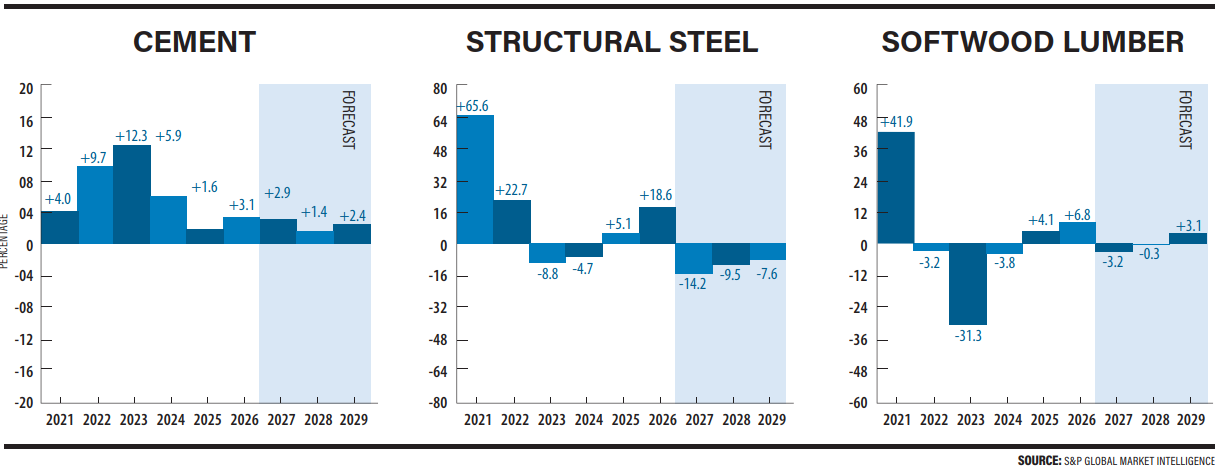
In the materials market, tariffs will continue to raise prices throughout the rest of the year, according to the S&P Global Market Intelligence second quarter forecast. Softwood lumber prices are predicted to rise 6.8% by the end of 2026, with plywood prices up 4% in the same time period.
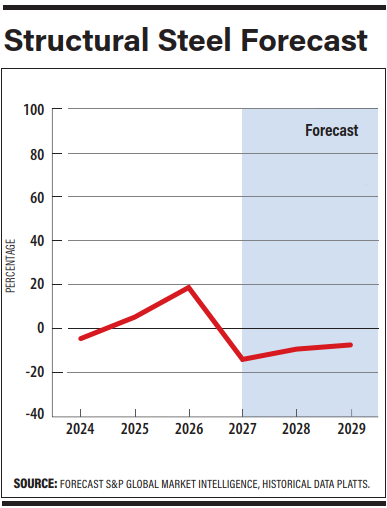
Steel prices are also expected to increase for the year. Structural shape prices will rise 18.6%, according to S&P Global Market Intelligence, while fabricated structural metal products and fabricated structural sheet are predicted to increase 7.7% and 8.3%, respectively. Reinforcing bar prices will experience a double digit boost, at 11.4%, with sheet metal expected to be up 5.5% by the end of 2026.
ConstructConnect’s Guckes shares the same prediction for steel prices. He points to the conflict in Iran as the catalyst, stating that the “full impact on energy prices has yet to be fully factored into construction prices.”
“The ongoing rise in energy prices will continue to work through the metal products supply chain,” he adds. “The result being an almost certain rise in future metals prices.”
Related links:
Economics: Data Center Surge Presses on Amid Ongoing Economic Issues, Community Pushback
Confidence Index: Construction Exec Confidence Unchanged Despite Iran Conflict
Equipment: Steady Pricing Seen in Used Machines as Manufacturers Continue to Absorb Tariff Costs
Labor: Compensation Increases on the Decline Following 2023 High