Construction History
From the Archives: July 5, 1984
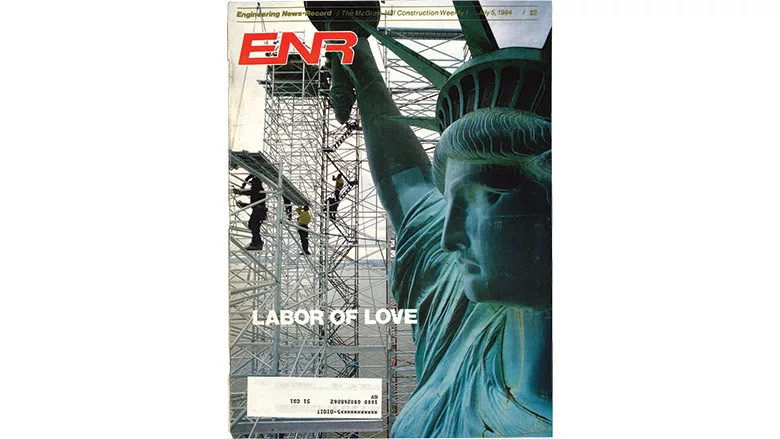
The restoration of the Statue of Liberty, seen on this 1984 cover, presented numerous challenges.
Liquid nitrogen at -320°F was used to remove seven layers of interior paint, followed by blasting with sodium bicarbonate to remove a layer of coal-tar paint. The most ponderous part of the job was replacing the iron armature, a network of 1,350 iron bars ending in 1,500 U-shaped copper saddles flush-riveted to the 80-ton copper envelope.
Condensation and rainwater leaks had caused galvanic action between the armature and the saddles, resulting in significant corrosion.
The iron bars were replaced with low-carbon stainless steel bars isolated with Teflon sleeves.
Nab Construction Corp. was the steel contractor. More powerful air-handling units were installed to lower the interior temperature and humidity.
The exterior scaffolding was an 81-ft rectangle that rose 250 ft and was never closer than 18 in. to the statue.
The statue’s shoulder needed bracing, as the sculptor, Auguste Bartholdi, had changed the position of the shoulder and arm on the torch side, against engineer Gustave Eiffel’s will.
The 3,500-lb torch had suffered so much corrosion due to alterations that caused leaks that it had to be replaced. Lehrer/McGovern was construction manager. The restoration was completed in time for the statue’s 1986 centennial celebration.
Looking for quick answers on construction and engineering topics?
Try Ask ENR, our new smart AI search tool.
Ask ENR →