Workforce
Construction Hiring Slows, but Contractors Keep Workers
Rising unemployment and weaker demand indicators suggest labor-market cooling, but competition for electricians and other skilled trades remains intense

Workers perform electrical and equipment work at an industrial facility. Industry economists say electricians remain among construction's hardest-to-fill positions as data center and energy projects compete for specialized labor.
The construction labor market may finally be showing signs of loosening after years of severe labor tightness, but contractors do not appear ready to let workers go—a dynamic reflected in new state unemployment data released by Associated Builders and Contractors.
March construction unemployment rose from a year earlier in 44 states, according to an ABC analysis of U.S. Bureau of Labor Statistics data, while separate labor and spending indicators suggest firms are moderating workforce growth rather than broadly retrenching.
The national not seasonally adjusted construction unemployment rate reached 6.7% in March, a 1.3-percentage-point increase from March 2025, according to the ABC analysis. Only Louisiana and Ohio posted lower estimated construction unemployment rates than a year earlier, while 44 states recorded increases.
ABC noted that the figures are estimates derived from household survey data because monthly state-level construction unemployment figures are not directly produced by BLS.
“The figures are not seasonally adjusted, so it is important to compare the same month in different years rather than make comparisons across months, since construction employment fluctuates a lot with the season,” said Kenneth Simonson, chief economist for the Associated General Contractors of America.
But broader employment indicators show a more complicated picture. National payroll construction employment remained 58,000 jobs above year-earlier levels, marking a 12th straight month of annual gains, though increases remained below 100,000 workers. Seasonally adjusted construction employment stood at 8.3 million workers, or 9.3% above its pre-pandemic peak.
RELATED
Construction Jobs Rebound, Jumping by 26K in March
Looking for quick answers on construction and engineering topics?
Try Ask ENR, our new smart AI search tool.
Ask ENR →
Job Openings, Demand Indicators Diverge
Job openings and hiring activity suggest a gradual rather than sharp cooling in the labor market. Construction job openings totaled 224,000 in March, up from February but down 54,000 from a year earlier, according to U.S. Bureau of Labor Statistics Job Openings and Labor Turnover Survey data.
“I think a more significant indicator of demand for workers is the Job Openings and Labor Turnover Survey, which has shown consistently weak hiring and job openings but also very low quit rates,” Simonson said.
Hiring improved month over month to 308,000 positions, while layoffs and voluntary quits remained below year-earlier levels. ABC Chief Economist Anirban Basu previously described February as the month with the least construction labor-force churn since the BLS began tracking the data in 2000, reflecting historically slow hiring activity alongside limited worker movement.
A higher unemployment rate does not necessarily mean a large influx of available workers. Instead, the data increasingly point toward a lower-turnover environment in which firms are hiring more selectively while preserving existing crews.

A March analysis from Associated Builders and Contractors found construction unemployment rates increased from a year earlier in 44 states, with the national rate rising 1.3 percentage points.
Chart: ABC/Markstein Advisors
Demand indicators have also softened.
National nonresidential construction spending declined 0.2% in March, with spending decreasing across nine of 16 nonresidential categories. Private nonresidential activity was down more than 2% from a year earlier, according to ABC analysis of U.S. Census Bureau construction spending data.
"While a large portion of the ongoing decline is due to steadily falling manufacturing-related construction activity, weakness is becoming more widespread," Basu said.
The manufacturing slowdown has become particularly pronounced. Manufacturing construction spending was down 17% year over year in March, according to the accompanying ABC spending analysis.
Basu said data center and related energy projects remain among construction's strongest segments, while opportunities in privately financed construction have softened. He noted that multifamily, office and lodging activity remain constrained—even healthcare construction has moderated. However, data center construction spending rose 34.3% year over year and remains one of the industry's strongest growth drivers.
“Electricians are the hardest positions to fill as data center projects are competing for thousands of them per site and often paying enough to draw workers away from less-urgent projects,” Simonson said.
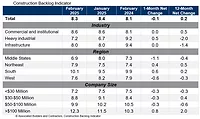
Despite weaker labor and spending indicators, broadly speaking, contractors still report substantial work under contract. ABC's Construction Backlog Indicator rose to 8.6 months in March, up from 8.1 months in February and slightly above year-earlier levels.
ABC economist Bernard Markstein attributed some of the slowdown to macroeconomic pressures, including higher energy costs associated with the Iran conflict, rising insurance premiums, labor costs and elevated borrowing rates.
"The Iran war and resulting hike in energy prices are negatively affecting the construction industry," Markstein said, adding that some projects have been scaled back or delayed.

Bryan Gottlieb is the online editor at Engineering News-Record (ENR).
Gottlieb is a five-time Society of Professional Journalists Excellence in Journalism award winner with more than a decade of experience covering business, construction and community issues, including finance, law and real estate. He has reported for Adweek and the San Diego Daily Transcript and led a community newsroom in Santa Monica, Calif. He served as editor-in-chief of the Detroit Metro Times and as managing editor at Roofing Contractor, where he helped shape national industry coverage. At Engineering News-Record, Gottlieb covers breaking news, large-scale infrastructure and megaprojects, regulatory developments and business trends across the U.S. and global construction sectors.
email: gottliebb@enr.com | office: (248) 786-1591