Economic Indicators
Construction Spending Sees Small Uptick in March
Private-sector activity continued to soften while data centers and infrastructure remained among the few major growth drivers, ABC says
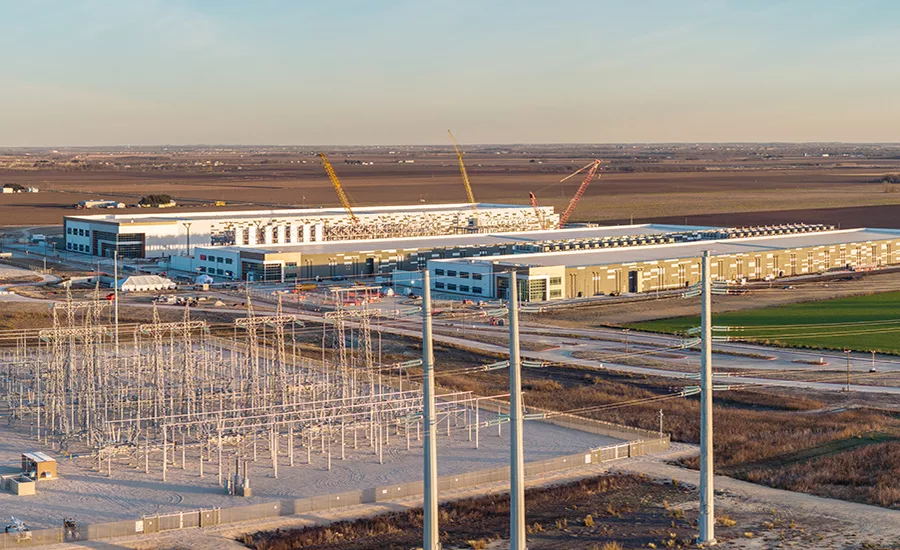
Electrical infrastructure is constructed near the Skybox Power Campus data colocation center in Hutto, Texas, north of Austin, on Dec. 31, 2025. Data centers and related power infrastructure remain among the strongest-performing nonresidential construction segments even as broader private-sector activity softens, according to Associated Builders and Contractors’ March spending analysis.
Updated 12:04 PM EDT, May 8, 2026
Total construction spending rose 0.6% in March, on a month-to-month basis, according to data recently released by the U.S. Census Bureau. Residential spending increased 1.6%, while non-residential spending fell 0.2% in the same time period.
Total nonresidential spending fell to a seasonally adjusted annual rate of $1.244 trillion, according to Associated Builders and Contractors’ analysis of the Census Bureau data.
ABC released the analysis May 7, following reporting delays tied to the recent federal government shutdown. Nine of 16 nonresidential subcategories posted monthly declines, while both public and private nonresidential spending each slipped 0.2%.
Year-over-year, total construction spending increased 1.6% in March, spurred by a 3.5% boost in the residential market, while non-residential spending saw a slight bump at 0.2%.
“Residential construction rebounded in March and investment tied to data centers and power projects continues to support activity, but several traditional nonresidential segments, including manufacturing and commercial construction, continue to lag,” said Macrina Wilkins, director of market insights for Associated General Contractors of America.
Manufacturing construction fell to $190.1 billion in March from $228.9 billion a year earlier, marking the steepest annual decline among major nonresidential categories.
Looking for quick answers on construction and engineering topics?
Try Ask ENR, our new smart AI search tool.
Ask ENR →
The retreat follows a record run-up in factory construction tied to federal incentive programs, including the CHIPS and Science Act and Inflation Reduction Act, which fueled a wave of semiconductor, battery and industrial megaproject announcements between 2022 and 2024.
On a monthly basis, several other markets, including education, transportation, and highway and street, also saw declines in spending. Conservation and development posted the sharpest monthly decline of any subcategory, falling 3.4% to $12.6 billion.

Total U.S. nonresidential construction spending plateaued in early 2026 after a multiyear surge driven largely by manufacturing megaprojects, data centers and infrastructure work, according to Associated Builders and Contractors’ analysis of U.S. Census Bureau data.
Chart courtesy of ABC
“While a large portion of the ongoing decline is due to steadily falling manufacturing-related construction activity, weakness [in the non-residential sector] is becoming more widespread,” Anirban Basu, chief economist at Associated Builders and Contractors, said in a statement.
“Both public and private sector activity fell in March, and the latter is now down more than 2% on a year-over-year basis,” Basu added.
Private nonresidential spending totaled $729.4 billion on a seasonally adjusted annualized basis, down 2.1% year over year. Public nonresidential spending, at $514.4 billion, declined 0.2% for the month but remained 3.7% above year-ago levels—a divergence consistent with continuing activity tied to Infrastructure Investment and Jobs Act-funded programs.
Several categories bucked the broader trend. Office construction rose 0.9% in March to $111.6 billion and is up 7% year over year, despite continued uncertainty surrounding office occupancy trends and long-term workplace demand.
Amusement and recreation climbed 1.1% for the month and 9.8% annually. Power infrastructure spending increased 0.2% in March and is up 5.3% year over year, while sewage and waste disposal rose 0.5% monthly and 8.6% annually.
RELATED
ABC: Private Nonresidential Construction Falls for Fourth Straight Month
Data Centers Remain Key Source of Momentum
“With the exception of the ongoing boom in data center construction (+34.3% year over year), there are few sources of momentum,” Basu said. “Despite this ongoing weakness, contractors remain optimistic about the outlook, according to ABC’s Construction Confidence Index.”
Among other declining categories, lodging fell 0.7%, commercial slipped 0.6%, water supply dropped 0.5%, transportation and educational construction each fell 0.4%, and highway and street spending declined 0.2%.
— Bryan Gottlieb contributed to this report

.webp?height=200&t=1746261584&width=200 "DnnImageHandler (2).png")
