Grid Operator PJM Interconnection Aims Changes to Speed New Capacity Adds
Largest U.S. power transmission manager counts on upgraded review process to accelerate capacity as data centers multiply and criticism over its management grows

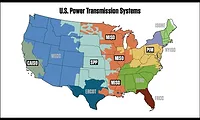
PJM, now managing all or part of 13 states, shown above in orange, counts on upgraded review process to accelerate capacity, with 349 projects proposed.
The nation’s largest power grid operator is counting on a revamped review process to accelerate the addition of new generating capacity. It's expected to not only help meet an expected data-center-driven 30-GW increase in demand across its service area by 2030, but also quell growing criticism over its management of the wholesale electricity market in its large and diverse region.
PJM Interconnection LLC announced April 29 in advance of an annual meeting that its reopened queue of proposed new interconnections includes applications from 811 projects totaling 220 GW. Most proposed projects are for traditional sources such as coal, methane, natural gas, nuclear and hydro power, with battery storage and renewables also in the mix. According to PJM's 2026 Long-Term Load Forecast, summer peak demand will rise to 253 GW by 2046 from 160 GW in 2025, a 58% increase driven primarily by data centers.
In its April 29 announcement, PJM noted 349 standalone storage projects and 157 natural gas plants in its accepted mix, including 142 solar projects, 65 in wind, 45 solar‑plus‑storage hybrids, 27 nuclear units, 15 described as “other” sources and 11 hydro projects. By capacity, there is 105.8 GW of gas power, 66.5 GW of storage, about 150 MW of hydro, 19.5 GW of wind and solar, 17.9 GW of nuclear and 500 MW of “other,” which PJM said includes biomass, coal, methane, and, for the first time, nuclear fusion, according to the operator, Massachusetts-based developer Commonwealth Fusion Systems recently sought grid inclusion for its planned 400-MW Fall Line Fusion Power Station in Chesterfield County, Va.
PJM was founded in 1927 as a power pool of three utilities serving Pennsylvania and New Jersey. Two Maryland utilities were added three decades later. It became a full regional transmission operator (RTO) in 2002, responsible for regional power market planning and management. It now oversees a grid serving all or part of 13 states and Washington, D.C.
Four-year Overhaul Brings Results
The announcement follows PJM’s four-year pause in accepting new interconnection applications while it cleared its existing backlog and worked with federal regulators to reform the industry’s time-consuming “first-come, first-served” evaluation process. For the new cycle, PJM will use what it calls a “first-ready, first-served appro
ach,” prioritizing projects that are more advanced and ready to move forward.
“Projects must demonstrate they are viable before entering the queue, including meaningful up-front financial commitments and proof of site control,” according to a company statement. “These requirements are designed to reduce speculative projects, improve predictability and increase the overall pace of interconnection.”
Looking for quick answers on construction and engineering topics?
Try Ask ENR, our new smart AI search tool.
Ask ENR →
PJM anticipates the process to evaluate and approve projects will take under two years—an ambitious timeline officials say will be achieved through use of tools from Google’s artificial intelligence research lab, including an automated document review and interconnection “intelligence” platform developed by its spinoff software firm Tapestry.
In a social media post, Tapestry General Manager Page Crahan said the system will eliminate evaluation bottlenecks that Lawrence Berkeley National Laboratory estimated in 2023 created a potential capacity backlog of 2,600 GW. Tapestry now will use siloed project databases, models and other evaluation tools to foster better collaboration among grid planners and project developers.
“By automating and improving the data verification process for things like land rights, equipment, and grid impacts, we aim to reduce the burden on energy developers and PJM planners,” Crahan said. PJM adds that AI could help add more flexibility to a feasibility assessment process tailored more for conventional large-scale coal and oil-fired generation facilities, rather than the smaller-scale, variable sources such as wind, solar and battery storage.
Who’s Paying the Bill?
But those same AI technologies require more data centers in more PJM service areas, upending a longstanding balance of supply and demand in the wholesale power market that has translated into higher electricity prices.
A report from Maryland Office of People’s Counsel found that rising capacity prices across the entire PJM footprint will result in $14.7 billion of added annual cost to electric customers, up sevenfold from $2.2 billion in capacity costs in the 2024-25 delivery year.
While the Maryland legislature recently enacted policy changes aimed at spurring renewable energy generation and providing some relief to ratepayers, Gov. Wes Moore (D) told PJM meeting attendees May 11 that the grid operator lacks a clear plan to address the wholesale power market’s broader issues.
“Reliability without affordability is not reliability; it’s just a transfer payment,” he said. “Affordability without reliability ... is just a way to make ratepayer pain permanent and erode trust in this system.” Another criticism levied at PJM has been its slow pace in adding less-expensive clean energy generation sources to the grid, a move that advocates say could help blunt price increases.
In a May 11 statement, the operator countered that it has processed “thousands of megawatts of renewable projects” and that factors beyond its control—permitting and siting hurdles, financing, and supply chain backlogs—have delayed or sidelined many projects.
Federal Energy Regulatory Commission Chair Laura Swett, a 2025 Trump administration appointee, raised concerns at the meeting that the grid operator might be too large now to function effectively to in meet data center power demand—with more than 1,000 utility members and an “unacceptable” governance structure. PJM states and the District of Columbia have “fundamentally different regulatory structures, resource portfolios and politics,” Swett said, claiming that confidence in its decision-making has “completely eroded.”
In its most recent capacity auction, held in December, PJM could not acquire enough capacity to meet its reserve margin target, triggering FERC warnings. PJM added 2.8 GW of capacity in 2025 and 4.8 GW in 2024, according to a January staff presentation. As of Jan. 8, 2 GW was being built and an added 3.2 GW was under construction and partly in service, PJM staff said.
FERC ‘Fix-It’ Conference Set for July 23
Swett said FERC would hold a conference July 23 to identify flaws in PJM’s governance process and solutions to fix them. “It will be a work session to build a record eyed toward actionable change,” she said, with attendees to include invited PJM board members and executive managers, investors, state regulators, consumer advocates, and transmission experts from other RTOs “to provide candid, concrete proposals for reform,” said Swett. “This will not be another airing of grievances.”
PJM “appreciates” Swett’s interest in the grid operator’s stakeholder process, said spokesman Jeffrey Shields. “We look forward to participating in the upcoming technical conference and continuing our work to strengthen grid reliability [and] ... bring new generation online as quickly as possible,” Shields said in a media response.
The PJM Power Providers Group, which represents independent power producers, also appreciates Swett’s comments, said Glen Thomas, its president. The group “doesn’t believe the PJM stakeholder process is fundamentally broken; however, there is certainly always room for improvement,” he told industry publication Utility Dive.
On a larger scale, PJM is exploring further changes in wholesale electricity market management in light of growing data center demand and other challenges. A company-issued report outlines three general frameworks to develop permanent solutions. “The choices embedded in these paths involve genuine trade-offs,” the report states, “and those ... affect different stakeholders uniquely.”
PJM says the framework proposals are intended to start stakeholder conversations on the best approach to rectify a situation that grid operator President and CEO David Mills calls “not tenable” and demands a prompt, well-considered solution.
“This is a generational challenge that no one organization, state or industry can solve alone,” said Shields after the Maryland governor’s address. “It will take coordination across policymakers, grid operators, utilities, generators, and large energy users to help evolve the grid at the speed and scale this moment demands,” he added.
The changes may not come soon enough for large utilities such as Columbus, Ohio-based American Electric Power Co. During its first-quarter results call in early May, Chairman, President and CEO Bill Fehrman told investors that concerns about PJM’s ability to expedite a solution to the power market’s many challenges could force his company to end its grid membership.
“If something is not done now, I expect we could still be having these same conversations in 10 years,” Fehrman said. “The PJM market worked very well when supply exceeded demand; we are now in a very different time.”