Environment
EPA 'Forever Chemicals' Guidance Highlights Areas Where More Research Is Needed
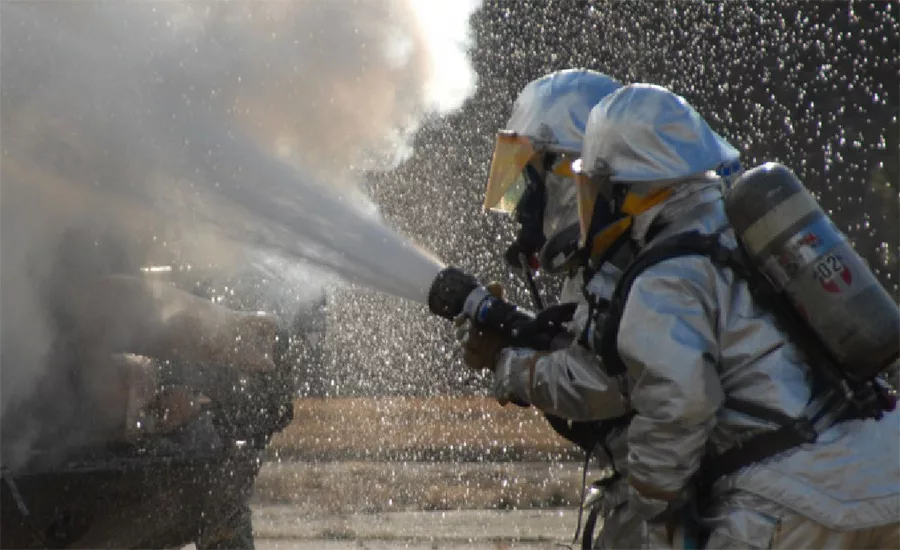
The US Defense Dept is phasing out use in firefighting of aqueous film-forming foam, which contains PFAS chemicals, with a target end date of Oct. 1.
U.S. Environmental Protection Agency interim guidance on best practices for disposal and destruction of per- and polyfluoralkyl substances—often described as ‘forever' chemicals—highlights several already widely used technologies, but others, particularly those focused specifically on destruction, are more nascent, according to several water sector sources interviewed by ENR.
EPA released the updated guidance last month to reflect the most recent data available on both separation and destructive technologies that are effective in reducing levels of the chemicals, called PFAS, in water, wastewater and manufactured products that make their way into human tissue. PFAS chemicals are known to cause health issues, including damage to fetal development as well as liver, immune and thyroid conditions.
The guidance does not impose new requirements but is designed to give states, utilities, waste handlers and local communities needed information to make decisions about how to manage the chemicals safely, and to protect human health, according to EPA officials.
“This updated guidance identifies approaches to manage PFAS waste using the best available gold-standard science, so communities across the country can be confident that these chemicals are being managed, disposed of and destroyed in ways that safeguard their health and their environment,” said EPA Administrator Lee Zeldin in a statement.
The guidance highlights three types of technologies to dispose of or destroy the substances: underground injection, landfills and a range of thermal treatments, which include incineration as well as more innovative technologies to break the carbon-fluorine bond.
“I think the important thing about the guidelines is that they are not recommending a specific technology. It's still such an emerging challenge for the water sector to deal with that being too prescriptive on technology doesn't make sense yet,” John Ikeda, chief mission officer at the Water Environment Federation, said, adding that the guidelines note that more research is necessary.
According to EPA, more information is needed to understand whether harmful byproducts of incomplete combustion, or PFAS air emissions, are formed by units operating at lower temperatures, such as municipal waste combustors.
Looking for quick answers on construction and engineering topics?
Try Ask ENR, our new smart AI search tool.
Ask ENR →
The EPA action follows release of a guidance memo earlier this year by the U.S. Dept. of Defense regarding PFAS disposal and destruction at its facilities across the country.
Both documents “speak to the fact that big conversations are being had and that need to be had on what are the best ways to handle these materials,” said Chris Higgins, executive director of a newly established research center to evaluate different PFAS destruction technologies at the Colorado School of Mines in Golden, Colo.
Although the handful of large federal settlements with manufacturers of PFAS such as 3M and DuPont will fund removal and destruction projects, actual cleanup work in most of these cases is not yet imminent, Higgins said, although “a lot of sites are being looked at, and they're doing their remedial investigations and figuring out what makes the most sense in terms of what they are trying to do.”
Local officials are often unsure about which technologies make the most sense for their own municipalities, and whether they need to remediate at all, said Leon Downing, director of innovation and research at Black & Veatch, which has performed various studies comparing benefits and drawbacks of different technologies.
“Many PFAS disposal and destruction technologies are pretty intensive from a capital standpoint and from an operating requirement standpoint. So we're starting to understand how we could do it and decide if there is enough of a driver … to do that,” he said.
Treatment options range from membranes, pyrolysis, gasification and supercritical water oxidation of biosolid streams, Downing said. “There are options out there, and the challenge becomes, ‘Okay, it destroys PFAs, but it's taking a very large amount of energy to do that, so where is the overall environmental impact balance?’”
EPA is accepting public comment through June 29.

.webp?height=200&t=1713570903&width=200 "EPA-headquartersEPA (1).jpeg")