AI Infrastructure
Maine Moves to Pause Data Centers Before Demand Arrives
Moratorium on 20-MW and up capacity projects advances despite limited ISO New England pipeline, as officials weigh grid capacity, cost and infrastructure risk
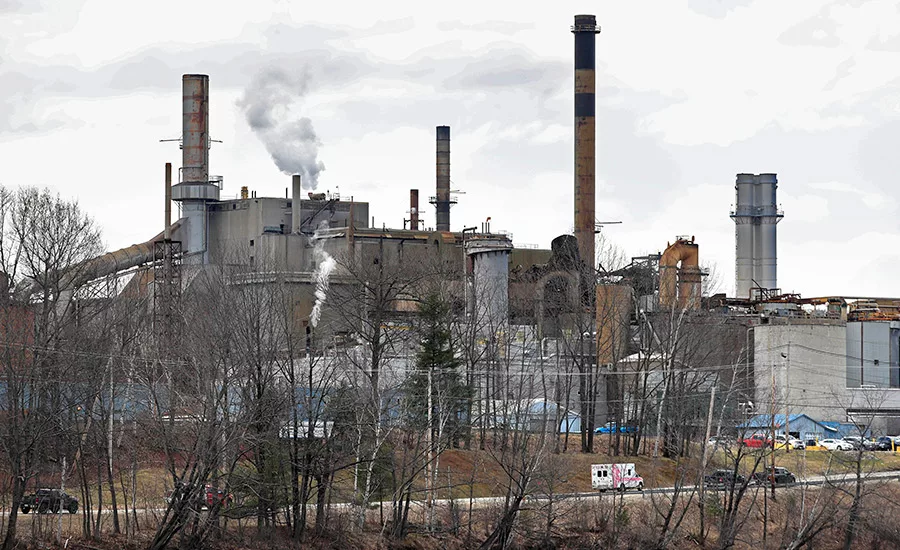
The former Androscoggin Mill in Jay, Maine, which closed in 2023, is being considered for redevelopment as a $550-million data center project that could be affected by the state’s proposed 20-MW capacity moratorium.
Maine lawmakers have approved what would be the nation's first statewide moratorium on large data centers, moving to pause new development even as regional grid officials say New England has yet to see the surge of projects emerging elsewhere.
The legislation, passed April 14, would bar state and local agencies from permitting data centers with loads of 20 MW or more until Nov. 1, 2027, while a newly created Maine Data Center Coordination Council evaluates impacts on electric grid capacity, ratepayers and environmental resources.
The council is also charged with assessing load growth projections, infrastructure needs and strategies to "protect ratepayers from rate inflation or negative financial effects" tied to large-load development.
Read More
Maine Data Center Moratorium Bill
Gov. Janet Mills (D) had previously said she wanted an exemption for a proposed data center redevelopment in Jay, a rural town where developers seek to convert a shuttered paper mill site, to win her support, but her office has not publicly said whether she will sign or veto the measure.
While policymakers across the U.S. are weighing how to manage the rapid expansion of energy-intensive computing tied to artificial intelligence, large-scale data center development in New England remains limited.
"To date, New England has not seen the level of interest in large data centers that other parts of the country have and so we're not expecting the rapid demand growth that other grid operators are projecting," Mary Cate Colapietro, a senior communications specialist at ISO New England, told ENR in an email.
ISO New England data indicate only a small pipeline of prospective large-load projects. Transmission owner surveys show "a couple hundred megawatts of large loads in the formal study phase," according to a March 2026 ISO presentation.
Looking for quick answers on construction and engineering topics?
Try Ask ENR, our new smart AI search tool.
Ask ENR →
Colapietro said one project identified through those surveys has an estimated nameplate capacity of about 200 MW, although ISO New England did not identify its location in materials it provided.
The bill's financial-risk provisions carry significant implications for developers and utilities operating in the region. The legislation directs the council to evaluate "projections of electric load growth, infrastructure needs and system reliability" and to consider cost-allocation approaches, rate-design changes, impact fees, energy-supply obligations and demand-response or load-flexibility requirements during periods of high demand or grid emergencies.
It also calls for recommendations on what data center developers should disclose to grid operators, utilities, agencies and municipalities about electric load, peak demand, water use and other operating characteristics.
That framework would require future developers and utilities to evaluate not only whether projects can be permitted, but also what operating, disclosure and cost obligations Maine may attach to them.
RELATED
States Push Data Center Pauses to Buy Time to Gauge Impacts
Grid Pressures Already Building
Regional planning data show demand pressures are already building even without significant data center expansion. ISO New England forecasts electricity use will increase by about 11% between 2025 and 2034, driven largely by electrification of heating and transportation.
Over the same period, peak demand is projected to rise from about 24,800 MW to nearly 26,900 MW in summer and from roughly 20,000 MW to about 26,000 MW in winter as electrification reshapes load patterns.
Nationally, analysts expect data centers to account for a significant share of future load growth. A 2025 analysis by Grid Strategies found that such facilities could account for roughly 55% of projected U.S. electricity demand growth over the next five years. The divergence between rapid national growth and limited regional activity has created a planning dilemma for states like Maine, which are weighing economic development opportunities against the risk of future infrastructure strain.
RELATED
Energy Sector Debates New US Rules to Power Up More 'Large Load' Data Centers
A Mill Town in the Balance
That tension is especially visible in Jay, where local officials are backing a proposed redevelopment of the former Androscoggin Mill, the Pixelle Specialty Solutions paper plant that closed in 2023, three years after a digester explosion crippled its pulp-making operations. JGT2 Redevelopment LLC, which bought the property in December 2023, is pursuing a $550-million co-location data center there for Sentinel Data Centers LLC of New York City.
Tony McDonald, a developer representing JGT2 Redevelopment, told Jay officials in March that the project would draw no more than 25 MW from Central Maine Power on days when its planned on-site solar system is not producing, and that developers believe the site's existing power infrastructure can handle that load without changes to the regional grid.
At the reported load level, the Jay proposal would exceed the bill's 20-MW threshold and would be swept into the moratorium absent a carveout. He also said the project could employ 800 to 1,000 workers during construction, support 125 to 150 permanent jobs and expand the town's tax base.
Ken Simonson, chief economist of the Associated General Contractors of America, disagrees with state and local officials adopting blanket moratoriums on data center development.
"Data center construction brings a large number of well-paying jobs to a region and generates even more in indirect and induced employment," he said in an April 16 email. A December 2025 analysis by Vista Site Selection found that construction of a hypothetical 250,000-sq-ft data center in Ohio would support 9,691 jobs, with a multiplier of 2.27, and contribute $2.4 billion in economic output while adding $1 billion to the state's GDP.
Democratic state Rep. Melanie Sachs, the bill's sponsor, said the temporary pause is needed to define how future projects should be sited and what obligations developers should bear before the market scales. In an April 14 statement after final passage, she said the bill would position Maine "to respond deliberately and responsibly to a rapidly evolving industry" whose projects "could have significant impacts on ratepayers,” the electric grid and the environment.
"These data centers … have impacts for grid resilience [and] environmental resources, so we just wanted to take a proactive approach and do it unlike any other state has so far," Sachs said in an interview with Maine Public.
ISO New England officials, meanwhile, said they are preparing for the possibility of future large-load growth even if current activity remains limited.
"Given the potential for large load development, the ISO is actively working to incorporate a forecast of this type of development in our upcoming CELT 2026 report," Colapietro said, referring to the grid operator's 10-year planning forecast for demand, capacity and transmission needs.
If Mills signs the measure, Maine would become an early test case in how states manage emerging large-load infrastructure tied to artificial intelligence, not after a wave of projects has arrived, but while the rules on who pays, who benefits and who bears the risk are still being written.

Bryan Gottlieb is the online editor at Engineering News-Record (ENR).
Gottlieb is a five-time Society of Professional Journalists Excellence in Journalism award winner with more than a decade of experience covering business, construction and community issues, including finance, law and real estate. He has reported for Adweek and the San Diego Daily Transcript and led a community newsroom in Santa Monica, Calif. He served as editor-in-chief of the Detroit Metro Times and as managing editor at Roofing Contractor, where he helped shape national industry coverage. At Engineering News-Record, Gottlieb covers breaking news, large-scale infrastructure and megaprojects, regulatory developments and business trends across the U.S. and global construction sectors.
email: gottliebb@enr.com | office: (248) 786-1591


.webp?height=200&t=1780577286&width=200 "Berkshire-Hathaway---TM-(2)")